

Hookito

Burundi · Books

Books from Burundi

3 books from and about Burundi: what each is about, the plot, and a note from Professor Kogi.

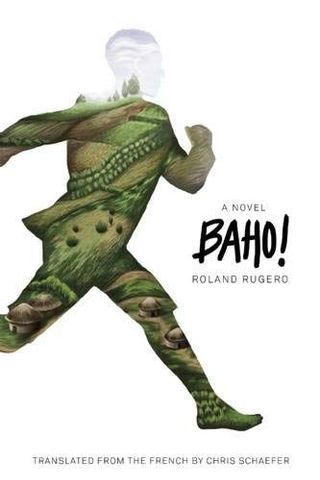
Cover of Baho

Baho

Roland Rugero

Original language: French · Paperback · ISBN 978-1939419620

Nyamuragi is a young mute living in rural Burundi. One day he approaches a young woman, trying through gestures to ask where he can find a private spot to relieve himself. She misreads his movements as a threat of sexual assault. When Nyamuragi runs, the community takes his flight as proof of guilt, and a pursuit begins that pulls in neighbors, elders, and the volatile energies of mob justice.

The novel sits in a landscape shaped by war, set among Burundi's green hillsides where social trust has worn thin. Nyamuragi cannot speak, and the people chasing him have little interest in pausing to interpret his silence. Roland Rugero uses this premise to examine how communication fails and how communities assign guilt when fear fills the gaps left by understanding. The tension between Nyamuragi's innocence and the crowd's certainty drives the story forward without relief.

Baho is Roland Rugero's second novel and is noted as the first Burundian novel translated into English. It is a short, concentrated work in which a single misunderstanding escalates quickly, exposing the fragility of justice in a society still carrying the marks of conflict.

Plot

When Nyamuragi, an adolescent mute, attempts to ask a young woman in rural Burundi for directions to an appropriate place to relieve himself, his gestures are mistaken as premeditation for rape. To the young woman's community, his fleeing confirms his guilt, setting off a chain reaction of pursuit, mob justice, and Nyamuragi's attempts at explanation.
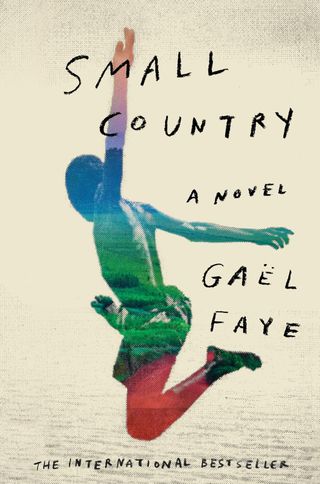
Cover of Small Country

Small Country

Gaël Faye

Original language: French · Hardcover · ISBN 978-1524759872

In Bujumbura, the capital of Burundi, ten-year-old Gabriel lives with his French father, Rwandan mother, and younger sister Ana. The year is 1992, and their expatriate neighborhood feels safe and enclosed. Gabriel and his friends fill their days stealing mangoes, sneaking cigarettes, and turning their quiet cul-de-sac into a shared territory governed by childhood rules. The novel, originally written in French by Gaël Faye, follows Gabriel's perspective as this familiar world begins to fracture.

Burundi and neighboring Rwanda are moving toward civil war and genocide, and the political tensions gradually press into Gabriel's household and street life. His mixed heritage places his family at a particular fault line. The story tracks how large-scale violence enters a child's field of vision in fragments: overheard conversations, shifting adult moods, new absences, and eventually direct confrontation with loss.

Faye, who was born in Burundi in 1982 to a French father and Rwandan mother, draws on a background that closely parallels Gabriel's. The novel is set in specific streets and neighborhoods of Bujumbura, grounding its events in real geography rather than abstraction. It moves between the small-scale textures of childhood and the broader historical forces that reshape them.

Plot

Burundi, 1992. For ten-year-old Gabriel, life in his comfortable expatriate neighborhood of Bujumbura with his French father, Rwandan mother and little sister Ana, is something close to paradise. These are carefree days of laughter and adventure – sneaking Supermatch cigarettes and gorging on stolen mangoes – as he and his mischievous gang of friends transform their tiny cul-de-sac into their kingdom. But dark clouds are gathering over this small country, and soon their peaceful existence will shatter when Burundi, and neighboring Rwanda, are brutally hit by civil war and genocide.

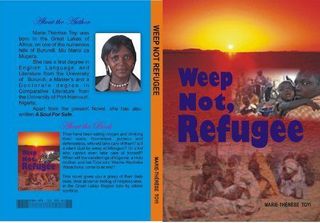
Cover of Weep Not, Refugee

Weep Not, Refugee

Marie-Therese Toyi

Original language: English · Kindle Edition

Weep Not, Refugee is a novel by Marie-Therese Toyi set against the backdrop of the Hutu-Tutsi conflict in Burundi. The story begins with Kigeme, a secondary school girl forced to flee to a place called Wirodi after violence erupts. During her flight, she witnesses and endures acts of extreme brutality, including the killing of both her parents and her own assault by a man called Kiroro, who poses as a benefactor.

The child born from that assault, Wache Wacheke Watachoka, becomes the central figure of the novel. He grows up in a refugee camp in Wirodi under harsh conditions. His mother Kigeme, left without resources or family, turns first to prostitution and then to begging as a long-term means of survival. The camp itself is a place of deprivation, and the surrounding society treats refugees with open hostility.

Through Wache's eyes, the novel traces what it means to grow up stateless, poor, and unwelcome. His daily experience in the camp sharpens his awareness of the barriers facing displaced people, and the story follows his efforts to find a foothold in a society that does not want him there. The title frames the novel's stance toward its subject from the outset.

Plot

Kigeme, a Burundian secondary school girl, must flee to Wirodi for her safety, due to the outbreak of the Hutu- Tutsi war in Burundi. On her way to exile, she has her mother raped in the open and drowned in a river, her father chopped into pieces by enemies, and herself raped by a casual philanthropist in the name of Kiroro. The fruit of this rape is Wache Wacheke Watachoka, the protagonist of the novel. He will be born and raised in a refugee camp in Wirodi, in conditions of extreme poverty. But he will grow up. Her mother Kigeme will pass through a short time of prostitution to a lifetime profession (begging) in order to bring up Wache. Daily sufferings in the camp open his eyes to the true face of the world around him and give him the stamina to struggle for his own survival. He is very much aware that in Wirodi a refugee is highly unwanted.

More from Burundi

See the country page for Burundi for its map, facts and largest cities, or browse books from other countries.

Links go to Amazon; Hookito doesn’t sell books. Know a book that belongs here, or spotted a mistake? Write to submissions@hookito.com.