Hookito

Czech Republic · Books

Books from Czech Republic
12 books from and about Czech Republic: what each is about, the plot, and a note from Professor Kogi.

Cover of Engineer of Human Souls

Engineer of Human Souls

Josef Skvorecky

Original language: Czech · Paperback · ISBN 978-1564781994

Engineer of Human Souls follows Danny Smiricky, a Czech novelist who has emigrated to Canada and now teaches American literature at a college in Toronto. The story moves between his present life in academia and his past in Czechoslovakia, where he lived through the Nazi occupation and later the Communist regime. Danny finds himself disconnected from his young Canadian students, who have little frame of reference for the political realities he carries with him. At the same time, agents of the Czech secret police continue to shadow him even in exile.

The novel's structure is layered and nonlinear. Danny shifts between identities and time periods, sometimes by choice and sometimes because history has assigned him a role he did not ask for. Skvorecky pairs this fragmented storytelling with a comic tone, finding dark humor in bureaucratic absurdity and the gaps between cultures. Each chapter is loosely organized around a different American author, linking Danny's teaching life to broader questions about literature, freedom, and displacement.

Skvorecky himself emigrated from Czechoslovakia to Canada in 1969, and the novel draws on that parallel without collapsing the distance between author and character. The Toronto setting grounds the story in a specific immigrant experience within a cold-war context.

Plot

As the novel begins, Danny is a professor of American literature at a college in Toronto. Out of touch with his young students, and hounded by the Czech secret police, Danny is let loose to roam between past and present, adopting whatever identity that he chooses or has been imposed upon him by History.
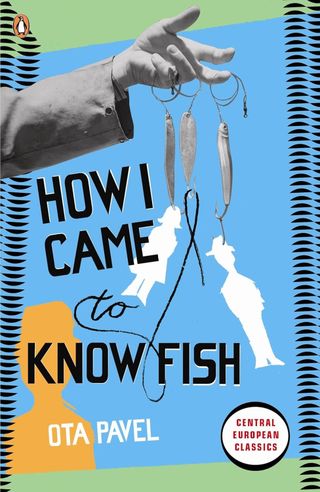
Cover of How I Came to Know Fish

How I Came to Know Fish

Ota Pavel

Original language: Czech · Paperback · ISBN 978-0141192833

Ota Pavel's memoir looks back at a childhood in Czechoslovakia through fishing. His father and Uncle Prosek were devoted anglers, and many chapters follow their outings along the rivers and ponds of the Czech countryside. Pavel writes about the patience of catching fish, the landscape around the water, and the family bonds formed during long hours spent outdoors together.

The book changes register when the Nazi occupation reaches the family. Pavel's father and two older brothers are sent to concentration camps, and the family's property, including their fish, is confiscated. The boy takes fish back in secret, under the watch of the SS, to feed those left at home. Ordinary pleasure and open danger sit side by side.

Across both periods, the father remains the central figure, a man working to provide for his household first in comfort and then under persecution. Ota Pavel worked as a sports journalist before turning to these stories. The memoir was published in Czech in 1974 and has since appeared in English translation, keeping its short chapters, its river settings, and its steady attention to fish, weather, and family.

Plot

Fishing with his father and his Uncle Prosek - the two finest fishermen in the world - he takes a peaceful pleasure from the rivers and ponds of his country. But when the Nazis invade, his father and two older brothers are sent to concentration camps and Pavel must steal their confiscated fish back from under the noses of the SS to feed his family. With tales of his father's battle to provide for his family both in wealthy freedom and in terrifying persecution, this is one boy's passionate and affecting tale of life, love and fishing.

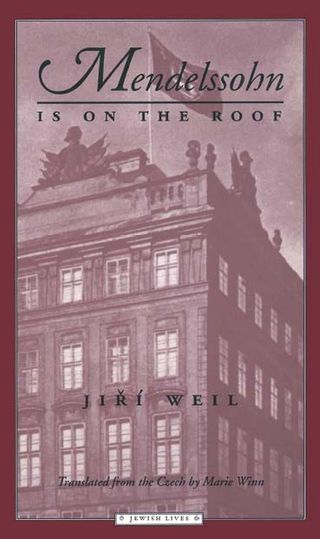
Cover of Mendelssohn Is on the Roof

Mendelssohn Is on the Roof

Jiří Weil

Original language: Czech · Paperback · ISBN 978-0810116863

The novel opens with a darkly comic scene on the roof of Prague's concert hall. An SS officer named Julius Schlesinger is ordered to remove the statue of Felix Mendelssohn, a composer targeted because of his Jewish heritage. Unable to identify which figure is Mendelssohn among the rooftop statues, Schlesinger falls back on the crude logic of Nazi racial theory and instructs his workers to take down the one with the largest nose. The statue they begin to topple turns out to be Richard Wagner, a composer celebrated by the Nazi regime.

From this absurd opening, Jiří Weil follows the lives of ordinary people in Prague under German occupation. The story traces how bureaucratic cruelty and petty authority reshape daily existence, turning minor officials into instruments of persecution and forcing others into difficult choices about resistance and survival. Weil, who lived through the occupation himself, sets these events against the specific streets and institutions of wartime Prague.

The book balances its satirical edge with a close attention to fear, loss, and small acts of defiance. Weil's writing treats the machinery of occupation not as distant history but as something enacted by recognizable people in familiar surroundings, where absurdity and danger sit side by side.

Plot

Julius Schlesinger, aspiring SS officer, has received orders to remove from the roof of Prague's concert hall the statue of the Jewish composer Felix Mendelssohn. But which of the figures adorning the roof is the Jew? Remembering his course on racial science, Schlesinger instructs his men to pull down the statue with the biggest nose. Only as the statue they have carefully chosen begins to topple does he recognize that it is not Mendelssohn; it is Richard Wagner. Thus begins a story of disarming simplicity that traces the transformation of ordinary lives in Nazi-occupied Prague. Death abetted by the petty malevolence of Nazi functionaries wins all the battles but ultimately loses the war, defeated by the fragile flowering of courage and defiance.

Cover of Tales from Two Pockets

Tales from Two Pockets

Karel Capek

Original language: Czech · Paperback · ISBN 978-1447459903

Tales from Two Pockets is a collection of short stories by Karel Capek, one of the most prominent Czech writers of the twentieth century. The book draws on the structure of crime and mystery fiction but bends it in unusual directions. Rather than straightforward detective puzzles, the stories place ordinary people in surprising, sometimes improbable situations that test their sense of right and wrong. Each tale is compact, often built around a single striking event or moral question.

Capek uses these compressed narratives to examine how justice works in practice, how truth can shift depending on perspective, and what happens when everyday life collides with the unexpected. The tone stays light and accessible even when the subject matter turns toward crime, guilt, or moral uncertainty. Many of the stories have a philosophical edge, but they reach their ideas through character and incident rather than abstract argument.

The collection was originally published in Czech as two separate volumes, one called Tales from One Pocket and the other Tales from the Other Pocket. Combined editions in English bring all the stories together under one title, preserving the paired structure Capek intended.

Plot

In Tales from Two Pockets Capek took the crime story and related forms of the genre to new levels, weaving strange, short, and powerful psychological studies of ordinary human beings caught in extraordinary and improbable circumstances. Through these intense but always fun stories, Capek moves brilliantly but lightly in the philosophical realms of human existence, exploring the nature of crime and justice, even the very concept of truth.

Cover of The Aroma of Czech Cuisine

The Aroma of Czech Cuisine

Denise Mazal Resnerova

Original language: English · Paperback · ISBN 978-0875658704

The Aroma of Czech Cuisine is a cookbook by Denise Mazal Resnerova that pairs recipes with short stories, folklore, and historical notes about Czech food culture. The book traces the origins of individual dishes and explores how Czech culinary traditions have traveled and taken root in the United States. Rather than presenting recipes alone, each section adds context about the customs, ingredients, and regional backgrounds behind the cooking.

Czech cuisine draws on Central European staples such as dumplings, roasted meats, root vegetables, and baked goods. Many dishes reflect the country's inland geography and its cold winters, where preserved and slow-cooked foods have long been practical. Resnerova uses her background as a chef to guide readers through these preparations while connecting them to the cultural occasions and family habits that shaped how the food is served.

The book functions as both a practical kitchen reference and a short introduction to Czech daily life as seen through its food. Recipes sit alongside explanations of their place in holidays, harvests, and household routines, giving each dish a setting beyond the plate.

Plot

With The Aroma of Czech Cuisine, Denise Mazal Resnerova embarks on a culinary journey infused with notes and mini stories that unveil the essence of Czech culture and its enduring influence in the United States. The book delves into folklore, uncovers recipe origins, and traces the historical threads that bind Czech cuisine to its cultural heritage. Whether you are a seasoned chef or a curious food enthusiast, The Aroma of Czech Cuisine promises to open the door to local Czech culture and transport you to the heart of Czech gastronomy, where every dish is a celebration of flavor, heritage, and the enduring spirit of the Czech people.

Cover of The Golden Age

The Golden Age

Michal Ajvaz

Original language: Czech · Paperback · ISBN 978-1564785787

The Golden Age by Michal Ajvaz follows a narrator who recalls his time on a small, unnamed island in the Atlantic Ocean. The people he finds there appear, at first, to do very little. They sit, watch, and observe the world around them with no apparent urgency. More strikingly, they draw no line between reality and representation. A reflection in a mirror holds the same weight for them as the person standing before it. Objects and their images exist on equal terms, a principle that shapes every part of how they live and think.

At the center of the island's culture is a single artifact known as The Book. It is handwritten, collectively authored, and constantly growing. Its pages contain stories of feuding royal families, sorcerers, and dramatic escapes. The Book is not stored away or treated as finished. It is a living, shared project, and the boundary between the fiction inside it and the life outside it is as porous as the boundary between object and reflection.

Ajvaz, a Czech author, constructs the novel as a kind of fantastical travelogue, echoing the tradition of invented-voyage literature that stretches back to Jonathan Swift. The island and its customs become a lens for examining how cultures assign meaning to stories, objects, and perception itself.

Plot

The islanders seem at first to do nothing but sit and observe the world, and indeed draw no distinction between reality and representation, so that a mirror image seems as substantial to them as a person (and vice versa); but the center of their culture is revealed to be The Book, a handwritten, collective novel filled with feuding royal families, murderous sorcerers, and narrow escapes.

Cover of The Good Soldier Svejk

The Good Soldier Svejk

Jaroslav Hasek

Original language: Czech · Paperback · ISBN 978-0140449914

Jaroslav Hasek's unfinished novel, published between 1921 and 1923, follows Josef Svejk, a good-humored, middle-aged Czech man called up to serve in the Austro-Hungarian army at the start of the First World War. Svejk declares himself an enthusiastic soldier, yet his repeated attempts to reach the front line never quite succeed. Whether through genuine incompetence or quiet cunning, he drifts from one absurd situation to the next, tangling with military doctors, police officers, chaplains, and commanding officers along the way.

The full Czech title translates roughly as The Fateful Adventures of the Good Soldier Svejk During the World War, and the book is structured as a loose chain of episodes rather than a tightly plotted narrative. Svejk plays cards, drinks, tells long-winded stories, and generally makes himself a nuisance, all while maintaining an air of cheerful obedience. The satire works by placing one apparently simple man against a sprawling military bureaucracy that proves no more rational than he is.

The novel has been translated into more than fifty languages, making it the most widely translated work of Czech literature. Hasek died in 1923 before completing it, so the story breaks off without a formal conclusion.

Plot

Good-natured and garrulous, Švejk becomes the Austro-Hungarian army's most loyal Czech soldier when he is called up on the outbreak of the First World War - although his bumbling attempts to get to the front serve only to prevent him from reaching it. Playing cards, getting drunk, and becoming a general nuisance, the resourceful Švejk uses all his natural cunning and genial subterfuge to deal with the doctors, police, clergy, and officers who chivvy him towards the battle.

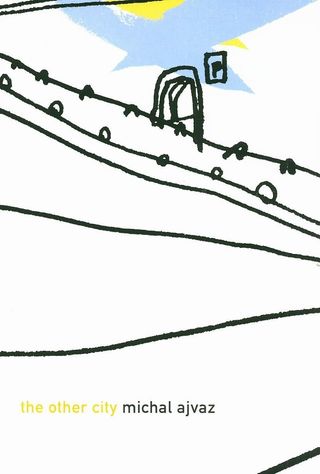
Cover of The Other City

The Other City

Michal Ajvaz

Original language: Czech · Paperback · ISBN 978-1564784919

Michal Ajvaz is a Czech writer whose novel The Other City presents Prague as a place with a hidden layer running alongside its familiar streets and landmarks. The narrator moves through the capital discovering a second version of the city, one populated by ghosts, eccentric figures, talking animals, and statues that should not exist. These elements occupy the edges of ordinary life, just out of sight for the crowds of visitors and residents who pass through every day.

The book reads partly like a fictional guidebook to this unseen Prague. Libraries shift into dense vegetation, hidden passages open underfoot, and water appears where it has no reason to be. Ajvaz works within a tradition of Czech fantasy writing, and the novel also carries the influence of Jorge Luis Borges, particularly in its interest in labyrinths, alternate realities, and the slippage between what is known and what is imagined. The Other City was the first of Ajvaz's novels to appear in English translation.

Prague itself is central to the book's structure. The city's layered history, winding lanes, and architectural density provide a concrete setting that supports the idea of a parallel world existing in plain sight, unnoticed because of habit.

Plot

The Other City is a guidebook to this invisible, "other Prague," overlapping the workaday world: a place where libraries can turn into jungles, secret passages yawn beneath our feet, and waves lap at our bedspreads. Heir to the tradition and obsessions of Jorge Luis Borges, as well as the long and distinguished line of Czech fantasists, Ajvaz's Other City—his first novel to be translated into English—is the emblem of all the worlds we are blind to, being caught in our own ways of seeing.

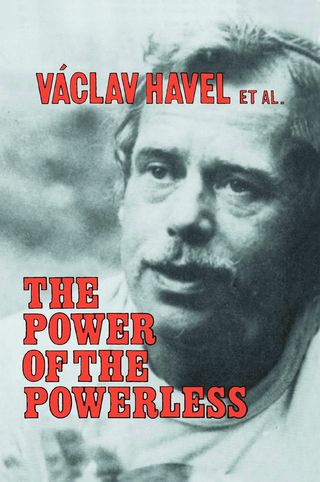
Cover of The Power of the Powerless

The Power of the Powerless

Václav Havel, John Keane

Original language: Czech · Paperback · ISBN 978-0873327619

This collection of essays, first published in 1985, grew out of the political and intellectual climate that followed the founding of Charter 77, a civic initiative launched in Czechoslovakia in 1977 to press for basic human and civil rights. Václav Havel's title essay anchors the book. In it, he examines how ordinary citizens living under authoritarian systems hold a form of political power, even when they appear to have none. The other contributors read Havel's essay and wrote responses to the questions it raises, creating a structured exchange of ideas rather than a simple anthology.

The contributors come from a wide range of democratic positions, including liberal, conservative, and socialist perspectives. Together they address the conditions of political life in central and Eastern Europe during the post-war decades, when single-party states shaped daily existence across the region. The essays consider how individuals relate to ideology, conformity, and civic responsibility when open political opposition carries serious personal risk.

John Keane edited the volume. Havel, who wrote the lead essay from Prague, would later become president of Czechoslovakia after the events of 1989. The book captures a period when dissident thought circulated largely through unofficial channels in the region.

Plot

Books of great political insight and novelty always outlive their time of birth and this reissued work, initially published in 1985, is no exception. Written shortly after the formation of Charter 77, the essays in this collection are among the most original and compelling pieces of political writing to have emerged from central and Eastern Europe during the whole of the post-war period. Václav Havel’s essay provides the title for the book. It was read by all the contributors who in turn responded to the many questions which Havel raises about the potential power of the powerless.

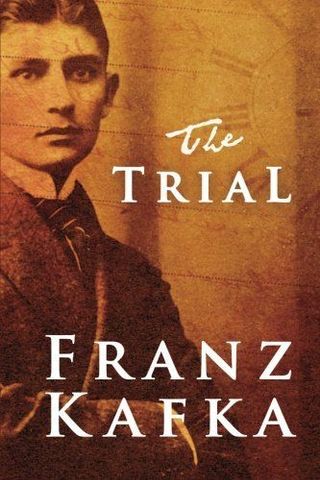
Cover of The Trial

The Trial

Franz Kafka

Original language: German · Paperback · ISBN 978-1612931036

Josef K., a bank clerk in an unnamed city, wakes one morning to find himself placed under arrest. No one tells him what he has been charged with. The officers who detain him offer no explanation, and the legal system he encounters afterward operates by rules that remain hidden from him. Written by Franz Kafka in 1914, The Trial follows Josef K. as he attempts to navigate a court structure that seems to exist in attics, private apartments, and back rooms, staffed by officials whose authority is real but whose logic is absent.

Kafka never finished the manuscript, and the novel was published posthumously in 1925, assembled by his friend Max Brod from papers Kafka had asked him to destroy. The story moves through encounters with lawyers, painters, priests, and other figures who each claim some knowledge of how the system works, yet none can offer Josef K. a clear path forward. The court is everywhere and nowhere, and guilt is assumed rather than proven.

The book gave rise to the word Kafkaesque, now widely used to describe situations where bureaucratic procedures seem irrational and inescapable. Kafka was born in Prague, then part of the Austro-Hungarian Empire, and wrote in German.

Plot

One of Kafka's major works, and perhaps his most pessimistic, this surreal story of a young man who finds himself caught up in the mindless bureaucracy of the law has become synonymous with the anxieties and sense of alienation of the modern age.

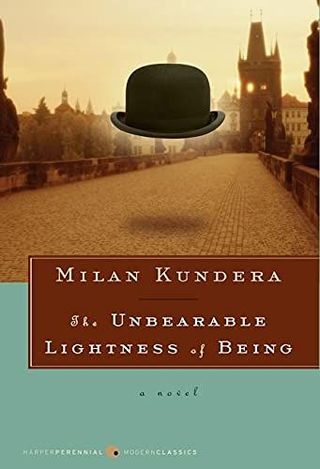
Cover of The Unbearable Lightness of Being

The Unbearable Lightness of Being

Milan Kundera

Original language: Czech · Paperback · ISBN 978-0061148521

Milan Kundera's novel follows two couples in Prague around the Soviet-led invasion of Czechoslovakia in 1968. At its center is Tomas, a surgeon divided between his attachment to Tereza, a young woman who arrives in his life almost by chance, and his continued pursuit of other women. Sabina, a painter and one of his lovers, is tied to Franz, an earnest academic in Geneva.

The title turns on a question borrowed from Nietzsche: if events happen only once and never return, do they carry any weight at all? Kundera threads that idea through characters who make choices about loyalty, freedom, and responsibility without knowing whether the choices hold lasting meaning. Political pressure after the occupation narrows their options, though the book treats politics as one force among several.

Kundera wrote in Czech while living in exile in France, and the book first reached readers in French translation in 1984. The structure is not linear: the narrative returns to the same events from different angles and different characters, and it moves between story, essay, and direct commentary. Prague and Geneva anchor much of the action, with other European cities in between.

Plot

In The Unbearable Lightness of Being, Milan Kundera tells the story of two couples, a young woman in love with a man torn between his love for her and his incorrigible womanizing, and one of his mistresses and her humbly faithful lover. In a world in which lives are shaped by irrevocable choices and by fortuitous events, a world in which everything occurs but once, existence seems to lose its substance, its weight.

Cover of Too Loud a Solitude

Too Loud a Solitude

Bohumil Hrabal

Original language: Czech · Paperback · ISBN 978-0156904582

Too Loud a Solitude is a short novel by Czech writer Bohumil Hrabal. Its narrator, Hanta, has spent thirty-five years operating a hydraulic press in a wastepaper compacting plant. His job is to destroy printed material, but over the decades he has pulled countless books from the machine before they are crushed. His home is now stacked floor to ceiling with rescued volumes. Through years of reading salvaged pages, Hanta has absorbed an education he never set out to acquire, and he can no longer distinguish his own thinking from the ideas he has gathered from books.

The story is set against the backdrop of a Czech police state, where the disposal of books carries political weight. Hanta occupies an odd position: he is both the instrument of destruction and a quiet guardian of what he is ordered to destroy. His internal world grows richer even as the system around him tries to reduce written culture to compressed bales of waste. Hrabal keeps the tone surprisingly warm and comic despite the grim setting.

Milan Kundera once called Hrabal the finest Czech writer of his time. The novel is compact in length, running closer to a long story than a traditional novel, and its compressed form mirrors the work Hanta performs each day at his press.

Plot

Too Loud a Solitude is a tender and funny story of Hanta––a man who has lived in a Czech police state––for 35 years, working as compactor of wastepaper and books. In the process of compacting, he has acquired an education so unwitting he can't quite tell which of his thoughts are his own and which come from his books. He has rescued many from jaws of hydraulic press and now his house is filled to the rooftops. Destroyer of the written word, he is also its perpetrator.

More from Czech Republic

See the country page for Czech Republic for its map, facts and largest cities, or browse books from other countries.

Free editions are on Project Gutenberg, matched by title and author. Links go to Amazon; Hookito doesn’t sell books. Know a book that belongs here, or spotted a mistake? Write to submissions@hookito.com.