
Hookito

Haiti · Books

Books from Haiti

8 books from and about Haiti: what each is about, the plot, and a note from Professor Kogi.

Cover of Everyone's Table: Global Recipes for Modern Health

Everyone's Table: Global Recipes for Modern Health

Gregory Gourdet

Original language: English · Hardcover · ISBN 978-0062984517

Everyone's Table is a cookbook by Gregory Gourdet containing 200 recipes built around nutrient-dense ingredients. The book focuses on foods high in beneficial fats, minerals, vitamins, and antioxidants, often grouped under the broad label of superfoods. Recipes range from vegetable-centered dishes and slow-cooked stews to fermented preparations and umami-heavy sauces, using both everyday and seasonal produce.

Gourdet's cooking draws on several distinct culinary traditions. He grew up in a Haitian household, trained in French culinary technique, and developed a lasting interest in the flavors and methods of Asian, North African, and West African kitchens. These influences appear throughout the book, shaping how ingredients are combined, seasoned, and prepared. The result is a collection that moves freely between regions rather than settling into a single cuisine.

The book includes 180 color photographs and is organized to serve daily home cooking rather than occasional special-occasion meals. Recipes are designed to be accessible to a range of skill levels, with attention to both flavor and nutritional content. Gourdet treats health-oriented cooking as something that should carry strong, layered taste rather than functioning as a concession.

Plot

Everyone’s Table features 200 mouth-watering, decadently flavorful recipes carefully designed to focus on superfoods—ingredients with the highest nutrient-density, the best fats, and the most minerals, vitamins, and antioxidants—that will delight and inspire home cooks. Gourdet’s dishes are inspired by his deep affection for global ingredients and techniques--from his Haitian upbringing to his French culinary education, from his deep affection for the cuisines of Asia as well as those of North and West Africa. His unique culinary odyssey informs this one-of-a-kind cookbook, which features dynamic vegetable-forward dishes and savory meaty stews, umami-packed sauces and easy ferments, and endless clever ways to make both year-round and seasonal ingredients shine.


Cover of Hadriana in All My Dreams

Hadriana in All My Dreams

René Depestre

Original language: French · Papperback · ISBN 978-1617755330

The story opens during Carnival in 1938 in Jacmel, a coastal town in southern Haiti. Hadriana, a young French woman, is preparing to marry a Haitian man from a well-known local family. On the morning of the ceremony, she drinks a mysterious potion and collapses at the altar. The town buries her, and the celebration turns into mourning.

A sorcerer later revives her as a zombie, and she passes out of ordinary life into popular legend. Depestre tells this with comic energy rather than dread, placing the events inside Carnival, when masks and disguise already unsettle the border between the living and the dead. Vodou belief, desire, and the racial distance between French and Haitian characters run through the whole account.

René Depestre, a Haitian writer who spent much of his life abroad, received the Prix Renaudot, a French literary award, for this novel. Zombification here works less as horror than as a question about who controls a person's body and name. Jacmel, the setting, is a real port on Haiti's southern coast known for its Carnival and its old ironwork architecture.

Plot

A beautiful young French woman, Hadriana, is about to marry a Haitian boy from a prominent family. But on the morning of the wedding, Hadriana drinks a mysterious potion and collapses at the altar. Transformed into a zombie, her wedding becomes her funeral. She is buried by the town, revived by an evil sorcerer, then disappears into popular legend. Set against a backdrop of magic and eroticism, and recounted with delirious humor, the novel raises universal questions about race and sexuality. The reader comes away enchanted by the marvelous reality of Haiti’s Vodou culture and convinced of Depestre’s lusty claim that all beings―even the undead ones―have a right to happiness and true love.

Cover of Love, Anger, Madness: A Haitian Triptych

Love, Anger, Madness: A Haitian Triptych

Marie Vieux-Chauvet

Original language: French · Paperback · ISBN 978-0812976922

Marie Vieux-Chauvet's trilogy collects three novellas set in a thinly fictionalized version of Haiti under the rule of François Duvalier. First published in 1968, the book was suppressed and largely vanished from circulation. Vieux-Chauvet herself was forced to leave Haiti for the United States. An authorized French edition appeared in 2005, and this volume brought the work into English for the first time, translated by Rose-Myriam Réjouis and Val Vinokur, with an introduction by Edwidge Danticat.

In the first novella, Claire is the eldest of three sisters sharing one household. After her parents die, she takes on the role of running the home, setting aside her own hopes. Her dark skin and unmarried status isolate her within the family. The second novella follows a middle-class family whose land is threatened by police, placing them under unbearable pressure. In the third, a young poet named René is trapped inside a house without food, surrounded by the threat of local armed men.

Each novella rises in intensity, moving from personal frustration to collective terror. The stories examine how dictatorship reshapes ordinary relationships, turning neighbors into informers and families against themselves. Race, class, and gender run through all three pieces as overlapping forces that shape daily survival under state violence.

Plot

Originally published in 1968, Love, Anger, Madness virtually disappeared from circulation until its republication in France in 2005. Set in the barely fictionalized Haiti of “Papa Doc” Duvalier’s repressive rule, Marie Vieux-Chauvet’s writing was so powerful and so incendiary that she was forced to flee to the United States. Yet Love, Anger, Madness endures. Claire, the narrator of Love, is the eldest of three daughters who surrenders her dreams of marriage to run the household after her parents die. In Anger, the police terrorize a middle-class family by threatening to seize their land. And finally, Madness paints a terrifying portrait of a Haitian village that has been ravaged by militants.

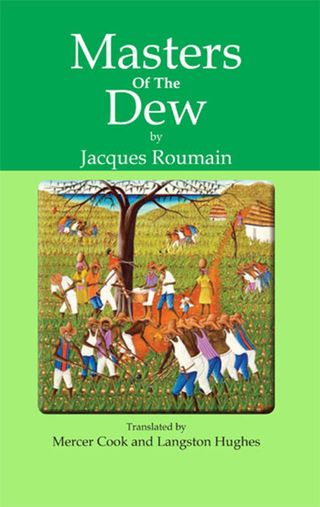
Cover of Masters of the Dew

Masters of the Dew

Jacques Roumain

Original language: French · Hardcover · ISBN 978-1584328490

Masters of the Dew follows Manuel, a young Haitian man who returns to his village of Fonds Rouge after years of cutting sugar cane in Cuba. He finds a settlement divided by a feud that began with a misunderstanding and ended in the deaths of two community leaders. Trees have been cut for fuel, the water source has failed, and the fields lie barren.

Jacques Roumain wrote the novel in French as Gouverneurs de la rosee, and it appeared in 1944, the year of his death. Langston Hughes and Mercer Cook prepared the English translation. Roumain worked as an ethnologist and was active in Haitian politics, and the book reflects close attention to rural speech, farming work, and the shared labour that keeps a village fed.

Manuel's search for a new spring runs alongside the harder task of speaking with neighbours who avoid one another. Roumain keeps the two problems tied together, since water can only reach the fields through many hands. The setting is a dry stretch of rural Haiti where lost tree cover has changed how rain and groundwater behave, making cooperation a practical condition for planting again.

Plot

One man, and one man alone, demonstrated to us the strength of his character when he fought to mend the familial ties that had been severed in his community of Fonds Rouge, Haiti due to a major misunderstanding that resulted in the death of two important community leaders. Shortly after, the inhabitants of Fonds Rouge were forced to live under drought conditions after they had cut down all the trees they possessed in order to use them to burn for heat/warmth. As a result, the natural water source that nourished the land before stopped suddenly and left the land barren and empty of the possibility of bringing life back into the area.

Cover of Ready to Burst

Ready to Burst

Frankétienne

Original language: French · Paperback · ISBN 978-1935744788

Ready to Burst is set in Haiti during the Duvalier dictatorship, a period when political leadership held control through surveillance, violence, and fear. The novel traces two young men, each trying to understand and survive an unstable society. Their separate paths point to a wider strain in Haiti at the time: educated citizens leaving the country, a pattern often called brain drain, and the pressures carried by those who stayed.

Frankétienne, widely regarded as Haiti's leading literary figure, built the book from a mix of prose and poetry rather than a single steady narrative voice. That combination matches the fractured conditions his characters live in, where creative expression and political restriction press against one another. He described the work as a picture of doom and bitterness confronting an unseeing apparatus of power.

Frankétienne stayed in Haiti through the dictatorship years instead of joining the writers and professionals who left. In 2009 he was named a Nobel Prize candidate in literature, and his reputation rests on decades of work in Haitian Creole and French that engages directly with the country's political and social conditions.

Plot

Ready to Burst follows the lives of two young men and their individual attempts to make sense of the deeply troubled society surrounding them. An informed critique of the “brain drain” prompted by the Duvalier dictatorship, Ready to Burst is, in Frankétienne’s words, a portrait of “the extreme bitterness of doom in the face of the blind machinery of power.” Widely recognized as Haiti’s most important literary figure and an outspoken challenger of political oppression, Frankétienne was a candidate for the Nobel Prize for Literature in 2009.

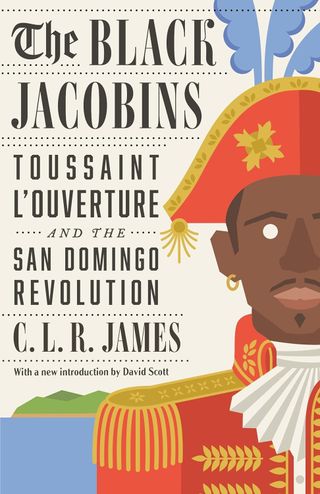
Cover of The Black Jacobins

The Black Jacobins

C.L.R. James

Original language: English · Paperback · ISBN 978-0679724674

In 1789, the French colony of Saint-Domingue accounted for roughly two-thirds of France's overseas trade and was the largest market in the European slave trade. The entire economy of the colony rested on the labor of approximately half a million enslaved people. C.L.R. James, a Trinidadian historian, wrote The Black Jacobins as the first major study of what happened when that system broke apart. The book traces how the upheaval of the French Revolution rippled across the Atlantic and helped ignite a revolt in August 1791.

The enslaved population of Saint-Domingue fought for twelve years against a succession of opponents: local white colonists, soldiers loyal to the French monarchy, a Spanish invasion, a British expedition of some 60,000 troops, and a French force of similar size sent by Napoleon and led by his own brother-in-law. The defeat of Napoleon's army in 1803 led to the founding of Haiti, an independent state that has endured since then.

James examines how people held in extreme subjugation organized themselves into a force capable of resisting several European powers at once. The book connects events in Paris and in the Caribbean, showing how colonial economics, revolutionary ideology, and military strategy shaped the course of the revolt.

Plot

The Black Jacobins, by Trinidadian historian C. L. R. James, was the first major analysis of the uprising that began in the wake of the storming of the Bastille in France and became the model for liberation movements from Africa to Cuba. It is the story of the French colony of San Domingo, a place where the brutality of plantation owners toward enslaved people was horrifyingly severe.

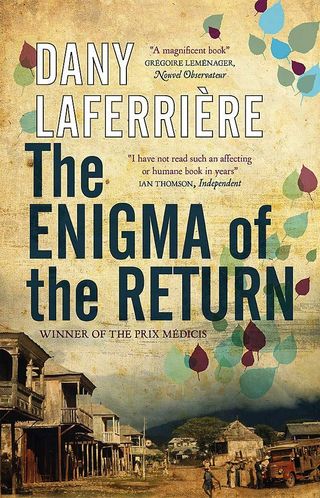
Cover of The Enigma of the Return

The Enigma of the Return

Dany Laferrière

Original language: English · Paperback · ISBN 978-0857059536

In this book, Dany Laferrière follows a character named Windsor Laferrière who left Haiti decades ago, fearing for his life. He has spent thirty-three years in Montreal when his father dies in New York, a man who was himself exiled for half a century. Windsor travels to New York for the funeral, then continues on to Haiti to bring word of the death to his mother. The return sets him face to face with a homeland defined by deep poverty and unrealized hopes.

The narrative mixes fiction, poetry, and autobiography, shifting between prose passages and verse without settling into a single form. Laferrière treats exile not as a single departure but as a condition that reshapes identity over time. Windsor's long absence has made Haiti both familiar and foreign, and the book traces that disorientation with careful, concrete detail. Montreal's winter and Haiti's heat serve as opposing poles of his life.

The French original, titled L'énigme du retour, received the Prix Médicis in 2009. Laferrière, born in Port-au-Prince, left Haiti in 1976 and lived for years in Montreal before eventually settling in Paris.

Plot

Windsor Laferrière left Haiti in fear for his life. He has lived in Montreal for thirty-three years, and when his father dies in New York, himself an exile for half a century, Windsor travels there to attend the funeral, and then back to Haiti to inform his mother of the death. In Haiti, Windsor is faced with the grim truth of life in his homeland - the endemic poverty, the thwarted ambitions, and broken dreams. But only here can he become a writer again . . . The Enigma of the Return lives where fiction, poetry, and autobiography meet. These creative tensions sustain a narrative of astonishing beauty, clarity, and insight.

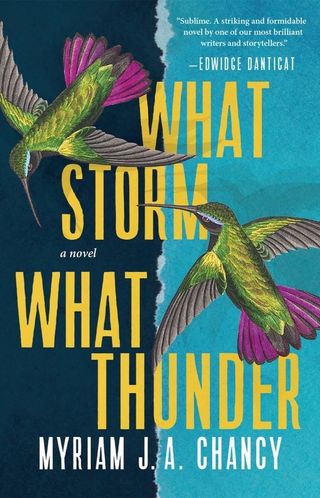
Cover of What Storm, What Thunder

What Storm, What Thunder

Myriam JA Chancy

Original language: English · Hardcover · ISBN 978-1951142766

What Storm, What Thunder is set around the 2010 earthquake that struck Port-au-Prince, Haiti, with a magnitude of 7.0. Myriam J. A. Chancy builds the novel through multiple voices, each belonging to a different person whose life is reshaped by the disaster. Among them are Richard, an expatriate water-bottling executive hiding the existence of a daughter; Anne, that daughter, who designs affordable housing for an international NGO; Leopold, a low-level drug trafficker; and Didier, a musician now driving a taxi in Boston.

Other voices include Sonia and her business partner Dieudonné, who believe a man following them is the vodou spirit of death. Sara, a mother in a displacement camp, is separated from her husband Olivier, an accountant who was forced to leave her behind. Their son Jonas connects and haunts both of their stories. Ma Lou, an elderly market vendor, serves as a kind of collective memory, holding the threads of all these lives together.

The novel moves between Haiti and the diaspora, between the hours before the earthquake and its long aftermath. Each narrator carries a distinct social position, from wealth to poverty, from those who stayed to those who left. The structure gives the event its scale not through statistics but through the accumulated weight of individual circumstances.

Plot

Award-winning author Myriam J. A. Chancy masterfully charts the inner lives of the characters affected by the disaster―Richard, an expat and wealthy water-bottling executive with a secret daughter; the daughter, Anne, an architect who drafts affordable housing structures for a global NGO; a small-time drug trafficker, Leopold, who pines for a beautiful call girl; Sonia and her business partner, Dieudonné, who are followed by a man they believe is the vodou spirit of death; Didier, an emigrant musician who drives a taxi in Boston; Sara, a mother haunted by the ghosts of her children in an IDP camp; her husband, Olivier, an accountant forced to abandon the wife he loves; their son, Jonas, who haunts them both; and Ma Lou, the old woman selling produce in the market who remembers them all.

More from Haiti

See the country page for Haiti for its map, facts and largest cities, or browse books from other countries.

Links go to Amazon; Hookito doesn’t sell books. Know a book that belongs here, or spotted a mistake? Write to submissions@hookito.com.