Hookito

Morocco · Books

Books from Morocco

11 books from and about Morocco: what each is about, the plot, and a note from Professor Kogi.

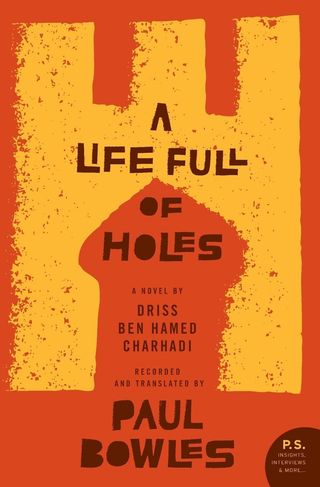
Cover of A Life Full of Holes

A Life Full of Holes

Driss ben Hamed Charhadi

Original language: Moroccan Arabic · Paperback · ISBN 978-0061565298

A Life Full of Holes emerged from an unusual partnership between Driss ben Hamed Charhadi, an illiterate Moroccan who worked as a servant and street vendor, and the American writer Paul Bowles, who had settled in Tangier. Charhadi narrated his story aloud in Moghrebi, the spoken Arabic dialect of Morocco, and Bowles transcribed and translated the account into English. The result is described as the first novel composed in Moghrebi, a dialect that was rarely written down at the time.

The narrative follows a shepherd and small-scale trafficker trying to survive in a world that offers little security. Daily struggles with poverty, labor, and social hierarchies shape his path through a society where stability is always fragile. The voice throughout is direct and unadorned, carrying the rhythms of spoken language rather than literary convention.

Bowles, who lived in Morocco for decades, served as both translator and recorder rather than co-author in the traditional sense. The collaboration raises questions about how oral storytelling crosses into printed literature, and about who controls the shape of a story when narrator and translator come from such different positions. The book sits at the intersection of autobiography, fiction, and ethnographic document.

Plot

A Life Full of Holes is the result of a singular collaboration between two remarkable individuals: Driss ben Hamed Charhadi, an illiterate North African servant and street vendor, and American novelist and essayist Paul Bowles. The powerful story of a shepherd and petty trafficker struggling to maintain hope as he wrestles with the grim realities of daily life, it is the first novel ever written in the Arabic dialect Moghrebi, faithfully recorded and translated into English by Bowles. Straightforward yet rich in complex emotions, it is a fascinating inside look at an unfamiliar culture—harsh and startling, yet interwoven with a poignant, poetic beauty.
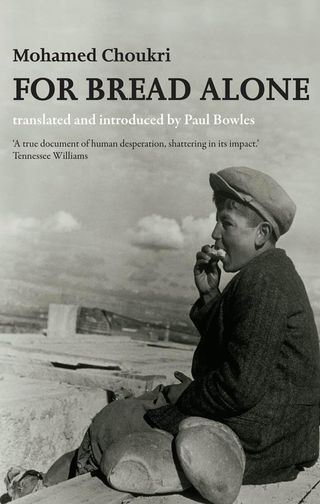
Cover of For Bread Alone

For Bread Alone

Mohamed Choukri

Original language: Arabic · Paperback · ISBN 978-1846590108

For Bread Alone is a memoir by Mohamed Choukri, originally written in Arabic under the title Al-Khubz al-Hafi. It covers the author's childhood and youth in mid-twentieth-century Morocco, beginning with his family's origins in the Rif Mountains and following his drift into the streets of Tangier. Choukri grew up in severe poverty, and the book describes the hunger, violence, and exploitation he encountered from an early age. He survived through begging, petty theft, and whatever work he could find, and the memoir presents these experiences in plain, direct language without sentiment or softening.

A central turning point in the narrative arrives when Choukri, already in his early twenties, decides to learn to read and write. Until that point he had been illiterate, and acquiring literacy opened a path toward becoming a writer and teacher. The book traces how that single decision reshaped his life, though it does not frame the change as simple or sudden.

The memoir was controversial when it first appeared. Its frank treatment of poverty, abuse, and street life in Morocco broke with the conventions of Arabic autobiography at the time. Choukri's spare prose style carries much of the book's force, keeping the focus on concrete detail rather than reflection or explanation.

Plot

For Bread Alone (Al-Khubz al-Hafi) by Mohamed Choukri is a raw and uncompromising memoir that follows the author's childhood and adolescence in mid-20th century Morocco. Born into poverty in the Rif Mountains, he navigates extreme deprivation, violence, and survival on the streets of Tangier through begging, theft, and exploitation. The narrative chronicles his pivotal decision in his early twenties to learn literacy—a turning point that transforms him into a writer and educator. Told with stark, unadorned language, the book offers a vivid portrait of marginalized life and personal resilience.

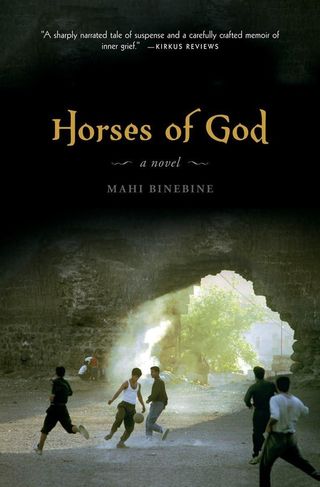
Cover of Horses of God

Horses of God

Mahi Binebine

Original language: Arabic · Paperback · ISBN 978-1935639534

Horses of God is a novel by Mahi Binebine, inspired by the suicide bombings of May 16, 2003 in Casablanca, the deadliest attack in Morocco's history. The bombers came from Sidi Moumen, a shantytown on the edge of the city, built beside a garbage dump. The novel follows four boys from that neighbourhood: Yachine, Nabil, Fuad and Ali. Their main escape is a football team they call the Stars of Sidi Moumen.

Yachine narrates from beyond death, recalling grim conditions alongside real moments of childhood happiness in the place he still calls home. The turning point arrives when his older brother Hamid starts attending religious meetings led by Abu Zoubeir, whose message offers discipline, purpose and guidance to young men with little of any. Week by week, the players are drawn into his circle.

Binebine, a Moroccan writer and painter, keeps the focus on distance: Sidi Moumen lies at the doorstep of a cosmopolitan city its residents seldom entered. Poverty, unemployment and violence shape the boys' daily lives, while football, brotherhood and the promise of belonging pull them in different directions. The narration stays with the friends rather than with the attack itself.

Plot

On May 16, 2003, fourteen suicide bombers launched a series of attacks throughout Casablanca. It was the deadliest attack in Morocco’s history. The bombers came from the shantytowns of Sidi Moumen, a poor suburb on the edge of a dump whose impoverished residents rarely if ever set foot in the cosmopolitan city at their doorstep. Mahi Binebine’s novel Horses of God follows four childhood friends growing up in Sidi Moumen as they make the life-changing decisions that will lead them to become Islamist martyrs. The seeds of fundamentalist martyrdom are sown in the dirt-poor lives of Yachine, Nabil, Fuad, and Ali, all raised in Sidi Moumen. The boys’ soccer team, The Stars of Sidi Moumen, is their main escape from the poverty, violence, and absence of hope that pervade their lives. When Yachine’s older brother Hamid falls under the spell of fundamentalist leader Abu Zoubeir, the attraction of a religion that offers discipline, purpose, and guidance to young men who have none of these things becomes too seductive to ignore. Narrated by Yachine from the afterlife, Horses of God portrays the sweet innocence of childhood and friendship as well as the challenges facing those with few opportunities for a better life.

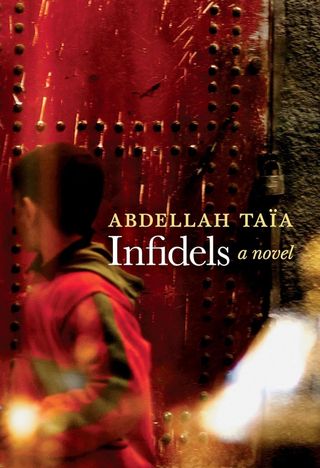
Cover of Infidels

Infidels

Abdellah Taïa

Original language: Arabic · Hardcover · ISBN 978-1609806804

Infidels is a novel by Abdellah Taïa set in Salé, a city on Morocco's Atlantic coast, across the river from the capital, Rabat. The story centers on Jallal, the son of a woman who works as both a prostitute and a traditional healer. At ten, Jallal accompanies his mother through daily life, defending her fiercely against those who scorn or threaten her. The book is built as a sequence of monologues, each voice carrying its own grief, longing, or anger.

Through these voices, the book traces Jallal's path out of boyhood toward the pull of jihad. The characters who pass through his world carry their own hopes for love and belonging, and those hopes come apart in turn under pressures of poverty, stigma, and desire. Taïa draws on the atmosphere of Salé, the city he left but returns to repeatedly in his fiction and films.

The monologue form gives each speaker a compressed space to talk. Confession, private fear, and open confrontation follow one another without pause. Taïa writes about sexuality, faith, and family bonds in a setting where all three are governed by strict social codes, and the tension between private feeling and public expectation runs through every voice.

Plot

Set in Salé, Morocco—the hometown Abdellah Taïa fled but to which he returns again and again in his acclaimed fiction and films—Infidels follows the life of Jallal, the son of a prostitute witch doctor—"a woman who knew men, humanity, better than anyone. In sex. Beyond sex." As a ten-year-old sidekick to his mother, Jallal spits in the face of her enemies both real and imagined. The cast of characters that rush into their lives are unforgettable for their dreams of love and belonging that unravel in turn.

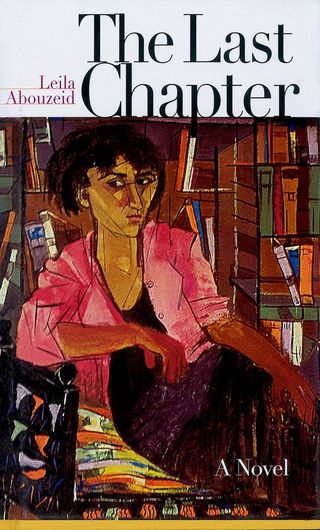
Cover of Last Chapter

Last Chapter

Leila Abouzeid

Original language: Arabic · Paperback · ISBN 978-9774247750

Last Chapter is a semi-autobiographical novel by Leila Abouzeid, following a young Moroccan woman named Aisha from adolescence into adulthood in the second half of the twentieth century. Rather than a straight timeline, the story arrives in flashbacks and remembered episodes, assembling a life shaped by changing expectations. Her romantic relationships form a central thread, and through them Abouzeid traces how roles between men and women in Morocco shifted across her lifetime.

Aisha's life touches several tensions in Moroccan society during those decades. Corruption in the workplace, the campaign for women's rights, and friction between Islamic and Western values all appear. Older practices of sorcery and witchcraft sit alongside modern institutions, and language itself becomes contested: Arabic or the French inherited from colonial rule. These clashes reach into everyday choices about work, family, and marriage.

Abouzeid wrote in Arabic and is among the Moroccan writers whose work has been translated into English. Fiction and memoir overlap throughout. The book keeps close to specific social and political detail rather than general statements, and its account of marriage, family obligation, and public life is drawn from the same period the author lived through.

Plot

Charting Aisha's path through adolescence and young adulthood up to the present, her story is told through a series of flashbacks, anecdotes, and glimpses of the past, all bound up with a strong, often strident, always compelling worldview that takes in Morocco, its politics, people, and traditions, Islam, and marriage. Male female relationships feature strongly in the narrative, and by exposing us to Aisha's troubled romantic encounters, Abouzeid uncovers the shifting male/female roles within the Morocco of her lifetime. Many aspects of Moroccan society are also explored through the other clashes of the modern and the traditional in Aisha's life. The workplace and corruption, the struggle for women's rights, the clash between Islamic and Western values as well as with the older practices of sorcery and witchcraft, and the conflict between colonial and native language use are all intertwined in a narrative that is both forceful and often poetic.

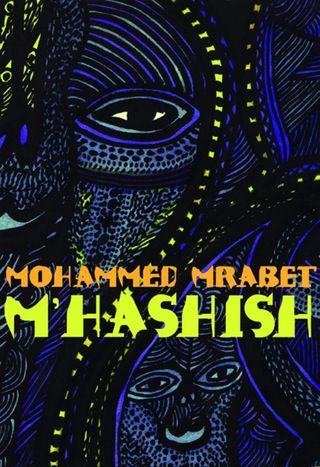
Cover of M'Hashish

M'Hashish

Mohammed Mrabet

Original language: Moghrebi Arabic · Paperback · ISBN 978-0872860346

M'Hashish is a collection of short stories rooted in Moroccan oral tradition, told by Mohammed Mrabet and translated into English by Paul Bowles. Mrabet, who grew up in Tangier and did not write in the conventional sense, spoke his stories aloud in Moghrebi Arabic while Bowles transcribed and translated them. The result is a set of narratives shaped by the rhythms of spoken language rather than literary convention, carrying a directness that print fiction rarely achieves.

The stories center on working-class and marginalized people in and around Tangier. Many of the characters drift between everyday life and states of hallucination or dreamlike perception, often connected to hashish use. Humor appears alongside the surreal, and the line between what is real and what is imagined stays deliberately unclear. Some tales read as anecdotes, others as fables without clear morals. The world they describe is specific to a particular social layer of mid-twentieth-century Morocco, where poverty, resourcefulness, and mysticism overlap in ordinary ways.

Bowles, an American writer who lived in Tangier for decades, served as a bridge between Mrabet's spoken Moghrebi and English-language readers. Their collaboration produced several books, of which M'Hashish remains among the most widely known.

Plot

M’Hashish is a collection of vivid, sometimes surreal tales drawn from Moroccan oral storytelling traditions, as recounted by Mohammed Mrabet and translated by Paul Bowles. The stories offer glimpses into the daily life, dreams, and inner worlds of Tangier’s working-class and marginalized characters. Woven with humor, mysticism, and hallucinatory episodes often linked to the use of hashish, the book reflects the blurred boundaries between reality and imagination. It’s both a literary work and a cultural artifact preserving voices rarely heard in mainstream literature.

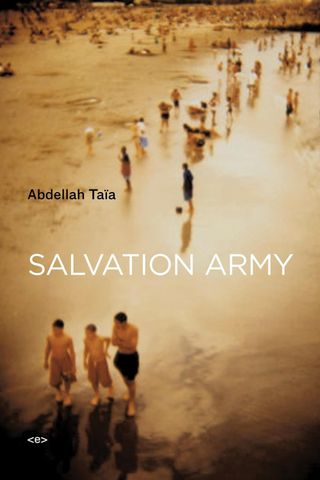
Cover of Salvation Army

Salvation Army

Abdellah Taïa

Original language: French · Paperback · ISBN 978-1584350705

Salvation Army is an autobiographical novel by Abdellah Taïa, a Moroccan writer who grew up in the city of Salé and later moved to Europe. The book follows Taïa's life in short, direct chapters, beginning with his childhood in a large family living in poverty. Early sections describe the household's internal dynamics, including unspoken tensions around sexuality in a society where homosexuality remains illegal under law. The narrative carries a tone that shifts between frank simplicity and quiet observation.

As the story moves forward, the setting changes from Salé to Tangier and eventually to Geneva, where Taïa arrives as a young man to study. Each location marks a different stage of self-awareness. In Morocco, desire and family loyalty exist in uneasy proximity. In Switzerland, the expected freedoms of the West prove less straightforward than imagined. Taïa does not present Europe as a simple escape or resolution.

The novel belongs to a current of French-language literature written by authors from North Africa and its diaspora. Taïa has been recognized in Moroccan press as one of the few public figures from the country to openly identify as gay, a fact that gives the book's plain-spoken honesty a specific social context.

Plot

An autobiographical novel by turn naïve and cunning, funny and moving, this most recent work by Moroccan expatriate Abdellah Taïa is a major addition to the new French literature emerging from the North African Arabic diaspora. Salvation Army is a coming-of-age novel that tells the story of Taïa's life with complete disclosure—from a childhood bound by family order and latent (homo)sexual tensions in the poor city of Salé, through an adolescence in Tangier charged by the young writer's attraction to his eldest brother, to a disappointing arrival in the Western world to study in Geneva in adulthood. In so doing, Salvation Army manages to burn through the author's first-person singularity to embody the complex mélange of fear and desire projected by Arabs on Western culture. Recently hailed by his native country's press as “the first Moroccan to have the courage to publicly assert his difference,” Taïa, through his calmly transgressive work, has “outed” himself as “the only gay man” in a country whose theocratic law still declares homosexuality a crime.

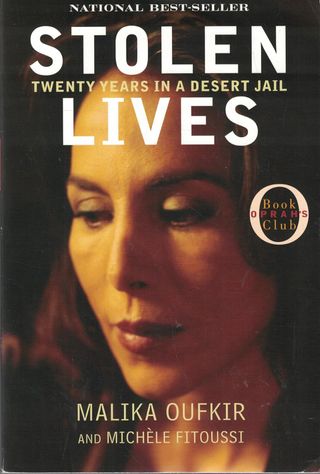
Cover of Stolen Lives : Twenty Years in a Desert Jail

Stolen Lives : Twenty Years in a Desert Jail

Malika Oufkir

Original language: French · Paperback · ISBN 978-0786886302

Malika Oufkir was born in 1953, the eldest daughter of General Mohamed Oufkir, who served as one of King Hassan II of Morocco's most powerful advisors. At the age of five, Malika was taken from her family and adopted by the King himself, raised inside the royal palace as a companion to his young daughter. Her childhood unfolded within the secluded world of the court harem, surrounded by privilege and ritual, yet cut off from ordinary life outside the palace walls.

In 1972, General Oufkir was implicated in a failed coup attempt against the King and was killed. The consequences for his family were severe. Malika, her mother, and her siblings were arrested and held in desert prisons for roughly twenty years, enduring isolation and harsh conditions far removed from the luxury of her earlier life. This memoir traces the full arc of that experience, from the gilded confinement of the royal court to the years of imprisonment that followed.

The book is set almost entirely within Morocco, moving between Rabat's royal palace and remote detention sites in the south. Oufkir's account is shaped by the contrast between two very different forms of captivity and by the question of what personal identity can survive when freedom is taken away so early and for so long.

Plot

Born in 1953, the eldest daughter of General Oufkir, the King of Morocco's closest aide, Malika was adopted by the King at the age of five, and was brought up as the companion to his little daughter. Spending most of her childhood and adolescence in the seclusion of the court harem, Malika was one of the most eligible heiresses in the kingdom, surrounded by luxury and extraordinary privilege.

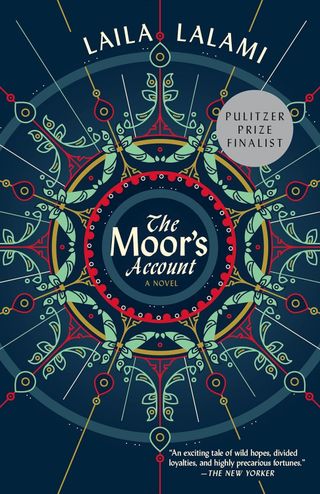
Cover of The Moor's Account

The Moor's Account

Laila Lalami

Original language: English · Paperback · ISBN 978-0804170628

Laila Lalami's novel reimagines the life of Mustafa al-Zamori, a Moroccan man from Azemmour who was sold into slavery and renamed Estebanico. He crosses the Atlantic as the property of the Spanish conquistador Andrés Dorantes, joining an expedition to Florida in 1527. The venture, led by Pánfilo de Narváez, collapsed. Of the hundreds of men who landed on the Gulf Coast, four survived, and Estebanico was one of them.

Written as a fictional first-person memoir, the book gives Estebanico a voice that the historical record never preserved. As the four survivors travel for years across the continent, the fixed roles of master and slave become harder to hold in place. Estebanico works as translator, healer, and storyteller, shaping how the group is received by the Indigenous peoples they meet. The novel follows how personal narratives pass into history, and who gets left out of them.

Lalami was born in Morocco and later moved to the United States. The surviving Spanish accounts of the expedition record Estebanico only in passing, and this novel works inside that gap, filling it with one man's version of the same events. The book was named a Pulitzer Prize finalist and a New York Times Notable Book.

Plot

In these pages, Laila Lalami brings us the invented memoirs Mustafa al-Zamori, called Estebanico. The slave of a Spanish conquistador, Estebanico sails for the Americas with his master, Dorantes, as part of a danger-laden expedition to Florida. Within a year, Estebanico is one of only four crew members to survive. As he journeys across America with his Spanish companions, the Old World roles of slave and master fall away, and Estebanico remakes himself as an equal, a healer, and a remarkable storyteller. His tale illuminates the ways in which our narratives can transmigrate into history—and how storytelling can offer a chance at redemption and survival.

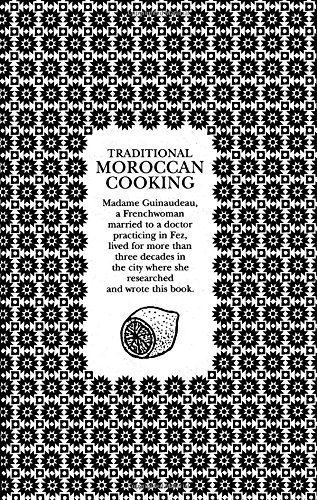
Cover of Traditional Moroccan Cooking: Recipes from Fez

Traditional Moroccan Cooking: Recipes from Fez

Z. Guinaudeau

Original language: English · Paperback · ISBN 978-1897959435

Traditional Moroccan Cooking: Recipes from Fez is a cookbook rooted in one specific city rather than an entire national cuisine. Z. Guinaudeau, a Frenchwoman who lived in Fez for many years, recorded recipes and food customs she observed inside private homes in the old medina. The book opens with scenes of daily life: spice markets, bread ovens, pottery workshops, and the rituals surrounding a formal banquet in a wealthy household. These descriptions give context to the recipes that follow, linking each dish to the place and the people who prepared it.

The recipes cover ground familiar to Moroccan cooking, including tagines, couscous, preserved lemons, and pastries, but they are presented through the lens of Fez, a city historically regarded as a center of Moroccan culinary tradition. Guinaudeau explains techniques such as lemon preservation and bread-making in practical detail, drawing on methods she learned directly from local cooks.

Fez was founded in the late eighth century and became a major cultural and intellectual hub in the medieval Islamic world. The city's medina, one of the largest car-free urban areas on Earth, still operates with many of the craft trades and food customs Guinaudeau documented. Her book serves as both a recipe collection and a record of kitchen practices tied to that particular setting.

Plot

Capturing the atmosphere of Fez, cultural capital of the medieval Moorish world, Madame Guinaudeau takes us behind closed doors into the kitchens and dining rooms of the old city. She invites us to a banquet in a wealthy home, shopping in the spice market and to the potter's workshop; shares with us the secrets of preserving lemons for a tagine; shows us how to make perfect Moroccan bread.

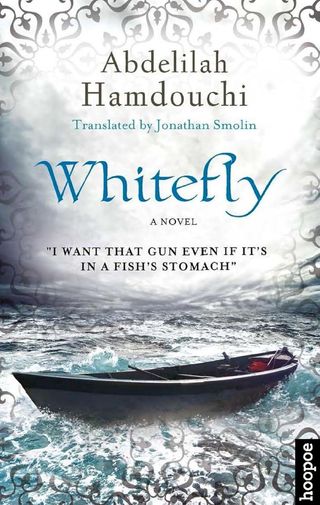
Cover of Whitefly

Whitefly

Abdelilah Hamdouchi

Original language: Arabic · Paperback · ISBN 978-9774167515

Four bodies surface in the waters near Tangier over the course of three days, each with a bullet wound in the chest. Detective Laafrit, working in a city where illegal crossings to Spain are common, quickly recognizes that these deaths do not fit the usual pattern of migrants lost at sea. Firearms are difficult to obtain in Morocco, and the presence of a gun points toward something organized and deliberate. Laafrit begins investigating the networks that operate along the coast, from human traffickers to drug smugglers, looking for the weapon and whoever is behind the killings.

The novel is set in Tangier, a port city on the Strait of Gibraltar where Africa and Europe are separated by roughly fourteen kilometers of open water. This geography shapes the story at every level. Smuggling routes, migration corridors, and cross-border crime form the daily landscape of Laafrit's work. As his investigation develops, a hunch leads him toward connections that extend well beyond Morocco's borders, suggesting an international dimension to the case.

Abdelilah Hamdouchi is a Moroccan author who writes crime fiction in Arabic. Whitefly belongs to a small but growing body of detective novels set in North Africa, where the genre draws on local policing realities and the specific pressures of border cities like Tangier.

Plot

When a fourth corpse in three days washes up in Tangier with a bullet in the chest, Detective Laafrit knows this isn’t just another illegal immigrant who didn’t make it to the Spanish coast. The traffickers. The drug dealers. The smugglers. They know what it takes to get a gun into Morocco, and so does Laafrit. As his team hunts for the gun, Laafrit follows a hunch and reveals an international conspiracy to unlock the case.

More from Morocco

See the country page for Morocco for its map, facts and largest cities, or browse books from other countries.

Links go to Amazon; Hookito doesn’t sell books. Know a book that belongs here, or spotted a mistake? Write to submissions@hookito.com.