Hookito

Mongolia · Books

Books from Mongolia

7 books from and about Mongolia: what each is about, the plot, and a note from Professor Kogi.

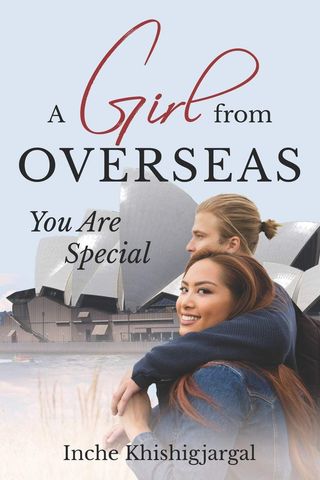
Cover of A Girl from overseas: You are special

A Girl from overseas: You are special

Inche Khishigjargal

Original language: English · Paperback · ISBN 978-1673916034

Enhe grows up in Mongolia, where nomadic life centers on hospitality and generosity rather than material wealth. When she travels to Australia to study at university, she encounters a social world organized around very different priorities. The contrast is not about language or logistics but about what people consider valuable in one another. Enhe finds herself navigating a society where status and money carry weight in ways she has not experienced before.

John is a young Australian businessman, confident and accustomed to using his success to impress. When he pursues Enhe, his usual approach falls flat. She is uninterested in displays of wealth and unmoved by the lifestyle he considers appealing. Their early encounters are shaped by this mismatch, but over time the two begin to learn from each other. Enhe opens up to parts of Australian culture, while John starts to reconsider what qualities actually matter in how people treat one another.

The novel is written by Inche Khishigjargal and follows a cross-cultural romance set between Mongolia and Australia. Its central tension comes from the collision of two value systems, one rooted in nomadic tradition and the other in urban commercial life, and the slow adjustments both characters make as they get closer.

Plot

When Enhe, a young girl from Mongolia, comes to Australia for university, she faces a culture shock that has nothing to do with settlement or language in a highly developed country. For the first time, she meets people who care more about wealth and status than others, while her nomadic upbringing placed a higher value on kindness and hospitality than one’s bank account. So when John, an entitled young businessman, sets his sights on the beautiful student, she is unimpressed by his attempts at courtship. But little by little, the unlikely couple gets to know each other, and as Enhe begins to appreciate to Australian culture, John learns there is more merit in the breadth of one’s heart than their wallet.
Cover of Mongolian recipes from every region

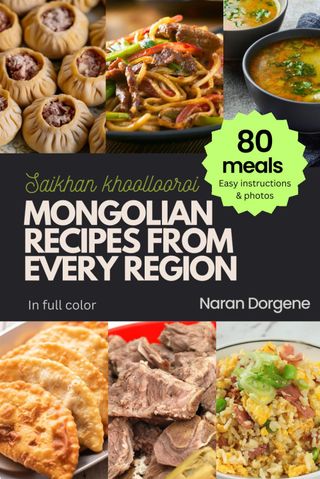
Mongolian recipes from every region

Naran Dorgene

Original language: English · Paperback · ISBN 979-8327335462

Mongolian Recipes from Every Region by Naran Dorgene is a cookbook collecting 100 dishes organized by their geographic origins across Mongolia. The book groups recipes according to distinct areas of the country, connecting each dish to local ingredients and food traditions specific to that region. Mongolia stretches across steppe grasslands, the Gobi desert, forested northern mountains, and western highlands, and this regional approach reflects how geography and climate shape what people eat in different parts of the country.

Each recipe is presented with a full-color photograph and includes measurements in both American and European standards. This dual-measurement format is a practical choice for a cookbook aimed at cooks outside Mongolia who may not have access to Mongolian-language sources. The regional categories offer context beyond the recipe steps themselves, linking individual dishes to the places and traditions they come from.

Mongolian cooking draws on a food culture shaped by pastoral herding, with dairy products and meat from sheep, goats, cattle, yaks, and horses forming a central part of daily meals across much of the country. The book covers dishes from various regions, giving readers a structured way to explore how local conditions produce different cooking methods and flavor combinations.

Plot

Regional Organization: Recipes are thoughtfully categorized by their regional origins, offering an insightful glimpse into the local traditions and ingredients specific to different areas of Mongolia. High-Quality Photos: Each recipe is accompanied by a stunning, full-color photo that not only guides your cooking but also celebrates the beauty of Mongolian cuisine. Adapted Measurements: Enjoy making these dishes wherever you are as all recipes include measurements in both American and European standards, making the cooking process seamless and accessible.

Cover of Rough Magic: Riding the World's Loneliest Horse Race

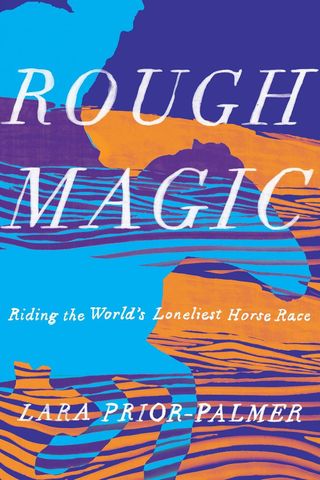
Rough Magic: Riding the World's Loneliest Horse Race

Lara Prior–Palmer

Original language: English · Hardcover · ISBN 978-1948226196

The Mongol Derby covers roughly 1,000 kilometers of Mongolian steppe, following a route inspired by the postal relay system that Genghis Khan established across his empire in the thirteenth century. Competitors ride semi-wild horses, switching to a fresh mount at each station, and many who enter never complete the course. In 2013, nineteen-year-old Lara Prior-Palmer signed up on impulse after finding the race online. She had grown up around horses in England but had done none of the structured preparation that most riders undertake for years before attempting the derby.

Rough Magic is Prior-Palmer's own account of the ten days she spent crossing grasslands, mountains, rivers, wetlands, and arid dunes on a succession of unfamiliar ponies. She slept in the homes of nomadic herding families, contended with dehydration and storms, and kept riding each morning despite exhaustion and falls. The book moves between the physical details of the race and her internal reflections on restlessness, impulse, and what drives a person to keep going when the sensible choice would be to stop.

Prior-Palmer became the first woman and the youngest person to win the Mongol Derby. Her writing stays close to the landscape and to the animals she rode, giving the narrative a texture grounded in specific terrain rather than abstract adventure.

Plot

At the age of nineteen, Lara Prior–Palmer discovered a website devoted to “the world’s longest, toughest horse race”―an annual competition of endurance and skill that involves dozens of riders racing a series of twenty–five wild ponies across 1,000 kilometers of Mongolian grassland. On a whim, she decided to enter the race. As she boarded a plane to East Asia, she was utterly unprepared for what awaited her. Riders often spend years preparing to compete in the Mongol Derby, a course that re–creates the horse messenger system developed by Genghis Khan. Many fail to finish. Prior–Palmer had no formal training. She was driven by her own restlessness, stubbornness, and a lifelong love of horses. She raced for ten days through extreme heat and terrifying storms, catching a few hours of sleep where she could at the homes of nomadic families. Battling bouts of illness and dehydration, exhaustion and bruising falls, she decided she had nothing to lose. Each dawn she rode out again on a fresh horse, scrambling up mountains, swimming through rivers, crossing woodlands and wetlands, arid dunes and open steppe, as American television crews chased her in their jeeps.

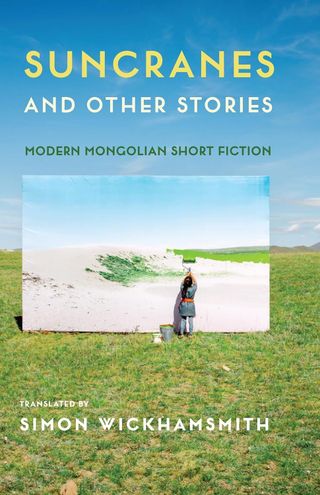
Cover of Suncranes and Other Stories: Modern Mongolian Short Fiction

Suncranes and Other Stories: Modern Mongolian Short Fiction

Simon Wickhamsmith

Original language: Mongolian · Paperback · ISBN 978-0231185745

Suncranes and Other Stories gathers modern Mongolian short fiction in English translation by Simon Wickhamsmith. The selection spans roughly a century, beginning after the socialist revolution of 1921 and reaching into the early twenty-first century. In that period a largely nomadic society met socialism and later capitalism, each arriving with its own promise of a new kind of society.

Styles vary widely. Some pieces work as fables in the Aesopian manner, using animals to make a point; others follow socialist realism, a state-approved style of the socialist period, and some take more experimental shapes. Folktales and epic poetry sit alongside Western prose models. Settings shift between Ulaanbaatar, the capital, and the wide grassland of the steppe, where the landscape and people's ties to it recur throughout.

Recurring tensions run through the collection: people trying to understand a way of life introduced by a foreign power, while also benefiting from some of the reforms that arrived with it. The writers included are among Mongolia's most highly regarded prose authors, and their stories move between herding life and the capital.

Plot

Over the course of the twentieth century, Mongolian life was transformed, as a land of nomadic communities encountered first socialism and then capitalism and their promises of new societies. The stories collected in this anthology offer literary snapshots of Mongolian life throughout this tumult. Spanning the years following the socialist revolution of 1921 through the early twenty-first century, these stories from the country’s most highly regarded prose writers show how Mongolian culture has forged links between the traditional and the modern. Writers employ a wide range of styles, from Aesopian fables through socialist realism to more experimental forms, influenced by folktales and epics as well as Western prose models. They depict the drama of a nomadic population struggling to understand a new approach to life imposed by a foreign power while at the same time benefiting from reforms, whether in the capital city Ulaanbaatar or on the steppe. Across the mix of stories, Mongolia’s majestic landscape and the people’s deep connection to it come through vividly.

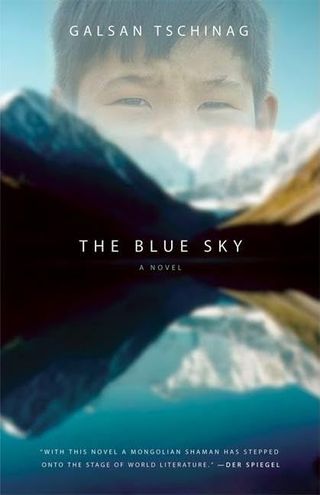
Cover of The Blue Sky

The Blue Sky

Galsan Tschinag

Original language: German · Paperback · ISBN 978-1571310644

The Blue Sky follows a young Tuvan shepherd boy named Dshurukawaa growing up in the high Altai Mountains of northern Mongolia. His family tends flocks on the mountain steppes, and his world is bounded by the peaks around him. The story draws on the oral traditions of the Tuvan people, a small Turkic-speaking group whose homeland straddles the border region between Mongolia and what is now the Russian republic of Tuva. Author Galsan Tschinag, himself of Tuvan origin, sets the novel in a landscape where nomadic herding life still follows older rhythms.

The pressure of the modern world arrives in stages rather than all at once. First, the boy's older siblings leave the family yurt to attend a distant boarding school. Then his grandmother dies, severing a living link to Tuvan customs and knowledge passed down through speech and memory. A further loss comes when his dog Arsylang swallows poison that the boy's father had laid out to protect the herd from wolves. Each event strips away part of the world Dshurukawaa knows.

The novel is structured around these accumulating separations, moving between the boy's close attachment to animals, landscape, and family and the forces pulling that life apart. Dshurukawaa addresses his grief to the sky itself, a presence central to Tuvan spiritual life.

Plot

In the high Altai Mountains of northern Mongolia, a young shepherd boy comes of age, tending his family’s flocks on the mountain steppes and knowing little of the world beyond the surrounding peaks. But his nomadic way of life is increasingly disrupted by modernity. This confrontation comes in stages. First, his older siblings leave the family yurt to attend a distant boarding school. Then the boy’s grandmother dies, and with her his connection to the old ways. But perhaps the greatest tragedy strikes when his dog, Arsylang—“all that was left to me”—ingests poison set out by the boy’s father to protect his herd from wolves. “Why is it so?” Dshurukawaa cries out in despair to the Heavenly Blue Sky, to be answered only by the wind.

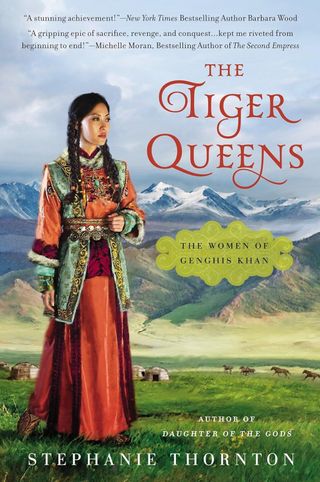
Cover of The Tiger Queens

The Tiger Queens

Stephanie Thornton

Original language: English · Paperback · ISBN 978-0451417800

The Tiger Queens by Stephanie Thornton is a historical novel set on the Mongolian steppe in the late twelfth century, as the warrior Temujin rises to become Genghis Khan. The story keeps its focus on the women around him rather than on the conqueror, beginning with Borte, who was promised to Temujin in childhood only to be left waiting for years. When he returns and makes her his queen, she becomes one of several women whose resolve helps hold a growing and unstable empire together.

The novel follows four central figures across different stages of Mongol expansion. Borte navigates her position as principal wife and political partner. Alaqai, her daughter with Temujin, grows up skilled in riding and archery. Fatima, a Persian woman taken captive, gradually redirects her anger into fierce allegiance. Sorkhokhtani, widowed young, works to secure the place of her sons in the line of succession as the empire starts to divide from within.

Thornton uses these overlapping perspectives to trace how the Mongol Empire was shaped by personal alliances, family tensions, and the strategic calculations of women whose names rarely appear in standard accounts of the period. The setting stays close to the grasslands and travelling felt-walled camps of the Mongol clans.

Plot

In the late twelfth century, across the sweeping Mongolian grasslands, brilliant, charismatic Temujin ascends to power, declaring himself the Great, or Genghis, Khan. But it is the women who stand beside him who ensure his triumph.... After her mother foretells an ominous future for her, gifted Borte becomes an outsider within her clan. When she seeks comfort in the arms of aristocratic traveler Jamuka, she discovers he is the blood brother of Temujin, the man who agreed to marry her and then abandoned her long before they could wed. Temujin will return and make Borte his queen, yet it will take many women to safeguard his fragile new kingdom. Their daughter, the fierce Alaqai, will ride and shoot an arrow as well as any man. Fatima, an elegant Persian captive, will transform her desire for revenge into an unbreakable loyalty. And Sorkhokhtani, a demure widow, will position her sons to inherit the empire when it begins to fracture from within.

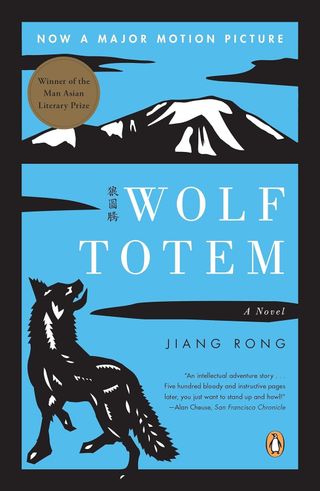
Cover of Wolf Totem

Wolf Totem

Jiang Rong

Original language: Chinese · Paperback · ISBN 978-0143115144

Wolf Totem follows Chen Zhen, a young Chinese student who volunteers to live among nomadic herders in a remote settlement near the border of Inner and Outer Mongolia. There he encounters a way of life shaped by harsh grassland and by the wolves that roam it. The herders treat the Mongolian wolf as sacred, and survival depends on a tense balance between people and wolf packs. Chen becomes absorbed in studying how the packs hunt and organize.

The story unfolds during the late 1960s and early 1970s, when campaigns pushed to convert pastoral grassland into farmland and to kill wolves as pests. Those policies threaten the herding culture and the ecosystem that sustains it. Jiang Rong uses Chen's attachment to the wolves to raise questions about ecological limits, rapid modernization, and what disappears when outside authority reshapes a landscape.

First published in China in 2004, Wolf Totem sold millions of copies there. Howard Goldblatt, a translator long associated with Chinese-language fiction, produced the English version. The book moves between period narrative and fable, and its structure keeps the wolves and the grassland at the centre rather than in the background.

Plot

Part period epic, part fable for modern days, Wolf Totem depicts the dying culture of the Mongols--the ancestors of the Mongol hordes who at one time terrorized the world--and the parallel extinction of the animal they believe to be sacred: the fierce and otherworldly Mongolian wolf. Beautifully translated by Howard Goldblatt, the foremost translator of Chinese fiction, this extraordinary novel is finally available in English.

More from Mongolia

See the country page for Mongolia for its map, facts and largest cities, or browse books from other countries.

Links go to Amazon; Hookito doesn’t sell books. Know a book that belongs here, or spotted a mistake? Write to submissions@hookito.com.