Hookito

Poland · Books

Books from Poland

7 books from and about Poland: what each is about, the plot, and a note from Professor Kogi.

Cover of Authentic Polish Cooking: 120 Mouthwatering Recipes

Authentic Polish Cooking: 120 Mouthwatering Recipes

Marianna Dworak

Original language: English · Paperback · ISBN 978-1510702196

Authentic Polish Cooking by Marianna Dworak is a cookbook containing 120 recipes organized by course. The collection covers a wide span of Polish dishes, from soups like beet soup to main courses such as Hunter's Stew and pork and rice stuffed cabbage leaves. Side dishes, salads, and desserts also appear, including cucumber salad, potato pancakes, the yeast cake known as babka, and several varieties of pierogies.

The book includes a section devoted to traditional Polish holiday meals, which in Poland often follow a distinct calendar of seasonal ingredients and religious observance. Estimated cooking times accompany each recipe, and the author provides suggestions for healthier ingredient substitutions where possible. Instructions are written for cooks at different skill levels, covering both straightforward everyday dishes and ones that require more preparation.

Polish cooking draws on a long tradition of preserving, fermenting, and slow-cooking that reflects the country's cold winters and agricultural history. Dworak's selection moves well beyond the stereotype of heavy meat-and-potato fare, giving space to soups, vegetable dishes, and baked goods that are central to daily and festive eating across Poland.

Plot

Polish cuisine is hearty and filling, and it is not all meat and potatoes. This truly authentic cookbook makes a fantastic addition to any kitchen. Organized by course, this cookbook features 120 recipes, including beet soup, cucumber salad, potato pancakes, Hunter’s Stew, pork and rice stuffed cabbage leaves, traditional “babka” cake, and of course, pierogies! With easy-to-follow instructions for simple as well as more intricate dishes, a section on traditional holiday meals, estimated cooking times, and suggestions for healthy ingredient substitutions, this cookbook will teach anyone how to cook delicious Polish food.
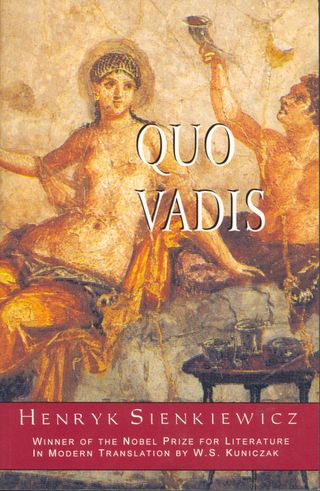
Cover of Quo Vadis

Quo Vadis

Henryk Sienkiewicz

Original language: Polish · Paperback · ISBN 978-0781805506

Quo Vadis is set in first-century Rome during the reign of Emperor Nero. The story follows Vinicius, a Roman military officer and nobleman, who becomes consumed with desire for Lygia, a young woman of royal origin from a conquered kingdom. Lygia lives in Rome as a political hostage, and she belongs to the small Christian community in the city. Vinicius, raised in the pagan traditions of Rome, is initially bewildered by her faith and attempts to claim her through force and status.

As Vinicius draws closer to Lygia and her community, he encounters a way of life built on compassion and forgiveness that stands in sharp contrast to the cruelty and excess of Nero's Rome. The apostle Peter leads the Christian group, whose growing presence unsettles the emperor. Nero's persecution of Christians escalates through increasingly brutal measures, and Lygia is eventually caught in the emperor's plans. Vinicius faces a turning point where he must choose between the power structures of Rome and the faith Lygia lives by.

Henryk Sienkiewicz, a Polish novelist, published the book in the 1890s. The novel is dense with historical detail about daily life, politics, and spectacle in imperial Rome, and it uses the collision between Roman paganism and early Christianity as its central dramatic tension.

Plot

Vinicius, the proud centurion who has fallen deeply in love with a mysterious young woman who disappears the night they meet; Ligia, the elusive beauty. Vinicius will not easily win her love, for she is a Christian, one of the group of dedicated believers led by the apostle Peter. Christians are rare in pagan, hedonistic Rome, and suffer great persecution

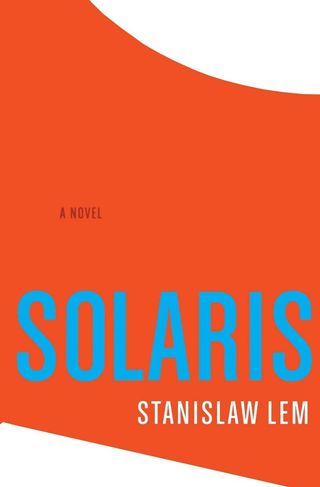
Cover of Solaris

Solaris

Stanislaw Lem

Original language: Polish · Paperback · ISBN 978-0156027601

Psychologist Kris Kelvin travels to a research station orbiting the planet Solaris, where a vast ocean covers nearly the entire surface. Scientists have spent decades trying to classify and communicate with this ocean, which appears to be a single, planet-wide organism. Their efforts have produced an enormous body of theoretical literature but little real understanding. When Kelvin arrives, he finds the small crew in disarray, each member haunted by figures that should not exist.

These figures turn out to be physical recreations of people drawn from the researchers' most buried memories. The ocean, for reasons no one can explain, has begun producing them. Kelvin's own visitor takes the form of a woman from his past, someone connected to deep personal guilt. The visitors are not illusions or hallucinations. They are solid, present, and persistent, which forces the crew to confront private histories they had no intention of sharing.

Stanislaw Lem, a Polish writer, published the novel in 1961. It centers on the limits of human knowledge when faced with something genuinely alien. Rather than presenting extraterrestrial contact as a problem that science can solve, Lem treats it as a situation that exposes how little humans understand about themselves.

Plot

When psychologist Kris Kelvin arrives at the planet Solaris to study the ocean that covers its surface, he finds himself confronting a painful memory embodied in the physical likeness of a past lover. Kelvin learns that he is not alone in this and that other crews examining the planet are plagued with their own repressed and newly real memories.

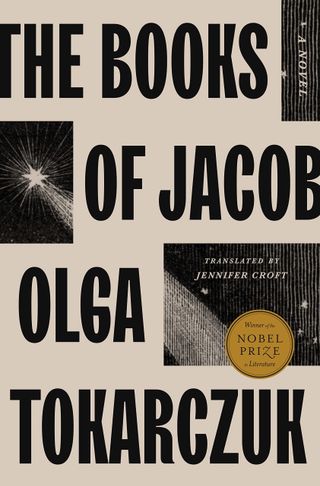
Cover of The Books of Jacob

The Books of Jacob

Olga Tokarczuk

Original language: Polish · Hardcover · ISBN 978-0593087480

In the mid-eighteenth century, a young man of uncertain origins arrives in a Polish village and begins to gather followers. Known as Jacob Frank, he claims ecstatic visions and reshapes his identity repeatedly, drawing people from Jewish communities across the region into a growing, fervent movement. Olga Tokarczuk builds her novel around this historical figure, tracing his path through the Habsburg and Ottoman empires as he converts first to Islam, then to Catholicism, unsettling religious authorities on every side.

Frank's story sits at the intersection of several forces shaping eighteenth-century Europe: Enlightenment ideas spreading through educated circles, deep tensions within and between religious communities, and the political fragility of the Polish-Lithuanian Commonwealth. Tokarczuk populates the novel with merchants, rabbis, priests, and ordinary believers caught up in Frank's orbit. The narrative moves across borders and languages, reflecting a period when central Europe's cultural map was far more layered than national boundaries suggest.

The book is structured in an unusual way, with sections that move both forward and backward in time. Tokarczuk, who received the Nobel Prize in Literature, wrote it originally in Polish, and the English translation runs well over nine hundred pages.

Plot

In the mid-eighteenth century, as new ideas—and new unrest—begin to sweep the Continent, a young Jew of mysterious origins arrives in a village in Poland. Before long, he has changed not only his name but his persona; visited by what seem to be ecstatic experiences, Jacob Frank casts a charismatic spell that attracts an increasingly fervent following. In the decade to come, Frank will traverse the Hapsburg and Ottoman empires with throngs of disciples in his thrall as he reinvents himself, again and again, converts to Islam and then Catholicism, is pilloried as a heretic and revered as the Messiah, and wreaks havoc on the conventional order, Jewish and Christian alike, with scandalous rumors of his sect’s secret rituals and the spread of his increasingly iconoclastic beliefs.

Cover of The Last Wish: Introducing The Witcher

The Last Wish: Introducing The Witcher

Andrzej Sapkowski’

Original language: Polish · mass market paperback · ISBN 978-0316029186

Geralt of Rivia is a witcher, a professional monster hunter whose body has been altered through rigorous training and a strange elixir. In this collection of linked stories by Polish author Andrzej Sapkowski, Geralt travels a world loosely drawn from Slavic and wider European folklore, taking contracts to kill creatures that threaten ordinary people. His abilities set him apart from the communities he protects, and he is treated with a mixture of respect and suspicion wherever he goes.

The stories in The Last Wish rework familiar fairy tales and legends, placing them in a setting where moral boundaries are rarely clean. Creatures that appear monstrous may turn out to be sympathetic, while outwardly noble humans may prove dangerous. Geralt operates inside these ambiguities, making choices that carry real consequences even when no option is clearly right. A framing narrative connects the individual tales, with Geralt recovering in a temple and recounting past encounters.

Sapkowski originally wrote these stories in Polish during the late 1980s and early 1990s, and the book became the entry point to a wider series. The setting blends medieval social structures with a distinct Central European sensibility, grounding its fantasy elements in a landscape shaped by local tradition rather than generic myth.

Plot

Geralt is a Witcher, a man whose magic powers, enhanced by long training and a mysterious elixir, have made him a brilliant fighter and a merciless hunter. Yet he is no ordinary killer. His sole purpose: is to destroy the monsters that plague the world. But not everything monstrous-looking is evil and not everything fair is good . . . and in every fairy tale, there is a grain of truth.

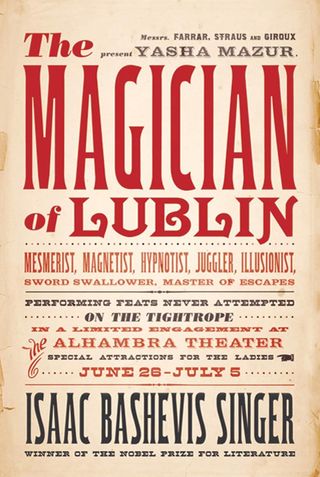
Cover of The Magician of Lublin

The Magician of Lublin

Isaac Bashevis Singer

Original language: Yiddish · Paperback · ISBN 978-0374532543

Yasha Mazur is a stage magician and escape artist whose performances have made him a well-known figure across eastern Poland. He is half Jewish, half Gentile, and moves between religious and secular worlds with the same ease he brings to his act. He keeps an observant Jewish wife at home, travels with a Gentile assistant, and maintains a mistress in more than one town along his circuit.

Singer places him among Jewish communities and small cities in Poland, where religious tradition and modern skepticism press against each other. Yasha is a freethinker who has drifted from his father's faith without fully leaving it. As his tangled private life begins to close in, he weighs one decisive escape: away from his wife, his homeland, and the last threads of the religion he was raised in.

Isaac Bashevis Singer wrote in Yiddish and was later widely read in English translation; he received the Nobel Prize in Literature in 1978. This is one of his shorter novels, and its central tensions turn on desire, obligation, and the hypnotic hold Yasha has over the women in his life.

Plot

Yasha Mazur is a Houdini-like performer whose skill has made him famous throughout eastern Poland. Half Jewish, half Gentile, a freethinker who slips easily between worlds, Yasha has an observant Jewish wife, a Gentile assistant who travels with him, and a mistress in every town. For Yasha is an escape artist not only onstage but in life, a man who lives under the spell of his own hypnotic effect on women. Now, though, his exploits are catching up with him, and he is tempted to make one final escape―from his wife and his homeland and the last tendrils of his father's religion.

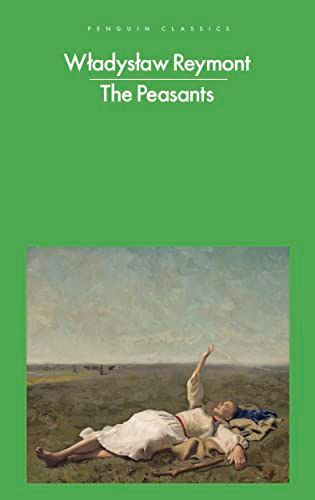
Cover of The Peasants

The Peasants

Wladyslaw Reymont

Original language: Polish · Kindle Edition

The Peasants follows life in the fictional Polish village of Lipce across four volumes, each named after a season: Autumn, Winter, Spring, and Summer. At the center is Boryna, the village's wealthiest farmer, a widower who marries the young Jagusia. The marriage sets off a slow-burning conflict, because Jagusia is drawn to Boryna's son Antek rather than to Boryna himself. Around this triangle, the rest of the village watches, talks, and takes sides. Reymont populates Lipce with sharply drawn figures: the sharp-tongued gossip Jagustynka, the devout wanderer Roch, the volatile Mateusz, and the quiet Witek, among others.

The novel's structure ties human events tightly to the agricultural calendar. Planting, harvest, festivals, and weather shape the rhythm of every chapter. Reymont wrote the book in Polish between 1904 and 1909, drawing on close observation of rural communities in central Poland. He received the Nobel Prize in Literature in 1924, with the Swedish Academy citing this work specifically.

Lipce functions as a complete social world, with its own hierarchies, customs, and pressures. Land ownership, family obligation, and village reputation drive the characters as forcefully as personal desire, and Reymont renders these forces through concrete daily detail rather than abstraction.

Plot

In the village of Lipce, scandal, romance, and drama crackle in every hearth. Boryna, a widower and the village's wealthiest farmer, has taken the young and beautiful Jagusia as his bride - but she only has eyes for his impetuous son Antek. Over the course of four seasons - Autumn to Summer - the tangled skein of their story unravels, watched eagerly by the other peasants: the gossip Jagustynka, pious Roch, hot-blooded Mateusz, gentle Witek

More from Poland

See the country page for Poland for its map, facts and largest cities, or browse books from other countries.

Free editions are on Project Gutenberg, matched by title and author. Links go to Amazon; Hookito doesn’t sell books. Know a book that belongs here, or spotted a mistake? Write to submissions@hookito.com.