Hookito

Turkey · Books

Books from Turkey

7 books from and about Turkey: what each is about, the plot, and a note from Professor Kogi.

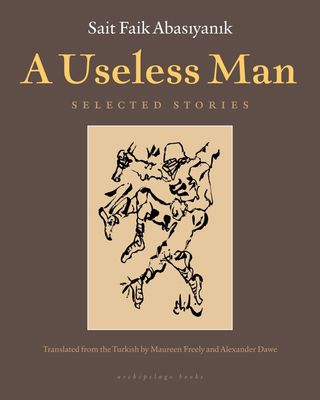
Cover of A Useless Man

A Useless Man

Sait Faik Abasıyanık

Original language: Turkish · Paperback · ISBN 978-0914671077

Sait Faik Abasıyanık, born in Adapazarı in 1906 and active until his death in Istanbul in 1954, produced twelve short story collections, two novels, and a book of poetry during his relatively brief life. A Useless Man gathers stories set largely in Istanbul and the nearby Princes' Islands, populated by coffeehouse owners, fishermen lost in their own thoughts, priests, poets, lovers, and street musicians belonging to a fading era. Many of these pieces draw on Abasıyanık's own experiences and frustrations.

The stories engage with pressures that shaped mid-twentieth-century Turkish life: rigid social expectations, rapid westernization under the early Republic, and the forced displacement of ethnic communities from Istanbul. Abasıyanık's prose maintains a deceptively calm, clear surface. Beneath that composure, the writing carries quiet resistance to the cultural and linguistic constraints imposed during the formation of the modern Turkish state.

The collection moves between close observation of ordinary people and a persistent awareness of what is being lost around them. Abasıyanık watches his city through its margins, recording the textures of daily life in neighborhoods, coffeehouses, and island shores while the political ground shifts beneath his characters.

Plot

Sait Faik Abasıyanık’s fiction traces the interior lives of strangers in his native Istanbul: ancient coffeehouse proprietors, priests, dream-addled fishermen, poets of the Princes’ Isles, lovers, and wandering minstrels of another time. The stories in A Useless Man are shaped by Sait Faik’s political autobiography – his resistance to social convention, the relentless pace of westernization, and the ethnic cleansing of his city – as he conjures the varied textures of life in Istanbul and its surrounding islands. The calm surface of these stories might seem to signal deference to the new Republic’s restrictions on language and culture, but Abasıyanık’s prose is crafted deceptively, with dark, subversive undercurrents. “Reading these stories by Sait Faik feels like finding the secret doors inside of poems,” Rivka Galchen wrote.
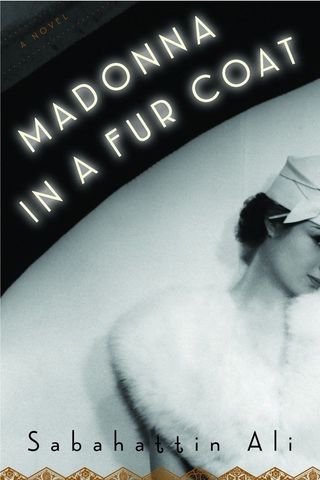

Cover of Madonna in a Fur Coat

Madonna in a Fur Coat

Sabahattin Ali

Original language: Turkish · Paperback · ISBN 978-1590518809

Madonna in a Fur Coat follows a quiet, reserved young man who travels from rural Turkey to Berlin during the 1920s. He arrives hoping to learn a trade, but the city pulls him in unexpected directions. Among its museums, political gatherings, and cabaret halls, he encounters a half-Jewish painter whose presence changes the course of his life. What begins as fascination gradually becomes something deeper and more complicated.

The novel sits at the intersection of two kinds of displacement. Its protagonist is caught between the customs he grew up with and the freedoms Berlin seems to offer. At the same time, his relationship with the artist forces him to confront what he is actually willing to risk for another person. Sabahattin Ali wrote the book in 1943, setting it against the social turbulence of interwar Germany while drawing on tensions between tradition and individual desire that shaped Turkish society during the same period.

First published in Turkish, the novel became one of the best-selling literary works in Turkey over several decades. The English translation, published by Penguin, made it available to a wider readership for the first time. Its structure uses a framing device in which the story is discovered after the fact, adding distance between the reader and the events described.

Plot

A shy young man leaves his home in rural Turkey to learn a trade and discover life in 1920s Berlin. There, amidst the city’s bustling streets, elegant museums, passionate politics, and infamous cabarets, a chance to meet with a beautiful half-Jewish artist transform him forever. Caught between his desire for freedom from tradition and his yearning to belong, he struggles to hold on to the new life he has found with the woman he loves.

Cover of Memed, My Hawk

Memed, My Hawk

Yashar Kemal

Original language: Turkish · Paperback · ISBN 978-1590171394

Memed, My Hawk follows a boy growing up in a poor mountain village in southern Turkey, where a local landlord keeps the inhabitants bound to harsh labor and submission. Memed is spirited and kindhearted, but conditions leave little room for either. His first attempt to flee ends in capture, torture, and near death. A later escape takes him into the hills as a roving brigand.

The novel is set in a region of rocky slopes covered in thistles, where the terrain shapes daily life as much as any human authority. Kemal draws a parallel between that landscape and Memed's character, since both can be generous or cutting depending on what has been forced on them. Memed becomes a figure celebrated in song, and he could be a liberator to his village, yet whether his new life will harden him past recovery stays an open question.

Yashar Kemal wrote in Turkish and published this novel in 1955. It became one of the most widely translated works of Turkish fiction. The story reflects the landlord system that shaped rural Anatolian life well into the twentieth century, when control of land decided who worked and who gave orders.

Plot

Memed, a high-spirited, kindhearted boy, grows up in a desperately poor mountain village whose inhabitants are kept in virtual slavery by the local landlord. Determined to escape from the life of toil and humiliation to which he has been born, he flees but is caught, tortured, and nearly killed. When at last he does get away, it is to set up as a roving brigand, celebrated in song, who could be a liberator to his people—unless, like the thistles that cover the mountain slopes of his native region, his character has taken an irremediably harsh and unforgiving form.

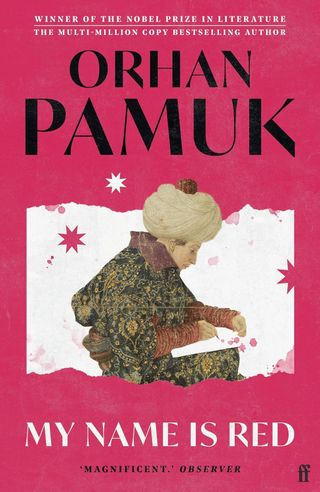
Cover of My Name Is Red

My Name Is Red

Orhan Pamuk

Original language: Turkish · Paperback · ISBN 978-0571268832

In late sixteenth-century Istanbul, the Ottoman Sultan commissions a secret illustrated book celebrating his reign and empire. The work is to be painted by the finest miniaturists of the era, but with a controversial instruction: the illustrations should follow European artistic conventions rather than traditional Ottoman methods. At a time when such stylistic choices carry serious religious and political risk, even the artists themselves are kept in the dark about who has ordered the project. When one of the miniaturists is found dead, the head of the workshop must turn to an outsider for help uncovering the killer.

The novel unfolds through multiple narrators, including the living, the dead, and even objects and colors. Each voice offers a different angle on the events surrounding the murder and the endangered book. Through these perspectives, Orhan Pamuk explores the collision between Ottoman and European traditions of representation, the meaning of artistic originality versus faithful imitation, and the personal entanglements of love and jealousy among the characters.

The story is set against the documented tension within Ottoman culture over figurative painting and Western influence during the reign of Sultan Murat III. Pamuk, who received the Nobel Prize in Literature, grounds the plot in the real artistic practices of Ottoman miniature painters and the workshops where they trained and competed.

Plot

My Name is Red is an unforgettable murder mystery, set amid the splendor of sixteenth-century Istanbul, from the Nobel prizewinning author In the late 1590s, the Sultan secretly commissions a great book: a celebration of his life and his empire, to be illuminated by the best artists of the day - in the European manner. At a time of violent fundamentalism, however, this is a dangerous proposition. Even the illustrious circle of artists are not allowed to know for whom they are working. But when one of the miniaturists is murdered, their Master has to seek outside help. Did the dead painter fall victim to professional rivalry, romantic jealousy or religious terror?

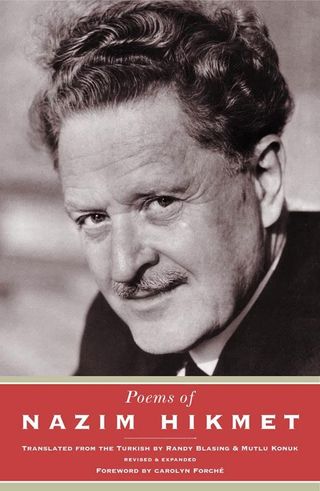
Cover of Poems of Nazim Hikmet

Poems of Nazim Hikmet

Nazim Hikmet

Original language: Turkish · Paperback · ISBN 978-0892552740

Nazim Hikmet, born in 1902 in what was then the Ottoman Empire, became one of the most widely translated Turkish poets of the twentieth century. He spent eighteen years as a political prisoner in Turkey and lived the final thirteen years of his life in exile, dying in 1963. Despite being banned in his home country for three decades, his work reached readers in more than fifty languages.

This collection, published to mark the centennial of Hikmet's birth, draws from four earlier selected volumes translated by Randy Blasing and Mutlu Konuk. It also includes more than twenty poems that had not previously appeared in English. The translations, developed over roughly a quarter century, aim to carry across Hikmet's direct emotional tone and his experiments with poetic form. Hikmet wrote in a style that could shift between lyrical intimacy and political clarity, and the translators worked to preserve that range in a single volume.

Hikmet's poetry often addresses confinement, distance from home, and ordinary human connection. His years in prison and exile gave these subjects a concrete weight drawn from lived experience rather than abstraction. The collection is organized to reflect the full span of his writing life, from early work to his later poems composed abroad.

Plot

A centennial volume, with previously unavailable poems, by Turkey's greatest poet. Published in celebration of the poet's one-hundredth birthday, this exciting edition of the poems of Nazim Hikmet (1902-1963) collects work from his four previously selected volumes and adds more than twenty poems never before available in English. The Blasing/Konuk translations, acclaimed for the past quarter-century for their accuracy and grace, convey Hikmet's compassionate, accessible voice with the subtle music, innovative form, and emotional directness of the originals.

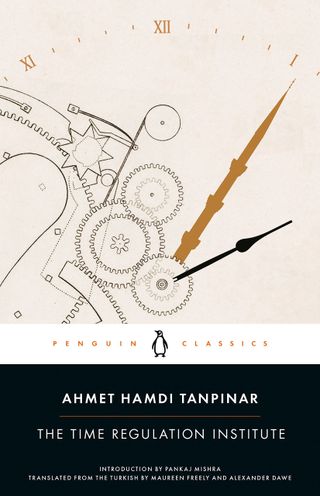
Cover of The Time Regulation Institute

The Time Regulation Institute

Ahmet Hamdi Tanpinar

Original language: Turkish · Paperback · ISBN 978-0143106739

Ahmet Hamdi Tanpinar's novel follows Hayri Irdal, an aimless but likeable figure drifting through a Turkey caught between its Ottoman past and a modernizing present. Hayri tells his life story to his psychoanalyst, describing the strange company he fell in with: a pharmacist experimenting with alchemy, a mystic who appears on television, a former Ottoman dignitary, and a man with an uncanny understanding of clocks.

These acquaintances lead him to the Time Regulation Institute, a vast organization created to set every clock in the country to Western time, enforcing compliance through an intricate scheme of fines. Much of the comedy comes from the bureaucratic machinery built around that simple aim. Tanpinar uses the premise to examine what happens when a society tries to remake itself by decree, swapping inherited rhythms for imported standards.

Hope for the future and longing for older ways sit side by side in Hayri's account. The book appeared in Turkish in 1961, a year before Tanpinar's death, and a full English translation followed more than fifty years later, which brought it to readers far outside Turkey. Tanpinar is counted among the central figures of twentieth-century Turkish writing.

Plot

At its center is Hayri Irdal, an infectiously charming antihero who becomes entangled with an eccentric cast of characters—a television mystic, a pharmacist who dabbles in alchemy, a dignitary from the lost Ottoman Empire, a “clock whisperer”—at the Time Regulation Institute, a vast organization that employs a hilariously intricate system of fines for the purpose of changing all the clocks in Turkey to Western time. Recounted in sessions with his psychoanalyst, the story of Hayri Irdal’s absurdist misadventures plays out as a brilliant allegory of the collision of tradition and modernity, of East and West, infused with a poignant blend of hope for the promise of the future and nostalgia for a simpler time.

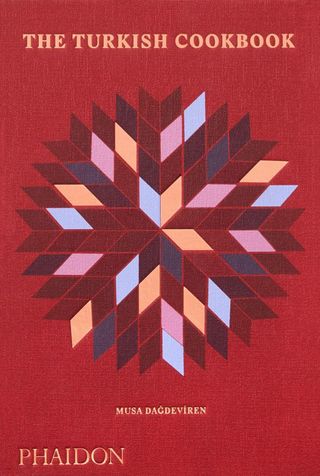
Cover of The Turkish Cookbook

The Turkish Cookbook

Musa Dagdeviren

Original language: English · Hardcover · ISBN 978-0714878157

The Turkish Cookbook by Musa Dagdeviren collects 550 recipes drawn from across Turkey, a country whose kitchens reflect both European and Asian cooking traditions. Dagdeviren is known for his long research into regional Turkish food, and the book covers a wide spectrum: grilled meats, pilafs, stews, dips, salads, pastries, and sweets. Familiar dishes such as lamb kofte, chicken kebabs, and pistachio baklava appear alongside lesser-known preparations from specific provinces and towns.

Turkey stretches from the Aegean coast to the mountains of eastern Anatolia, and its geography shapes its cooking. Coastal areas favor olive oil, herbs, and seafood, while the interior relies on grain, dairy, and dried legumes. The recipes in this collection reflect that range, moving between quick everyday meals and more elaborate preparations. Dagdeviren treats home cooking as a serious subject, giving space to family staples that rarely appear in English-language cookbooks.

The physical edition is bound in a linen case with gold stamping. At 550 recipes, the book functions less as a single narrative and more as a reference organized around ingredients, techniques, and regional variation across Turkey's diverse landscape.

Plot

Vibrant, bold, and aromatic, Turkish food - from grilled meats, salads, and gloriously sweet pastries to home-cooking family staples such as dips, pilafs, and stews - is beloved around the world. Wrapped in a handsome linen case with gold stamping, this is the first book to so thoroughly showcase the diversity of Turkish food, with 550 recipes for the home cook that celebrate Turkey's remarkable European and Asian culinary heritage - from little-known regional dishes to those that are globally recognized and stand the test of time, be they lamb kofte, chicken kebabs, tahini halva, or pistachio baklava.

More from Turkey

See the country page for Turkey for its map, facts and largest cities, or browse books from other countries.

Links go to Amazon; Hookito doesn’t sell books. Know a book that belongs here, or spotted a mistake? Write to submissions@hookito.com.