Hookito

Guyana · Books

Books from Guyana

8 books from and about Guyana: what each is about, the plot, and a note from Professor Kogi.

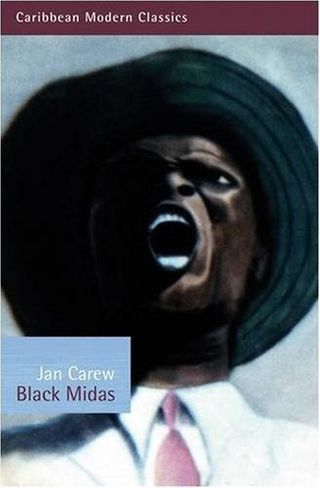
Cover of Black Midas

Black Midas

Jan Carew

Original language: English · Paperback · ISBN 978-1845230951

Black Midas by Jan Carew is set in Guyana and follows Aron Smart, a young man orphaned early in life and raised by grandparents on a farm. They stress the importance of education, but when a sudden turn of fortune ends his schooling, Aron finds himself with few prospects. Discouraged, he turns to the same trade that defined his father's life: diamond prospecting in the dense interior of the country.

Aron proves remarkably successful in the mines, earning the nickname Shark from the men who work alongside him. His rapid wealth brings a new obsession. He sets out to buy entry into the middle class, convinced that money alone can open doors that colonial society has kept shut. The novel draws a direct parallel between twentieth-century prospectors like Aron and the earlier Spanish explorers who crossed the Atlantic seeking El Dorado, linking personal ambition to a centuries-old pattern of extraction and self-destruction.

Carew uses Aron's rise to examine greed, class division, and the limited choices available in postcolonial Guyana. The story is rooted in a specific landscape where rivers, forests, and mining camps shape daily life as much as any social hierarchy.

Plot

Comparing ruthless 20th-century prospectors to the long-ago Spanish explorers who raped a continent in their quest for El Dorado, the novel follows the dreams and delusions of Aron Smart, a youth orphaned early in life and brought up on a farm by his grandparents who impressed upon him the value of an education. When Aron’s schooling is cut short after a reversal of fortune, however, he becomes deeply discouraged by his lack of opportunity and decides to follow in his father’s footsteps as a diamond prospector. He quickly becomes very rich—his companions in the mines call him “Shark”—and he is determined to use his new wealth to buy his way into the middle class.
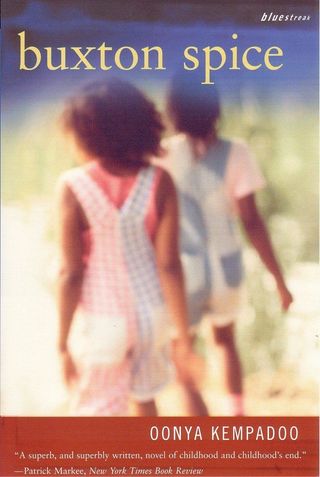
Cover of Buxton Spice

Buxton Spice

Oonya Kempadoo

Original language: English · Paperback · ISBN 978-0807083710

Buxton Spice is Oonya Kempadoo's first novel, set in the fictional coastal town of Tamarind Grove in 1970s Guyana. The story is narrated by Lula, a young girl whose observations carry the reader through a place defined by heat, dust, color, and the lush presence of mango trees. Her home serves as both a school and a community gathering point, and her world is shaped by the canal banks where children play, the eccentric families around her, and the slow shift of seasons and moods in a small settlement.

As Lula moves from childhood into adolescence, her awareness sharpens. She begins to notice the tensions among adults, the emerging desires of older girls, and the consequences that follow. The village sits at a crossroads of cultures, and divisions along lines of race, money, and religion start to press harder on daily life. Political friction builds toward an outbreak of violence that disrupts the rhythms of Tamarind Grove.

Kempadoo writes Lula's voice in language close to the Guyanese coast, grounding the novel in specific textures of place. The narrative follows Lula's growing consciousness as the familiar world she knows becomes harder to read and less certain.

Plot

Told in a girl's voice as she moves from childhood into adolescence, Buxton Spice is the story of the town of Tamarind Grove: its eccentric families, sweeping joys, and sudden tragedies. The novel brings to life 1970s Guyana-a world at a cultural and political crossroads-and perfectly captures a child's keen observations, sense of wonder, and the growing complexity of consciousness that marks the passage from innocence to experience.

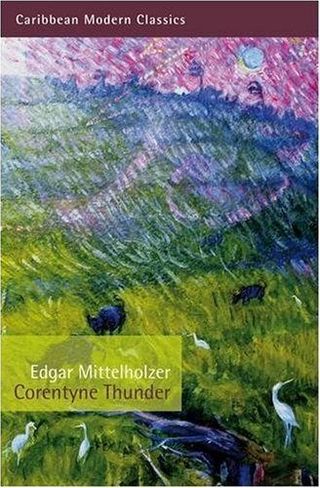
Cover of Corentyne Thunder

Corentyne Thunder

Edgar Mittelholzer

Original language: English · Paperback · ISBN 978-1845231118

Corentyne Thunder, first published in 1941, is set along the Corentyne coast of British Guiana. At its center is Ramgollal, an elderly Indian cow-minder who has spent years of hard labor saving money and building up a herd of cattle. His family stretches across three generations and two marriages, and he measures his place in the world partly through their fortunes. His eldest daughter, from his first marriage, lives as the partner of a prosperous white planter, and their son Geoffry has grown up light-skinned and driven to succeed.

Geoffry's ambitions give Ramgollal quiet pride, but the family's stability fractures when Geoffry becomes involved with Kattree, a younger daughter from Ramgollal's second marriage. The relationship crosses lines within the family that cannot easily be undone, and the consequences reach into every part of Ramgollal's carefully constructed life.

Edgar Mittelholzer wrote the novel as a portrait of the Indian immigrant community in the British Caribbean colonies during the early twentieth century. The book is recognized as one of the first modern novels to center the lives of Indo-Caribbean people in the region, and it draws much of its texture from the flat coastal landscape where cattle and sugarcane shaped daily existence.

Plot

Set on the coast of British Guiana, the story spans three generations and revolves around Ramgollal, an old Indian cow-minder on the Corentyne coast who has worked hard for many years to save money and build his herd of cows. He is proud of his children from two marriages, particularly the daughter of his first marriage, who is married to a well-to-do white planter. Their son Geoffry is light-skinned, ambitious, and poised to make a success of his life, and Ramgollal takes much satisfaction in his grandson’s accomplishments. When Geoffry seduces and impregnates Kattree, his mother’s half-sister, however, Ramgollal’s world begins to fall apart.

Cover of My Bones and My Flute

My Bones and My Flute

Edgar Mittelholzer

Original language: English · Paperback · ISBN 978-1845232955

Milton Woodsley, a painter, accepts an invitation from the wealthy businessman Henry Nevinson to travel upriver into the Berbice forests of Guyana. He believes the trip is about producing paintings for the family. Once the steamer is underway, the Nevinsons mention something stranger: they have been hearing a flute player that nobody else can detect. The simple commission begins to look like something else entirely.

Edgar Mittelholzer was born in British Guiana in 1909, and he gave his 1955 book a subtitle promising a ghost tale told in an old-fashioned way. The wording carries dry humor, though the novel builds real dread as a handful of town people meet forces in the deep forest that resist calm explanation. Under the supernatural pressure sit questions about slavery, individual cruelty, and wrongs that still echo.

The setting shapes the whole book. Barking baboons and unseen movement in the undergrowth surround the visitors, far from familiar town comforts. The isolation of the jungle cottage leaves no easy retreat once events escalate. Mittelholzer wrote twenty-three novels along with two non-fiction titles before his death in 1965, and here he uses a familiar ghost-story shape to look at historical harm.

Plot

Only when he is on board the steamer halfway to their remote destination upriver in Guyana does Milton Woodsley realize that there is more to Henry Nevinson’s invitation to spend time with his family in their jungle cottage. Milton, an artist, thinks he has been invited to do some paintings for Nevinson, a wealthy businessman. But when the Nevinsons mention a flute player that no one else can hear, Woodsley begins to glean that there is more to their stay.

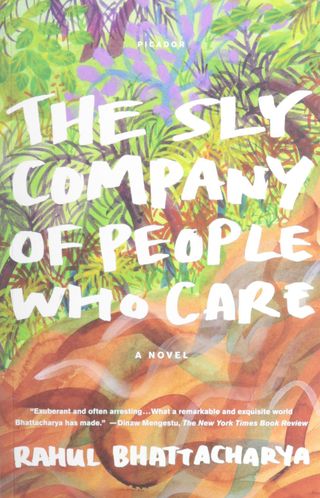
Cover of The Sly Company of People Who Care

The Sly Company of People Who Care

Rahul Bhattacharya

Original language: English · Hardcover · ISBN 978-0374265854

A twenty-six-year-old cricket journalist from Bombay quits his job and moves to Guyana, a small South American country shaped by colonial history and successive waves of migration. The novel follows his time in Georgetown, where old wooden houses stand in varying stages of decay, on coastal sugarcane plantations, and in the dense rainforest interior where diamond hunters work. He becomes absorbed by a society built by descendants of enslaved Africans and indentured laborers, mostly from India, who arrived under British rule.

Rahul Bhattacharya's unnamed narrator is drawn to Guyana partly by cricket, a sport that still connects the Caribbean to South Asia and Britain. But his attention gradually shifts from sport to place and people. He watches how different communities coexist in a country where ethnic and political tensions run close to the surface. The landscape itself plays a central role, from the low-lying coast protected by sea walls to the forested highlands further south.

The story eventually crosses Guyanese borders when the narrator sets out on an adventure with Jan, a spirited companion. The book won the 2012 Royal Society of Literature Ondaatje Prize, which recognizes writing that evokes the spirit of a place.

Plot

In flight from the tame familiarity of home in Bombay, a twenty-six-year-old cricket journalist chucks his job and arrives in Guyana, a forgotten colonial society of raw, mesmerizing beauty. Amid beautiful, decaying wooden houses in Georgetown, on coastal sugarcane plantations, and in the dark rainforest interior scavenged by diamond hunters, he grows absorbed with the fantastic possibilities of this new place where descendants of the enslaved and indentured have made a new world. Ultimately, to fulfill his purpose, he prepares to mount an adventure of his own. His journey takes him beyond Guyanese borders, and his companion will be the feisty, wild-haired Jan.

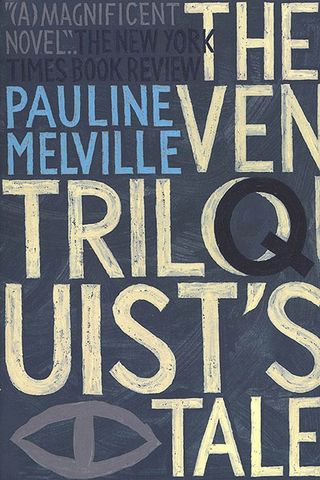
Cover of The Ventriloquist's Tale

The Ventriloquist's Tale

Pauline Melvill

Original language: English · Paperback · ISBN 978-1582340265

The Ventriloquist's Tale by Pauline Melville is set in Guyana, South America, and follows two layered storylines separated by decades. In one strand, a British woman writer travels to Guyana and becomes involved with Chofy McKinnon, a man of Scottish and Indigenous descent who works as a cattle rancher on the savanna. Through their relationship, a buried family story surfaces: the affair between Chofy's ancestors, the siblings Beatrice and Danny, which took place around the time of a solar eclipse in 1919.

The novel moves between the interior savannas and forests of Guyana and its urban life, spanning close to a century. Among its cast is Father Napier, an evangelist whom the local Indigenous community sees as a giant grasshopper. Chofy himself is pulled between the world of the savanna and a possible urban future. The book operates as a story within a story, connecting past and present through a single extended family.

Melville, who has Guyanese roots, uses the structure to explore tensions between nature and culture, rationalism and local belief systems, and the complicated legacies of mixed ancestry in a post-colonial South American setting. The solar eclipse of 1919 anchors the historical timeline and marks a turning point in the family's history.

Plot

Unforgettable characters illuminate the theme and plot: Sonny, the strange, beautiful, and isolated son of Beatrice and Danny, the brother and sister who have a passionate affair at the time of the solar eclipse in 1919; Father Napier, the sandy-haired evangelist whom the Indians perceive as a giant grasshopper; Chofy McKinnon the modern Indian, torn between savanna life and urban future. This is a novel that embraces nearly a century, large in scope but intimate as a whisper, where laughter is never far from the scene of tragedy; a parable of miscegenation and racial elusiveness, of nature, defying culture, magic confronting rationalism and of the eternally rebellious nature of love.

Cover of To Sir with Love

To Sir with Love

E.R. Braithwaite

Original language: English · mass market paperback · ISBN 978-0515105193

E.R. Braithwaite's To Sir with Love is a semi-autobiographical novel set in postwar London. Braithwaite, originally from British Guiana (now Guyana), arrived in England with university qualifications and professional training but found that racial prejudice blocked him from employment in engineering and other fields he was qualified for. Eventually he took a teaching position at a school in London's East End, where he was assigned a class of working-class teenagers with little interest in authority or formal learning.

The book follows Braithwaite's efforts to reach students who are distrustful of adults and accustomed to being dismissed. Rather than relying on strict discipline, he begins treating them with a level of respect they are unaccustomed to receiving, insisting they address one another with courtesy and take responsibility for their own conduct. The classroom becomes a space where questions about race, class, and dignity surface in direct and sometimes uncomfortable ways.

Braithwaite's account is shaped by his position as both an outsider and an authority figure. He faces prejudice not only from the wider society but occasionally from students and their families. The novel was first published in 1959 and draws closely from Braithwaite's own experience during this period.

Plot

To Sir, With Love by E.R. Braithwaite tells the inspiring story of an educated Black man from British Guiana who becomes a teacher in a tough London school after facing racial discrimination in postwar Britain. Through patience, respect, and empathy, he transforms a class of unruly, working-class students into mature young adults who learn self-discipline and dignity. The novel highlights themes of racism, social inequality, and the transformative power of education and human understanding.

Cover of What's Cooking in Guyana

What's Cooking in Guyana

Carnegie School of Home Economics

Original language: English · Paperback · ISBN 978-1405013130

What's Cooking in Guyana is a cookbook compiled by the Carnegie School of Home Economics, an institution based in Guyana. The second edition presents a revised and expanded collection of recipes that reflect the country's varied food traditions. New sections cover Indian and Amerindian dishes, broadening the range of cuisines represented alongside Guyanese staples. The book uses a four-colour format with colour photographs accompanying the recipes.

A background section at the beginning of the book introduces basic facts about the ingredients used in Guyanese cooking. This serves as a practical guide for readers unfamiliar with local produce and culinary products. The recipes are aimed at home cooks, amateur chefs, and professionals interested in working with ingredients and techniques specific to Guyana.

Guyana sits on the northern coast of South America, and its cuisine draws on African, Indian, Amerindian, Chinese, and European influences, shaped by centuries of migration and trade. The inclusion of both Indian and Amerindian recipe sections in this edition reflects two of the country's largest cultural communities and the distinct ingredients and methods each brings to the table.

Plot

There are new recipe sections featuring well-known Indian and Amerindian dishes, and a background to food preparation is also included at the beginning of the book to provide a useful guide to some basic facts about the ingredients that are being used. Accompanied by new colour photographs, this new edition will do much to stimulate interest in, and use of, local Guyanese foods and culinary products that home-makers, amateur cooks and chefs will take a delight in preparing and presenting and, in doing so, develop a culinary skill that is unique to Guyana.

More from Guyana

See the country page for Guyana for its map, facts and largest cities, or browse books from other countries.

Links go to Amazon; Hookito doesn’t sell books. Know a book that belongs here, or spotted a mistake? Write to submissions@hookito.com.

Where to next?

Back to the globe
Hookito landscape illustration