Hookito

Rwanda · Books

Books from Rwanda

6 books from and about Rwanda: what each is about, the plot, and a note from Professor Kogi.

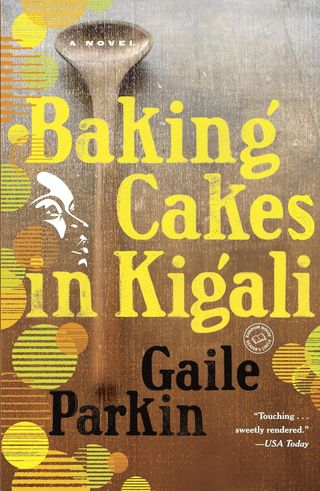
Cover of Baking Cakes in Kigali

Baking Cakes in Kigali

Gaile Parkin

Original language: English · Paperback · ISBN 978-0385343442

Angel Tungaraza runs a small cake-baking business from her kitchen in Kigali, the capital of Rwanda. Customers arrive to place orders for birthdays, weddings, and other occasions, but they often stay longer than expected. Angel listens. Over tea and cake consultations, her visitors share personal troubles, family complications, and quiet hopes they have not spoken aloud elsewhere. Her kitchen becomes a place where people feel safe enough to talk honestly, and Angel, a mother herself, responds with steady warmth and practical thinking.

Gaile Parkin's debut novel is set in a country still shaped by recent history, though the story focuses on daily life rather than large-scale events. Through Angel's interactions, the book follows several overlapping storylines: preparations for an unconventional wedding, a painful mystery connected to Angel's own family, and a series of unlikely bonds forming among the people who pass through her home. The community around Angel is drawn from different backgrounds and nationalities, reflecting the international presence in Kigali during the period.

Parkin, who lived in Rwanda, grounds the novel in specific local textures, from the ingredients Angel uses to the social customs that guide her conversations. The story moves at the pace of its setting, building through accumulation of small exchanges rather than dramatic turns.

Plot

This soaring novel introduces us to Angel Tungaraza: mother, cake baker, pillar of her community, keeper of secrets big and small. Angel’s kitchen is an oasis in the heart of Rwanda, where visitors stop to order cakes but end up sharing their stories, transforming their lives, leaving with new hope. In this vibrant, powerful setting, unexpected things are beginning to happen: A most unusual wedding is planned, a heartbreaking mystery involving Angel’s own family unravels, and extraordinary connections are made—as a chain of events unfolds that will change Angel’s life and the lives of those around her in the most astonishing ways.
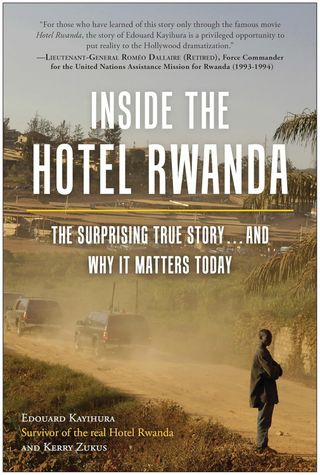
Cover of Inside the Hotel Rwanda

Inside the Hotel Rwanda

Edouard Kayihura, Kerry Zukus

Original language: English · Hardcover · ISBN 978-1937856748

During the 1994 genocide in Rwanda, the Hôtel des Mille Collines in Kigali sheltered more than a thousand people seeking safety. The 2004 film Hotel Rwanda presented the hotel manager, Paul Rusesabagina, as a heroic figure who protected Hutu and Tutsi civilians. Edouard Kayihura, who spent those hundred days inside the building, gives a sharply different account, written with Kerry Zukus.

Kayihura describes growing up in a society divided along ethnic lines and recounts his path to the hotel, where he expected protection. Alongside his own memoir he gathers testimony from other survivors and from UN peacekeepers. His account presents Rusesabagina as someone who profited from the crisis, demanding payment from those seeking refuge and threatening people who could not pay. It also states that the hotel's owners urged him to stop.

The result works as a survivor's record and as a political argument, since Rusesabagina later used his international fame in Rwandan opposition politics. The book raises questions about how accounts of mass violence change when commercial film shapes them, and about who decides which version of an event becomes public memory.

Plot

In Inside the Hotel Rwanda, survivor Edouard Kayihura tells his own personal story of what life was really like during those harrowing 100 days within the walls of that infamous hotel and offers the testimonies of others who survived there, from Hutu and Tutsi to UN peacekeepers. Kayihura tells of his life in a divided society and his journey to the place he believed would be safe from slaughter. Inside the Hotel Rwanda exposes Paul Rusesabagina as a profiteering, politically ambitious Hutu Power sympathizer who extorted money from those who sought refuge, threatening to send those who did not pay to the genocidaires, despite pleas from the hotel's corporate ownership to stop.

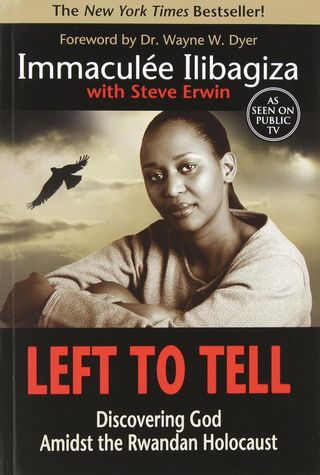
Cover of Left to Tell: Discovering God Amidst the Rwandan Holocaust

Left to Tell: Discovering God Amidst the Rwandan Holocaust

Immaculee Ilibagiza, Steve Erwin

Original language: English · Paperback · ISBN 978-1401908973

In 1994, Rwanda descended into a genocide that killed nearly a million people, most of them Tutsi, in about three months. Immaculee Ilibagiza, a young Tutsi woman, lost most of her family. Her memoir, co-written with Steve Erwin, recounts how she survived by hiding for 91 days in a small bathroom belonging to a local pastor, together with seven other women. The space was so cramped that the women stayed nearly motionless and silent.

The book follows Ilibagiza from her childhood in a close family to the sudden collapse of ordinary life when the violence began. Much of the account centers on the weeks in hiding, where fear, hunger, and uncertainty shaped every hour. During that time she turned intensely to prayer, and the memoir traces how her faith changed in confinement.

After emerging from hiding, Ilibagiza eventually chose to confront and forgive those responsible for the deaths in her family. The book addresses that decision directly, placing it within her understanding of faith and unconditional love rather than treating it as an easy or expected step.

Plot

Immaculee Ilibagiza grew up in a country she loved, surrounded by a family she cherished. But in 1994 her idyllic world was ripped apart as Rwanda descended into a bloody genocide. Immaculee’s family was brutally murdered during a killing spree that lasted three months and claimed the lives of nearly a million Rwandans. Incredibly, Immaculee survived the slaughter. For 91 days, she and seven other women huddled silently together in the cramped bathroom of a local pastor while hundreds of machete-wielding killers hunted for them. It was during those endless hours of unspeakable terror that Immaculee discovered the power of prayer, eventually shedding her fear of death and forging a profound and lasting relationship with God. She emerged from her bathroom hideout having discovered the meaning of truly unconditional love—a love so strong she was able seek out and forgive her family’s killers.

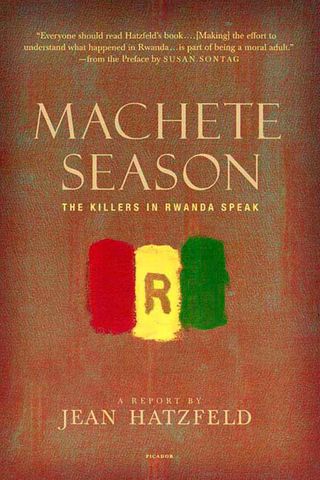
Cover of Machete Season

Machete Season

Jean Hatzfeld

Original language: French · Paperback · ISBN 978-0312425036

Between April and May 1994, approximately 800,000 Tutsi people in Rwanda were killed by Hutu citizens over a period of weeks. The rate of killing reached roughly 10,000 people per day, most struck down with machetes. Machete Season is built from interviews that journalist Jean Hatzfeld conducted with nine Hutu men, all now imprisoned, who took part in the violence. The men came from the same district and knew one another. In their region, an estimated 50,000 of the 59,000 Tutsi inhabitants were killed.

Hatzfeld, a veteran foreign correspondent, recorded how these men described the organization of the killings, their own participation, and their reactions during and after. Most of the interviewees were farmers before the genocide. What makes the book unusual is its direct reliance on the perpetrators' own words and recollections. Hatzfeld does not treat their statements as settled truth. He notes that such testimony raises difficult questions even as it appears to offer explanations.

The book sits within Hatzfeld's broader work on Rwanda, which also includes accounts from survivors. Its focus on a small group from one area gives the material a specific, local scale rather than a purely statistical view of the 1994 genocide.

Plot

In April-May 1994, 800,000 Rwandan Tutsis were massacred by their Hutu fellow citizens--about 10,000 a day, mostly being hacked to death by machete. In Machete Season, the veteran foreign correspondent Jean Hatzfeld reports on the results of his interviews with nine of the Hutu killers. They were all friends who came from a single region where they helped to kill 50,000 out of their 59,000 Tutsi neighbors, and all of them are now in prison, some awaiting execution. It is usually presumed that killers will not tell the truth about their brutal actions, but Hatzfeld elicited extraordinary testimony from these men about the genocide they had perpetrated. He rightly sees that their account raises as many questions as it answers. Adabert, Alphonse, Ignace, and the others (most of them farmers) told Hatzfeld how the work was given to them, what they thought about it, how they did it, and what their responses were to the bloodbath.

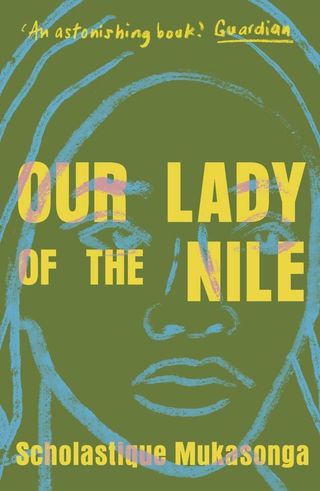
Cover of Our Lady of the Nile

Our Lady of the Nile

Scholastique Mukasonga

Original language: French · Paperback · ISBN 978-1911547884

Set in 1970s Rwanda, Our Lady of the Nile by Scholastique Mukasonga takes place at a fictional girls' boarding school positioned high on a ridge near the source of the Nile. The school exists to shape its students into the country's future female elite, kept apart from the tensions building in the world below. Colonial white nuns oversee their education, and a racial quota allows only two Tutsi students for every twenty enrolled.

Gloriosa, the school's dominant Hutu student, begins to adopt the political prejudices of her parents, while Tutsi classmates Veronica and Virginia push back, searching for space to claim their own identity and history. The novel was originally published in French as Notre-Dame du Nil by Gallimard in 2012. Mukasonga, herself a Rwandan writer and genocide survivor, sets her story fifteen years before the 1994 genocide, using the enclosed school grounds and a long rainy season to compress the country's mounting ethnic divisions into a small, observable space.

Within the school walls, friendship, curiosity, fear, and persecution develop side by side. The boarding school operates as a contained version of the broader society, where political loyalty, ethnic identity, and personal ambition collide among students still forming their sense of the world.

Plot

Parents send their daughters to Our Lady of the Nile to be moulded into respectable citizens, and to protect them from the dangers of the outside world. The young ladies are expected to learn, eat, and live together, presided over by the colonial white nuns. It is fifteen years prior to the 1994 Rwandan and a quota permits only two Tutsi students for every twenty pupils. As Gloriosa, the school's Hutu queen bee, tries on her parents' preconceptions and prejudices, Veronica and Virginia, both Tutsis, are determined to find a place for themselves and their history. In the struggle for power and acceptance, the lycée is transformed into a microcosm of the country's mounting racial tensions and violence. During the interminable rainy season, everything slowly unfolds behind the school's closed doors: friendship, curiosity, fear, deceit, and persecution.

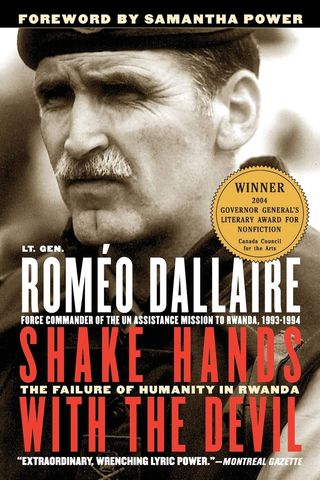
Cover of Shake Hands with the Devil

Shake Hands with the Devil

Roméo Dallaire

Original language: English, French · Paperback · ISBN 978-0786715107

In 1993, Canadian lieutenant-general Roméo Dallaire was appointed force commander of the United Nations Assistance Mission for Rwanda, known as UNAMIR. His task was to support a peace process between the country's warring factions. What followed bore little resemblance to that mandate. Between April and July 1994, about eight hundred thousand Rwandans were killed in a genocide that unfolded with extraordinary speed. Dallaire and a small UN contingent remained in the country, and his requests for reinforcements went unanswered.

Shake Hands with the Devil is his account of those months, told from the position of the commander on the ground. Dallaire sets out the operational limits his force faced, the political decisions taken at the UN Security Council, and the choices of governments that did not intervene. He also traces his path from Cold War officer to a retired general living with post-traumatic stress disorder.

Much of the book takes place in Kigali and surrounding regions of Rwanda, a small landlocked country in the African Great Lakes area. Alongside the record of the mission, Dallaire describes the effort to shelter civilians at sites his troops could reach, and the gap between what a peacekeeping mandate allowed and what the situation required.

Plot

When Romeo Dallaire was called on to serve as force commander of the UN Assistance Mission for Rwanda, he believed that his assignment was to help two warring parties achieve the peace they both wanted. Instead, he was exposed to the most barbarous and chaotic display of civil war and genocide in the past decade, observing in just one hundred days the killings of more than eight hundred thousand Rwandans. With only a few troops, his own ingenuity and courage to direct his efforts, Dallaire rescued thousands, but his call for more support from the world body fell on deaf ears. In Shake Hands with the Devil, General Dallaire recreates the awful history the world community chose to ignore. He also chronicles his own progression from confident Cold Warrior to devastated UN commander, and finally to retired general struggling painfully, and publicly, to overcome posttraumatic stress disorder -- the highest-ranking officer ever to share such experiences with readers.

More from Rwanda

See the country page for Rwanda for its map, facts and largest cities, or browse books from other countries.

Links go to Amazon; Hookito doesn’t sell books. Know a book that belongs here, or spotted a mistake? Write to submissions@hookito.com.

Where to next?

Back to the globe
Hookito landscape illustration