Hookito

Belarus · Books

Books from Belarus

8 books from and about Belarus: what each is about, the plot, and a note from Professor Kogi.

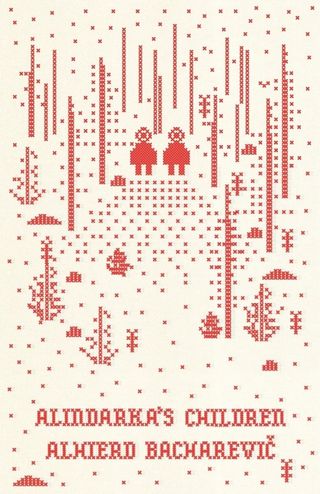
Cover of Alindarka's Children: Things Will Be Bad

Alindarka's Children: Things Will Be Bad

Alhierd Bacharevic

Original language: Belarusian · Paperback · ISBN 978-0811231961

In a camp at the edge of a forest, children are subjected to drugs, therapy, and coercion designed to make them forget their own language. Among them are Alicia and her brother Avi, whose perceptions blur under the influence of small berries that warp the mind. Their father manages to rescue them from the camp, but the two children slip away from him and venture into the forest on their own.

What follows is a dark, fairy-tale-shaped encounter with a series of threatening figures. The forest holds Granmaw, who lives in a hovel, a character called McFinnie who has betrayed his own language, a border guard named Bannock the Bogill who is also a murderer, and a wolf. The landscape shifts between natural beauty and menace, with timber songs and green scales playing out like a kaleidoscope through Avi's altered vision.

Alhierd Bacharevic is a Belarusian writer, and this novel is described as his first book to appear in English. Language suppression sits at the centre of the story, set against a landscape where borders, forests, and adults with authority each pose distinct dangers to children trying to keep hold of words they have been ordered to forget.

Plot

It’s not Avi’s fault, it’s those sourish, mind-bending little berries that are to blame, those tiny wee spheres. Bilberries, bletherberries that befuddle the mind, babbleberries that give you a kick. The beautiful green forest scales, the timber songs, play out like a kaleidoscope before his eyes. In a camp at the edge of a forest children are trained to forget their language through drugs, therapy, and coercion. Alicia and her brother Avi are rescued by their father, but they give him the slip and set out on their own. In the forest they encounter a cast of villains: the hovel-dwelling Granmaw, the language-traitor McFinnie, the border guard and murderer Bannock the Bogill, and a wolf.

Cover of King Stakh's Wild Hunt

King Stakh's Wild Hunt

Uladzimir Karatkevich

Original language: Belarusian · Hardcover · ISBN 978-1909156111

On a rainy evening in the Belarusian countryside, a young folklorist named Andrey Belaretsky takes shelter in a remote castle owned by the Yanovsky family. There he meets Nadzeya Yanovsky, the last living descendant of an old noble line. Nadzeya is convinced that a centuries-old curse, triggered by the betrayal of her ancestor Roman Yanovsky the Old, has been claiming the lives of her relatives across twenty generations. She believes her own death is approaching.

The castle and its surroundings carry an atmosphere of sustained dread. Figures known as the Little Man and the Lady-in-Blue have been spotted near the grounds, and out in the fields a spectral procession called the Wild Hunt has appeared. Belaretsky, trained to study folklore rather than fear it, begins investigating the strange events. The people he encounters in the surrounding marshlands are fearful, secretive, or desperate, and the landscape itself seems to close in around the story.

Uladzimir Karatkevich wrote the novel in Belarusian, and the setting draws on the history and rural geography of Belarus. The book works as both a Gothic mystery and a reflection on the fate of a declining noble culture in a changing country. Belaretsky's scientific outlook collides repeatedly with local superstition as he tries to separate real danger from legend.

Plot

On a late rainy evening a young scientist, folklorist Andrey Belaretsky finds himself lodging overnight in a mysterious castle belonging to the Yanovskys, an old noble family. There he meets the hostess of the house, Nadzezhda Yanovsky, a neurotic young thing and the last descendant of her family. Fears and terrible premonitions, for which she believes to have substantial grounds, overpower her. The act of betrayal by her far ancestor Roman Yanovsky the Old brought the curse on the family for twenty generations to come, and has since claimed lives of all the young noble's relatives under bizarre and unnatural circumstances. Nadzeya expects her nearing demise in terror, moreover supported by the recent signs of the upcoming tragedy. Ghosts of the Little Man and the Lady-in-Blue were sighted wandering around the castle, and out in the fields from time to time shows itself the Wild Hunt.

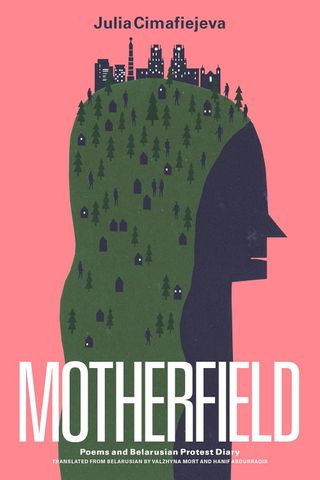
Cover of Motherfield

Motherfield

Julia Cimafiejeva

Original language: Belarusian · Paperback · ISBN 978-1646052257

Julia Cimafiejeva grew up in rural Belarus, in a area that was reclassified as a Chernobyl zone during her childhood. Her poetry collection Motherfield opens with a diary section tracking events in Belarus after the disputed 2020 presidential election. The entries record protests, encounters with police, and the poet's responses to the detention of people close to her. Fear, guilt, and despair run through these pages alongside a persistent will to act and to speak.

The poems connect personal experience to wider patterns of authoritarian control and ecological damage. Cimafiejeva writes about patriarchal structures and state power as forces that shape daily life in concrete, physical ways. The collection also addresses questions of language, readership, and what it means to insist on self-determination when the space for it is shrinking. The book follows the poet toward a decision to leave Belarus and continue writing from exile.

Motherfield sits at the intersection of political witness and private record. The rural landscape marked by nuclear fallout and the urban landscape marked by state violence become linked territories in the collection, each bearing consequences that outlast any single political moment.

Plot

Julia Cimafiejeva was born in an area of rural Belarus that became a Chernobyl zone when she was a child. The book opens with a poet’s diary that records the course of violence unfolding in Belarus since the 2020 presidential election. It paints an intimate portrait of the poet’s struggle with fear, despair, and guilt as she goes to protests, escapes police, longs for readership, learns about the detention of family and friends, and ultimately chooses life in exile.

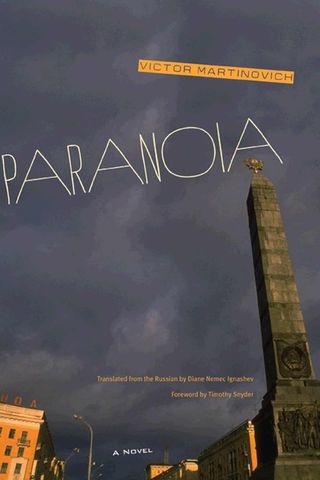
Cover of Paranoia

Paranoia

Victor Martinovich

Original language: Belarusian · Paperback · ISBN 978-0810128767

Paranoia by Victor Martinovich is set in an unnamed city and country that closely resemble Minsk and Belarus, though neither is explicitly identified. The story follows a young man whose former lover has vanished under unclear circumstances, and a young woman who is involved with the minister of state security. Their romance unfolds under the pressure of a surveillance state where private life and political control are difficult to separate.

The novel explores how authoritarian power operates not only through force but through psychological infiltration, shaping the fears and choices of ordinary people from the inside. Martinovich draws on the tradition of dissident literature while grounding his characters in a recognizably post-Soviet, globally connected environment. The book was banned immediately after publication, a detail that underscores the political sensitivity of its subject matter.

Martinovich, a Belarusian author, writes in a style that keeps the setting deliberately unspecified, allowing the story to function both as a portrait of a particular political reality and as a broader study of how dictatorships maintain themselves. The central relationship carries much of the tension, as personal trust becomes almost impossible when the state occupies every private space.

Plot

Although Minsk and Belarus are never mentioned, they are clearly the author’s inspiration for the novel’s setting. The plot focuses on a doomed romance between a young man whose former lover has disappeared and a young woman whose other lover is the minister of state security. The novel evokes classic dissident literature while artfully depicting the post-Soviet, globalized world.

Cover of Red Crosses

Red Crosses

Sasha Filipenko

Original language: Russian · Paperback · ISBN 978-1609456931

In a Minsk apartment building, two neighbors form an unexpected bond. Tatiana Alexeyevna, a woman past ninety, is losing her memory to Alzheimer's disease. Alexander, a young man carrying a private grief, has recently moved in next door. As Tatiana's hold on her past weakens day by day, she begins telling Alexander about her life, racing against the illness that is steadily erasing everything she has witnessed.

Her account stretches across much of the twentieth century in the Soviet Union and its aftermath. It touches on Stalin-era repression, the machinery of denunciation and punishment, and the small acts of endurance that kept people alive through decades of political fear. The novel's title refers to the Red Cross organization and its entanglement with Soviet authorities during periods when prisoners and their families had little outside protection. Filipenko, a Belarusian author writing in Russian, structures the story as a conversation between two people at very different stages of loss.

The two timelines run in opposite directions. Tatiana is trying to pass on what she remembers before it disappears, while Alexander is struggling with a wound he would rather not carry. Their pact against forgetting gives the novel its central tension, binding personal grief to historical memory.

Plot

One struggles not to forget, while the other would like nothing better. Tatiana Alexeyevna is an old woman, over ninety, rich in lived experience, and suffering from Alzheimer’s. Every day, she loses a few more of her irreplaceable memories. Alexander is a young man whose life has been brutally torn in two. Tatiana tells her young neighbor her life story, a story that encompasses the entire Russian 20th century with all its horrors and hard-won humanity. Little by little, the old woman and the young man forge an unlikely friendship and make a pact against forgetting.

Cover of The Belarusian Cookbook

The Belarusian Cookbook

Alexander Bely

Original language: English · Hardcover · ISBN 978-0781812092

The Belarusian Cookbook by Alexander Bely collects over 190 recipes drawn from the culinary history of Belarus. Bely, a historian born in the country, has reconstructed dishes from both peasant kitchens and aristocratic tables, aiming to document a national food tradition that has often been overshadowed by its larger neighbors. The recipes come with step-by-step instructions and are accompanied by cultural and historical notes that place each dish in context.

The book reflects the varied influences that have shaped Belarusian cooking. Jewish culinary traditions and the foodways of neighboring regions appear alongside distinctly local preparations. Bely also includes holiday menus and guidance on pantry essentials, giving the collection a practical structure beyond individual recipes. Ingredients and techniques common in Belarusian households, such as root vegetables, grains, dairy, and preserved foods, recur throughout.

Belarus sits between Poland, Lithuania, Latvia, Russia, and Ukraine, a geographic position that has made its cuisine a meeting point for several culinary traditions. By organizing recipes from different social classes and cultural communities, Bely treats the cookbook as a form of historical record, preserving dishes that might otherwise fade from everyday use.

Plot

The Belarusian Cookbook by Alexander Bely presents over 190 authentic recipes that capture the country’s culinary heritage, from simple peasant fare to aristocratic dishes. Alongside step-by-step instructions, Bely weaves in cultural and historical context, highlighting influences from Jewish traditions and neighboring regions. The book also includes holiday menus and pantry essentials, making it both a practical guide and a cultural record of Belarus’s rich food traditions.

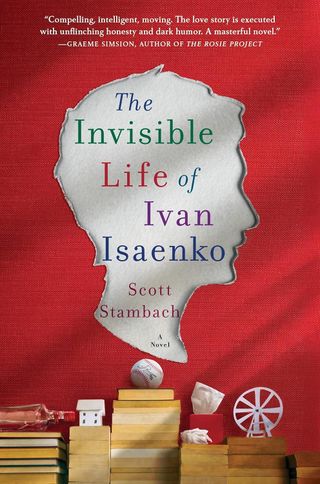
Cover of The Invisible Life of Ivan Isaenko

The Invisible Life of Ivan Isaenko

Scott Stambach

Original language: English · Hardcover · ISBN 978-1250081865

Ivan Isaenko is seventeen and has never lived anywhere except a hospital for gravely ill children in the Belarusian city of Mazyr. Born with severe physical deformities, he is sharp-minded, widely read, and deeply bored. His days follow one pattern, so he fills the hours by turning the people and routines around him into a private game, observing and manipulating from a careful distance. His narration is wry and self-aware, shaped by someone with little contact beyond the hospital walls.

That distance collapses when a new patient named Polina arrives. She disrupts his habits, takes his books, and earns the affection of the nurses. Ivan resents her at first, but her presence pulls him out of the detachment he has relied on for years. A relationship forms between them, fragile and urgent, set against the realities of serious illness. For the first time, Ivan finds himself wanting something beyond survival.

Scott Stambach sets the novel in a specific institutional setting in southeastern Belarus, and the story moves between dark comedy and plain description of serious illness. Ivan's voice carries it: guarded, perceptive, and quick to notice how the staff and other residents behave around him when they think no one is watching.

Plot

Seventeen-year-old Ivan Isaenko is a life-long resident of the Mazyr Hospital for Gravely Ill Children in Belarus. For the most part, every day is exactly the same for Ivan, which is why he turns everything into a game, manipulating people and events around him for his own amusement. Until Polina arrives. She steals his books. She challenges his routine. The nurses like her. She is exquisite. Soon, he cannot help being drawn to her and the two forge a romance that is tenuous and beautiful and everything they never dared dream of. Before, he survived by being utterly detached from things and people. Now, Ivan wants something more: Ivan wants Polina to live.

Cover of The Unwomanly Face of War

The Unwomanly Face of War

Svetlana Alexievich

Original language: Russian · Paperback · ISBN 978-0399588747

Svetlana Alexievich, a Belarusian writer awarded the Nobel Prize in Literature in 2015, spent years recording the spoken testimony of Soviet women who served in the Second World War. More than a million took part, working as nurses, doctors, pilots, tank drivers, snipers, and machine-gunners. They served at the front, behind it, and inside occupied territory, and after the victory their accounts were left out of official history.

To gather these voices, Alexievich traveled thousands of miles and visited more than a hundred towns. The book collects what the women remembered in their own speech, ordered as a chorus of separate accounts rather than a single narrator. Instead of strategy or politics, attention rests on the practical texture of daily life under fire, the small particulars that formal records usually omit.

The Russian original appeared under a title stating that war has no woman's face, and this English edition brought the work to readers who had waited long for a full translation. Alexievich has built other books the same way, interviewing many people and setting their recollections side by side so that one shared experience is described from dozens of positions.

Plot

In The Unwomanly Face of War, Alexievich chronicles the experiences of the Soviet women who fought on the front lines, on the home front, and in the occupied territories. These women—more than a million in total—were nurses and doctors, pilots, tank drivers, machine-gunners, and snipers. They battled alongside men, and yet, after the victory, their efforts and sacrifices were forgotten. Alexievich traveled thousands of miles and visited more than a hundred towns to record these women’s stories. Together, this symphony of voices reveals a different aspect of the war—the everyday details of life in combat left out of the official histories.

More from Belarus

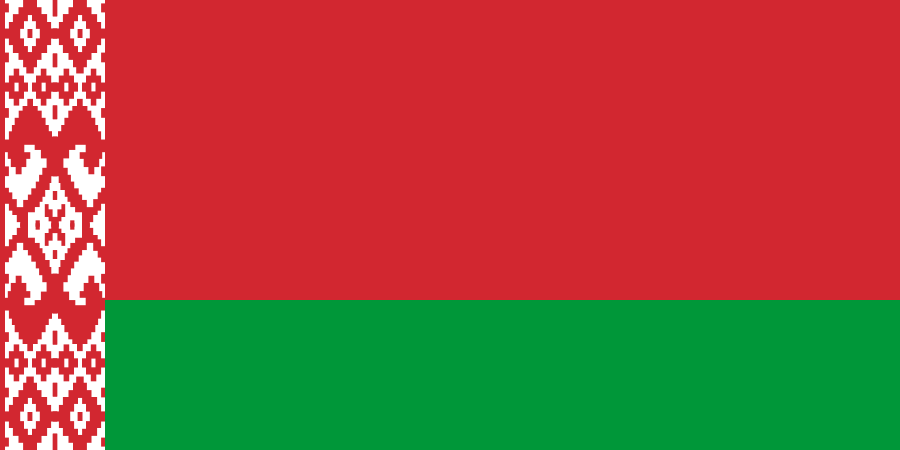
See the country page for Belarus for its map, facts and largest cities, or browse books from other countries.

Links go to Amazon; Hookito doesn’t sell books. Know a book that belongs here, or spotted a mistake? Write to submissions@hookito.com.

Where to next?

Back to the globe
Hookito landscape illustration