
Hookito

Eritrea · Books

Books from Eritrea

6 books from and about Eritrea: what each is about, the plot, and a note from Professor Kogi.

Cover of African Titanics

African Titanics

Abu Bakr Hamid Kahal

Original language: Arabic · Paperback · ISBN 978-1850772736

African Titanics follows Abdar, an Eritrean migrant who sets out on a northward route toward the Mediterranean. Written by Abu Bakr Hamid Kahal, the novel traces Abdar's path through the landscapes and border crossings that thousands of real migrants have faced on similar routes. The title draws a parallel between the overcrowded vessels carrying people across the sea and the famous ship whose passengers trusted their lives to a journey that turned fatal.

Along the way, the story connects Abdar's experience to older figures of travel and exploration, placing contemporary migration within a longer history of movement across and out of Africa. The dangers Abdar encounters are specific and grounded: the desert, the smugglers, the sea. Kahal uses fiction to give shape to a transit that is often reduced to statistics or brief news coverage.

The book is set against the particular pressures that drive people from Eritrea, a small country on the Horn of Africa bordered by Sudan, Ethiopia, and Djibouti, with a Red Sea coastline. Kahal's narrative stays close to Abdar's point of view, tracking the personal cost of each stage of the route north.

Plot

The novel follows the adventures of Eritrean migrant Abdar as he journeys north, connecting today’s migrants with legendary adventurers of the past.
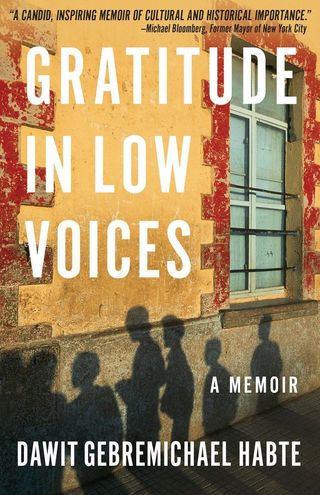

Cover of Gratitude in Low Voices

Gratitude in Low Voices

Dawit Gebremichael Habte

Original language: English · Hardcover · ISBN 978-0795350276

Dawit Gebremichael Habte grew up in Eritrea during the long conflict between Eritrea and Ethiopia. As a teenager, he and his sisters crossed into Kenya without parents or legal documents, facing the kinds of abuse and neglect that many refugees encounter when they travel without protection. The book follows Dawit from that difficult departure through his eventual arrival in the United States, where he was granted asylum while still a young person.

In the U.S., Dawit pursued his education with determination and was admitted to Johns Hopkins University. He went on to work as a software engineer at Bloomberg, where he eventually gained support from Michael Bloomberg to return to Eritrea and create business opportunities for others. The memoir traces how family bonds, outside help, and personal persistence shaped his path from a displaced teenager to someone able to contribute to his country of origin after roughly thirty years of war.

The title points to the book's recurring concern with quiet, sustained gratitude toward the people who helped along the way. Dawit's account addresses what it means to care for family across borders and how to respond to those who assist people in vulnerable circumstances.

Plot

Dawit Gebremichael Habte fled his homeland of Eritrea as a teenager. In the midst of the ongoing Eritrean-Ethiopian war, Dawit and his sisters crossed illegally into Kenya. Without their parents or documents to help their passage, they experienced the abuse and neglect known by so many refugees around the world. But Dawit refused to give up. He stayed resilient and positive. Journeying to the United States under asylum—and still a boy—Dawit found a new purpose in an unfamiliar land. Against impossible odds, he studied hard and was accepted to Johns Hopkins University, eventually landing a job as a software engineer at Bloomberg. After a few years, with the support of Michael Bloomberg himself, Dawit returned to his homeland to offer business opportunities for other Eritreans. Dawit found a way to help his ancestral land emerge from thirty years of debilitating war.

Cover of Heart of Fire

Heart of Fire

Senait Mehari

Original language: English · Paperback · ISBN 978-1861979131

Senait Mehari was born in 1974 to an Ethiopian mother and an Eritrean father. Abandoned by both parents, she spent her first years in a state orphanage before returning to her father's care. When war between Eritrea and Ethiopia escalated, her father handed Senait and two of her stepsisters over to the Eritrean Liberation Front. She was six years old. For three years she lived in a training camp for child soldiers, where she was taught to handle a rifle and endured hunger, illness, and physical punishment.

In 1983, an uncle organized an escape that brought the sisters to Sudan. They lived in Khartoum for four years before their father, now in Germany, arranged for them to join him there. Life in Germany brought its own difficulties. By the age of fourteen, Senait had left home and was living on the streets. She bought a cheap keyboard and began teaching herself music, eventually building a career as a soul singer.

Heart of Fire is Mehari's account of these events, spanning the orphanage, the military camp, displacement across borders, and the slow process of finding stability in a new country. The memoir traces a childhood shaped by decisions made by adults during wartime, set against the broader conflict over Eritrean independence that lasted decades.

Plot

Born in 1974 to an Ethiopian mother and an Eritrean father, Senait Mehari was abandoned by her parents and spent her early years in a state orphanage. After four years she returned to her father, but as the onset of war threatened he made the shocking decision to give Senait and two of her stepsisters to the rebel troops of the Eritrean Liberation Front. Six-year-old Senait went on to spend three harrowing years in a training camp for child soldiers. She witnessed first-hand the brutalities of war, learned how to use a rifle and endured hunger, sickness, and beatings. In 1983, she and her sisters were rescued when her uncle arranged a daring escape to Sudan. After four years of living in Khartoum the sisters were summoned to Germany by their father, where life continued to prove difficult. At age 14 Senait left home to live on the streets, bought herself a cheap keyboard and began playing music.

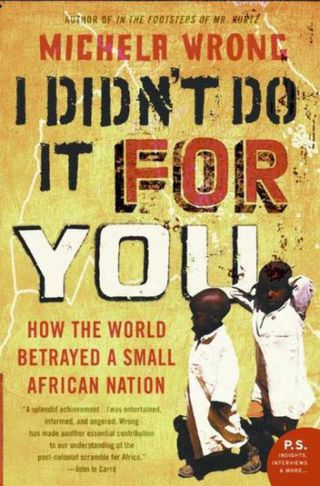
Cover of I Didn't Do It for You: How the World Betrayed a Small African Nation

I Didn't Do It for You: How the World Betrayed a Small African Nation

Michela Wrong

Original language: English · Paperback · ISBN 978-0060780937

Michela Wrong traces the modern history of Eritrea through the succession of foreign powers that occupied, exploited, or manipulated the small Horn of Africa nation. Italy under Mussolini treated it as a staging ground for imperial expansion into Ethiopia. After the Second World War, Britain administered the territory and dismantled much of its industrial infrastructure. The United States later established a signals intelligence facility there during the Cold War, while the Soviet Union backed Ethiopia in a broader contest for regional influence.

Each chapter follows a different period of outside intervention, building a layered account of how strategic interests repeatedly overrode the concerns of the people living on the ground. Eritrea fought one of the longest guerrilla wars in recorded history before achieving independence from Ethiopia in 1993, and Wrong examines how that prolonged struggle shaped the country's political culture and collective memory.

Wrong, a journalist who reported extensively from East Africa, draws on archival research and interviews conducted inside Eritrea and abroad. The book connects specific episodes, such as the fate of a massive American listening post on the Eritrean highlands, to broader patterns of Cold War rivalry and colonial administration across the continent.

Plot

Scarred by decades of conflict and occupation, the craggy African nation of Eritrea has weathered the world's longest-running guerrilla war. The dogged determination that secured victory against Ethiopia, its giant neighbor, is woven into the national psyche, the product of cynical foreign interventions. Fascist Italy wanted Eritrea as the springboard for a new, racially pure Roman empire; Britain sold off its industry for scrap; the United States needed a base for its state-of-the-art spy station; and the Soviet Union used it as a pawn in a proxy war.

Cover of Quick & Simple: Eritrean & Ethiopian Recipes

Quick & Simple: Eritrean & Ethiopian Recipes

Gebriela Birhane, Amarech Tewolde

Original language: English · Paperback · ISBN 979-8586631671

Quick and Simple: Eritrean and Ethiopian Recipes is a short cookbook by Gebriela Birhane and Amarech Tewolde that gathers ten dishes from the shared cooking traditions of the two countries. It is written for beginners, with recipes chosen for speed and ease rather than specialist technique, and several are marked as vegan or gluten free. Plant-based cooking has a long history in both places, where Orthodox Christian fasting periods shaped ordinary meals.

The recipes are credited to Mama Ami, described as having more than fifty years of experience cooking Eritrean and Ethiopian food. Photographs of the finished plates appear alongside the instructions, together with short stories that give the dishes context. The framing is domestic and practical, closer to a family kitchen record than to a formal culinary reference or a regional encyclopedia.

Eritrean and Ethiopian kitchens share a great deal, including injera, a spongy fermented flatbread that serves as both plate and utensil, and berbere, a spice blend built on dried chili peppers, fenugreek and other ground seasonings. This collection keeps to a focused set of ten preparations rather than surveying the many regional styles found across either country.

Plot

Bring the warm vibrant flavors of Eritrea and Ethiopia to your table in this beginners guide! In this cookbook, you'll learn 10 signature Eritrean/Ethiopian recipes which are quick and simple to make. Full of warmth, love and authentic flavors, these East African dishes will make you the envy of your friends and family! With over 50 years of experience cooking Ethiopian & Eritrean food, Mama Ami takes you on an East African food adventure through photography of beautiful dishes and stories.

Cover of The Consequences of Love

The Consequences of Love

Sulaiman Addonia

Original language: English · Hardcover · ISBN 978-1400067992

Naser is a young Eritrean immigrant in Jeddah, sent to Saudi Arabia with his younger brother to escape war at home. They live with a conservative uncle, though daily life is governed by the religious police, who enforce strict separation between men and women. Walls divide mosques, panels partition buses, and women move through the city covered in the black abaya. He stays behind to work through the hot season.

His routine shifts when a folded note lands at his feet. It comes from a girl he has never seen or heard speak. She tells him to find her by looking for pink shoes beneath the hem of her abaya. A secret exchange of letters follows, carried out against rules that punish contact between unrelated men and women with public beating or death.

Addonia's debut novel draws its tension from small physical details: paper, ink, a glimpse of colour, and the narrow gaps where two people can briefly stand near each other. The author was born in Eritrea and lived as a refugee in Sudan and Saudi Arabia, and the book's picture of exile, work, and surveillance is built from that ground.

Plot

Naser and his younger brother were sent to Saudi Arabia to avoid the war back home, but though they live with their conservative Muslim uncle they remain under the watchful, wrathful eyes of the religious police, who monitor the community’s every action, govern the near indestructible boundaries between men and women–walls in mosques, panels on buses, separate visiting quarters in houses, and, of course, the black veil, or abaya, that adorns the women–and punish any disobedience by public beating or death. But a splash of color arrives in Naser’s world when unexpectedly a small piece of paper is dropped at his feet. It is a love note from a girl whose face he has never seen and whose voice he has never heard. To identify her among the sea of veiled women, she instructs him to look for a pair of pink shoes peeking out from under her draped abaya. Intrigued and encouraged, Naser rebels against Wahhabist Islamic convention and begins a clandestine correspondence with the girl. Yet even as the barriers that divide them begin to crumble under the weight of their passionate prose and devotion, the lovers’ illicit affair will face the ultimate and most heartrending test.

More from Eritrea

See the country page for Eritrea for its map, facts and largest cities, or browse books from other countries.

Links go to Amazon; Hookito doesn’t sell books. Know a book that belongs here, or spotted a mistake? Write to submissions@hookito.com.

Where to next?

Back to the globe
Hookito landscape illustration