
Hookito

Georgia · Books

Books from Georgia

6 books from and about Georgia: what each is about, the plot, and a note from Professor Kogi.

Cover of Bread and Ashes: A Walk Through the Mountains of Georgia

Bread and Ashes: A Walk Through the Mountains of Georgia

Tony Anderson

Original language: English · Paperback · ISBN 978-0099437871

In the summer of 1998 Tony Anderson set out to walk across the mountains of Georgia, moving from the border with Azerbaijan westward to Svaneti. He wanted to reach the highland communities of the Tush, Khevsurs, Ratchuelians and Svans, and to see whether these separate groups shared elements of a single mountain culture. His route ran through high valleys where paths and passes matter more than roads.

The walk also tested an old geographic idea: that the Caucasus range formed an unbroken wall between the Black Sea and the Caspian, sealing one side from the other. Anderson found instead communities where older customs and local beliefs continued through decades of Soviet rule and through the instability that followed the end of the Soviet Union in 1991.

Alongside the 1998 trek, Anderson returns to earlier visits and to Georgia's recent politics, including the move to independence and the conflicts in Abkhazia and South Ossetia. The account moves between close observation of daily life in small settlements and wider questions about how mountain terrain shapes borders and loyalties. Tusheti lies in the east, Svaneti in the far west, weeks apart on foot.

Plot

Tony Anderson set out in the summer of 1998 to walk through Georgia. He wanted particularly to visit the Georgian mountain tribes - Tush, Khevsurs, Ratchuelians, and Svans - to discover if they shared a common mountain culture, and to test the old idea of the Caucasus as an impenetrable barrier from sea to sea. From Azerbaijan to Svaneti, Anderson found communities where the old customs and beliefs still triumphantly survive, despite years of Communist oppression and the terrible uncertainties since the collapse of the Soviet Union.
Cover of Kvachi

Kvachi

Mikheil Javakhishvili

Original language: Georgian · Paperback · ISBN 978-1564788795

Kvachi follows Kvachi Kvachantiradze, a Georgian con artist whose schemes carry him through a string of identities and misadventures. He is a womanizer, insurance fraudster, bank robber, and pimp who attaches himself to powerful figures, including Rasputin, and who also tries filmmaking and revolution. The novel belongs to the picaresque tradition, the literary form built around a roguish, low-born hero who survives by wit rather than virtue.

Mikheil Javakhishvili, a leading Georgian novelist of the early twentieth century, wrote Kvachi during a period when Georgia's political situation was shifting between independence and Soviet control. The book's fast-moving dialogue and black humour give it comic energy, while the parade of swindles keeps the plot unpredictable. Kvachantiradze is not presented as admirable; his charm is inseparable from his dishonesty.

For decades the novel stayed out of view for readers outside Georgian, and its English translation brought Javakhishvili's work to a wider audience. Its schemes place it near the European picaresque line running from Cervantes to Fielding. The story moves from Georgian provincial life into Russia, linking small local scams to the circles surrounding imperial power.

Plot

This is, in brief, the story of a swindler, a Georgian Felix Krull, or perhaps a cynical Don Quixote, named Kvachi Kvachantiradze: womanizer, cheat, perpetrator of insurance fraud, bank-robber, associate of Rasputin, filmmaker, revolutionary, and pimp.

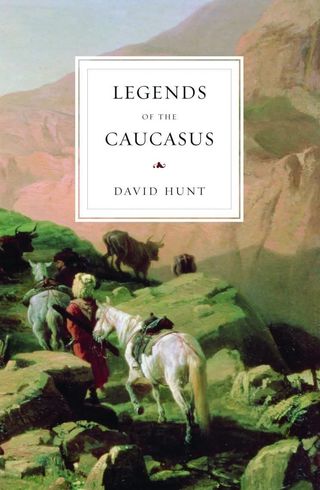
Cover of Legends of the Caucasus

Legends of the Caucasus

David Hunt

Original language: Georgian · Paperback · ISBN 978-0863564734

The Caucasus mountain region, stretching between the Black Sea and the Caspian Sea, is home to an unusual density of languages and ethnic groups. Legends of the Caucasus, compiled by David Hunt, gathers one hundred and one stories drawn from fourteen of these groups. The tales come from an oral tradition in which knowledge was stored in memory and handed from one generation to the next, often performed in a mixture of prose and verse by storytellers within their communities.

The legends circle around concerns shared across mountain cultures: defending against outside threats, avoiding famine, and holding families and clans together as working units. These are practical worries shaped by geography, where isolated valleys and difficult terrain made cooperation and group memory essential for survival. Hunt's collection preserves material from a folk literature that remains largely unknown to English-speaking audiences.

The book also carries an awareness of change. As alphabets and written language spread through the Caucasus, the oral traditions that sustained these stories have been fading. Many of the ways of life portrayed in the legends belong to a world that is disappearing within living memory, making the act of recording them a matter of timing as much as scholarship.

Plot

The one hundred and one legends included in this book reflect the cultures of fourteen different ethnic groups their dynamism and the matters that concerned them: survival against external dangers, the risk of starvation, and the persistence of the family or clan as a coordinated group. Descended from an oral tradition, much of their knowledge was retained in memories and passed down the generations. Yet, with the introduction of the alphabet, the way of life they portray is rapidly becoming extinct.

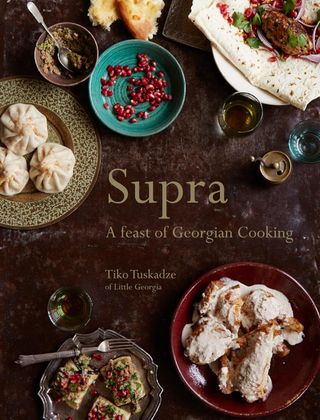
Cover of Supra: The legendary Georgian cookbook

Supra: The legendary Georgian cookbook

Tiko Tuskadze

Original language: English · Hardcover · ISBN 978-1911216162

Georgia sits at a geographic crossroads, bordered by Russia, Turkey, Azerbaijan, and Armenia along routes that once connected East and West. Its cooking reflects centuries of exchange with neighboring cultures while remaining distinctly its own. Tiko Tuskadze, chef and owner of Little Georgia restaurant in London, presents over 100 recipes from this tradition in her first book. The title refers to the supra, a Georgian gathering of family and friends centered on shared food, toasts, conversation, and drink.

The recipes follow the order in which dishes would appear at an actual supra. Pates, sauces, and salads are set out before guests arrive, followed by soups, breads, cheese dishes, meat, poultry, fish, and vegetables, finishing with fruit-based sweets. Familiar Georgian dishes such as khachapuri (cheese bread), khinkali (dumplings), and kebabi (lamb kebabs) appear alongside less widely known preparations like ajapsandali, an aubergine stew, and ckmeruli, poussin cooked in garlic and walnut sauce.

Tuskadze draws on recipes and stories passed through her own family, grounding the book in personal history as well as national food culture. The structure gives readers a working outline for assembling a full Georgian table rather than treating each dish in isolation.

Plot

In this, her first book, Tiko Tuskadze, chef-owner of London’s celebrated Little Georgia restaurant, opens her kitchen to share her love for the food of her home country and the recipes and stories that have been passed down through her family for generations. The book opens with an introduction to the delicious, yet little-known, food of Georgia and an exploration and explanation of the traditions and cultural significance of the supra. Recipes follow the authentic procession of dishes, starting with pâtés and sauces then salads, which are traditionally laid out on the table before guests arrive; moving on to sections on soups, bread and cheese, meat dishes, poultry dishes, fish dishes, vegetable dishes and ending with a few fruity treats.

Cover of The Eighth Life

The Eighth Life

Nino Haratischvili

Original language: Georgian · Paperback · ISBN 978-1950354146

Nino Haratischvili's novel begins in the early 1900s in Georgia, then a territory near the southern edge of the Russian Empire. A family there grows wealthy through a chocolate recipe kept secret and treated almost as a ritual object. The drink it produces is said to give intense pleasure, yet an aftertaste turns bitter for those who taste it.

Stasia receives the recipe from her Georgian father and carries it north when she marries Simon, whose posting takes them to St Petersburg during the Russian Revolution. Her marriage is the first of many attachments that begin sweetly and later sour. Across the century that follows, further generations live through war, political upheaval, loss, and moments of joy.

Nino Haratischvili was born in Georgia and writes in German. Her novel follows a family line rather than one central hero, so relationships return in new forms and later relatives notice echoes of earlier lives. The chocolate recipe threads through those years as both a household treasure and a warning. Georgia anchors the opening chapters before the setting widens across the Soviet Union and further west.

Plot

At the start of the twentieth century, on the edge of the Russian empire, a family prospers. It owes its success to a delicious chocolate recipe, passed down the generations with great solemnity and caution. A caution which is justified: this is a recipe for ecstasy that carries a very bitter aftertaste… Stasia learns it from her Georgian father and takes it north, following her new husband, Simon, to his posting at the center of the Russian Revolution in St Petersburg. Stasia’s is only the first in a symphony of grand but all too often doomed romances that swirl from sweet to sour in this epic tale of the red century.

Cover of The Knight in the Panther's Skin

The Knight in the Panther's Skin

Shota Rustaveli

Original language: Georgian · Paperback · ISBN 979-8607888282

The Knight in the Panther's Skin is a medieval Georgian epic poem composed in the 12th century by Shota Rustaveli, who is widely regarded as Georgia's national poet. The work belongs to the period sometimes called the Georgian Golden Age, when the Kingdom of Georgia reached a high point of political power and cultural production under the reign of Queen Tamar. The poem is structured in more than 1,600 quatrains written in a verse form now named after Rustaveli himself.

The story follows intertwined quests involving loyalty, friendship, and devotion. Its central figures are knights whose fates become linked across distant lands, and the narrative moves through courts, wildernesses, and foreign kingdoms. Themes of chivalric honor, sacrifice, and the bonds between companions run through the poem. Rustaveli drew on both Georgian literary traditions and broader influences from the cultures surrounding the Caucasus and beyond.

The poem holds a central place in Georgian literature and has been translated into numerous languages over the centuries. Copies of it were traditionally given as wedding gifts in Georgia, reflecting its deep presence in the country's cultural life. The Rustavelian quatrain remains a recognized poetic form in Georgian letters.

Plot

The Knight in the Panther's Skin is a Georgian medieval epic poem, written in the 12th century by Georgia's national poet Shota Rustaveli. The poem consists of over 1600 Rustavelian Quatrains and is considered to be a "masterpiece of the Georgian literature".

More from Georgia

See the country page for Georgia for its map, facts and largest cities, or browse books from other countries.

Links go to Amazon; Hookito doesn’t sell books. Know a book that belongs here, or spotted a mistake? Write to submissions@hookito.com.

Where to next?

Back to the globe
Hookito landscape illustration