Hookito

French Guiana · Books

Books from French Guiana

4 books from and about French Guiana: what each is about, the plot, and a note from Professor Kogi.

Cover of Batouala

Batouala

Rene Maran

Original language: French · Hardcover · ISBN 978-1498139724

Batouala, first published in 1921, is a novel by René Maran set in French Equatorial Africa, in the region then known as Oubangui-Chari. It centers on Batouala, a Banda chief whose authority and community face steady erosion under French colonial administration. The book portrays daily village life, customs, and ceremonies alongside the pressures of taxation, forced labor, and cultural disruption imposed by colonial officials. Maran, born in Martinique and himself a colonial administrator in the region, drew on years of direct observation.

The novel was notable for presenting its world largely through African eyes at a time when most French-language fiction about Africa adopted a European viewpoint. Maran's preface openly criticized French colonial practices, which provoked controversy in France even as the book received the Prix Goncourt in 1921. That award made Maran the first Black writer to win the prize. The story traces tensions between Batouala's attachment to established traditions and the administrative machinery reshaping his territory. Rather than staging a single dramatic confrontation, the novel accumulates small scenes of ordinary and ceremonial life to show how colonial rule altered the fabric of a community from within.

Plot

The book is set in French Equatorial Africa and follows the life of Batouala, a tribal chief, as he navigates the changing landscape of colonialism and the impact it has on his people. The story is told through the eyes of a French colonial administrator, who is attempting to bring modernization and civilization to the region. However, he soon realizes that the traditional way of life of the indigenous people is not something that can be easily replaced.


Cover of Papillon

Papillon

Henri Charriere

Original language: French · Paperback · ISBN 978-0061120664

Henri Charrière was convicted of murder in Paris in 1931 and sentenced to life in the penal colonies of French Guiana. He maintained he was innocent. Known as Papillon, a nickname from a butterfly tattoo on his chest, he spent years in harsh prison camps France maintained overseas, where tropical disease, forced labour and isolation made survival difficult.

His account follows repeated attempts to escape, each planned under extreme constraints and each ending in recapture or failure. The narrative moves through mainland camps and eventually to Devil's Island, a small rocky outcrop in the Îles du Salut group that held prisoners considered the most difficult. Conditions there were arranged so that escape would appear impossible.

The book first appeared in France in 1968, more than twenty years after Charrière's final escape, and met immediate acclaim. Some historians and journalists have questioned how strictly factual the autobiography is, suggesting that certain episodes may draw on the experiences of other convicts. Charrière stood by his version. The penal colony itself was closed in the years after the Second World War.

Plot

Henri Charrière, nicknamed "Papillon," for the butterfly tattoo on his chest, was convicted in Paris in 1931 of a murder he did not commit. Sentenced to life imprisonment in the penal colony of French Guiana, he became obsessed with one goal: escape. After planning and executing a series of treacherous yet failed attempts over many years, he was eventually sent to the notorious prison, Devil's Island, a place from which no one had ever escaped . . . until Papillon. His flight to freedom remains one of the most incredible feats of human cunning, will, and endurance ever undertaken.

Cover of The Bastards

The Bastards

Bertne Juminer

Original language: French · Paperback · ISBN 978-0813912042

The Bastards follows a group of medical students from French Guiana studying at the University of Montpellier in France. Rather than centering on a single character, the novel treats the group collectively, tracking how each member responds to the social and political pressures of being Caribbean students in a European institution. Their time in Montpellier forces them to confront the distance between themselves, their French classmates, and fellow students from Africa.

Bertne Juminer uses the university setting to outline three broad paths his characters take in the struggle for emancipation. Some gravitate toward direct confrontation and eventually violence. Others choose patient professional work, hoping to build moral and civic standards among their compatriots through personal example. A third group, burdened by middle-class origins they view as a liability, pursue extreme measures to prove their loyalty to the broader cause. The novel traces how these positions form, clash, and pull the group apart.

The book is as much about education in its wider sense as it is about medicine. Social awareness, political alignment, and racial identity all develop alongside the students' formal studies, shaped by the particular position French Guiana holds as an overseas territory of France rather than an independent nation.

Plot

The protagonist is collective, a group of medical students from French Guiana at the University of Montpellier, France, who learn what separates them as Caribbean people from their French and African counterparts. Juminer characterizes the three principal types of men drawn together in the stuggle for emancipation: "those who sooner or later will opt for violence; those who, by their sterling example, prefer to work patiently in the socioprofessional arena, in order to instill a certain moral and civic sense in their countrymen; and finally, those who wear their bourgeois legacy like a curse and will be ready to try anything, including terrorism, to prove that they are not enemies of the people."

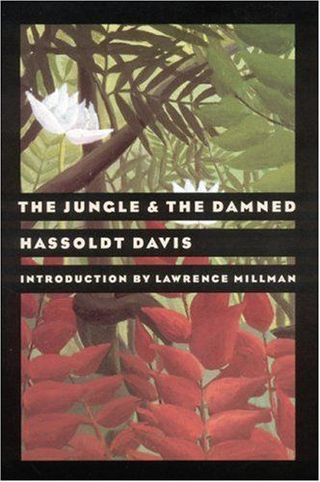
Cover of The Jungle and the Damned

The Jungle and the Damned

Hassoldt Davis

Original language: English · Paperback · ISBN 978-0803265981

Hassoldt Davis was an American adventurer and travel writer who lived from 1907 to 1959. In The Jungle and the Damned, he recounts a trip taken with his wife, filmmaker Ruth Staudinger, shortly after their marriage. The couple traveled first to Devil's Island, the notorious French penal colony off the coast of French Guiana, and then continued into the interior of the territory to follow a river that had seen little or no outside exploration.

French Guiana in the mid-twentieth century was still administered as an overseas territory of France, and Devil's Island had only recently closed as a prison. Davis describes the landscape, the people they encountered, and the practical difficulties of navigating a remote tropical river by small boat. Staudinger, who worked as a filmmaker, accompanied him throughout. The book sits within a tradition of husband-and-wife expedition writing that was common in that era, though few such journeys began at a former penal colony.

Davis published several travel books during his career, and Ernest Hemingway reportedly described his writing as fantastic and magnificent. The Jungle and the Damned focuses on a single expedition rather than a survey of a region, giving it a narrower and more immediate scope than some of his other work.

Plot

With his intrepid new wife, filmmaker Ruth Staudinger, Davis sets off on an improbable honeymoon, first to Devil’s Island, and then down an unexplored river in the interior of French Guiana. The result is a swashbuckling saga that deserves a place on any adventure bookshelf.

More from French Guiana

See the country page for French Guiana for its map, facts and largest cities, or browse books from other countries.

Links go to Amazon; Hookito doesn’t sell books. Know a book that belongs here, or spotted a mistake? Write to submissions@hookito.com.

Where to next?

Back to the globe
Hookito landscape illustration