
Hookito

Israel · Books

Books from Israel

9 books from and about Israel: what each is about, the plot, and a note from Professor Kogi.

Cover of A Horse Walks into a Bar

A Horse Walks into a Bar

David Grossman

Original language: Hebrew · Hardcover · ISBN 978-0451493972

In a small club in an Israeli city, a middle-aged comedian named Dov Greenstein takes the stage for a night of stand-up. The audience includes Avishai Lazar, a district court justice who knew Dov decades earlier, when he was a thin, odd kid who walked on his hands to fend off local bullies. As the evening unfolds, Dov's act slips between comedy and confession, and what begins as a performance gradually turns into something far more personal.

Dov's routine circles back through his childhood. His mother, a Holocaust survivor, required constant care. His father, ambitious and harsh, had little patience for the boy's oddness or creativity. The set builds toward a week Dov spent at a military youth camp, where Lazar was also present, and where an event took place that would mark Dov permanently. David Grossman structures the novel around a single evening, compressing a lifetime of memory into one unsteady performance.

Lazar, watching from the crowd, is forced to confront his own connection to what Dov reveals. The book moves between the comedian's voice on stage and Lazar's quiet reckoning in the seats, holding both perspectives without resolving one into the other. Grossman is also the author of To the End of the Land.

Plot

In a little dive in a small Israeli city, Dov Greenstein, a comedian a bit past his prime, is doing a night of stand-up. In the audience is a district court justice, Avishai Lazar, whom Dov knew as a boy, along with a few others who remember Dov as an awkward, scrawny kid who walked on his hands to confound the neighborhood bullies. Gradually, as it teeters between hilarity and hysteria, Dov’s patter becomes a kind of memoir, taking us back into the terrors of his childhood: we meet his beautiful flower of a mother, a Holocaust survivor in need of constant monitoring, and his punishing father, a striver who had little understanding of his creative son. Finally, recalling his week at a military camp for youth—where Lazar witnessed what would become the central event of Dov’s childhood—Dov describes the indescribable while Lazar wrestles with his own part in the comedian’s story of loss and survival.
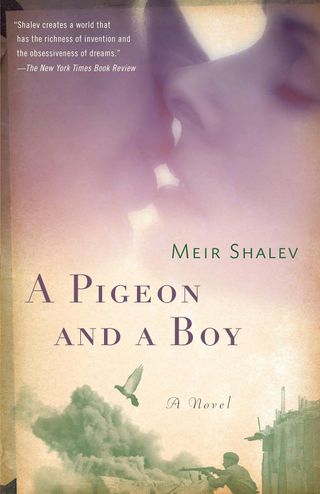

Cover of A Pigeon and a Boy

A Pigeon and a Boy

Meir Shalev

Original language: Hebrew · Paperback · ISBN 978-0805212143

A Pigeon and a Boy follows two storylines set decades apart in Israel. In the first, during the 1948 War of Independence, a young pigeon handler uses carrier birds to relay messages across the battlefield. Fatally wounded, he sends one final pigeon carrying a personal gift to the girl he has loved since they were young. The act is quiet and deliberate, a last use of the skill that defined his wartime role.

The second storyline takes place in the present day. Yair Mendelsohn, a middle-aged bird-watching tour guide, reconnects with a woman he knew in childhood. As their relationship develops, Yair also receives a gift from his dying mother, one that ties him back to the events of 1948. Through Yair's story, the novel traces the ways that war-era losses and attachments persist across generations in Israeli life.

Meir Shalev, an Israeli novelist known internationally, structures the book around the parallel between these two acts of love separated by half a century. Pigeons serve as a concrete link between the narratives, connecting wartime communication technology with the habits and knowledge of a present-day naturalist guide.

Plot

During the 1948 War of Independence—a time when pigeons are still used to deliver battlefield messages—a gifted young pigeon handler is mortally wounded. In the moments before his death, he dispatches one last pigeon. The bird is carrying his extraordinary gift to the girl he has loved since adolescence. Intertwined with this story is the contemporary tale of Yair Mendelsohn, who has his own legacy from the 1948 war. Yair is a tour guide specializing in bird-watching trips who, in middle age, falls in love again with a childhood girlfriend. His growing passion for her, along with a gift from his mother on her deathbed, becomes the key to a life he thought no longer possible.

Cover of Judas

Judas

Amos Oz

Original language: Hebrew · Hardcover · ISBN 978-0544464049

Set in Jerusalem in 1959, Judas follows Shmuel Ash, a young biblical scholar whose life has lost direction. He takes a job caring for Gershom Wald, an elderly, sharp-tongued intellectual living in an old stone house in the city. The arrangement brings Shmuel into close quarters with Atalia Abarbanel, a woman in her forties whose late father was a prominent figure in the Zionist movement. Atalia is guarded and distant, yet Shmuel finds himself drawn to her.

The novel is structured around the overlapping currents of personal longing and political memory. Shmuel's academic interest in the figure of Judas Iscariot runs alongside the household's buried grief and the still-raw divisions within Israeli society over the founding of the state. Wald and Atalia each carry different versions of that history, and their conversations with Shmuel pull the narrative between intimacy and argument.

Amos Oz sets the story within a single winter, using the confined space of the house and the cold Jerusalem weather to keep his three characters close together. The book received the International Literature Prize. It was Oz's first full-length novel after A Tale of Love and Darkness.

Plot

Jerusalem, 1959. Shmuel Ash, a biblical scholar, is adrift in his young life when he finds work as a caregiver for a brilliant but cantankerous old man named Gershom Wald. There is, however, a third, mysterious presence in his new home. Atalia Abarbanel, the daughter of a deceased Zionist leader, a beautiful woman in her forties, entrances young Shmuel even as she keeps him at a distance. Piece by piece, the old Jerusalem stone house, haunted by tragic history and now home to the three misfits and their intricate relationship, reveals its secrets.

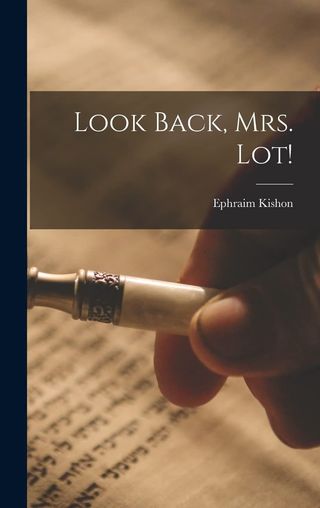
Cover of Look Back, Mrs. Lot!

Look Back, Mrs. Lot!

Ephraim Kishon

Original language: Hebrew · Hardcover · ISBN 978-1013317828

Ephraim Kishon was a Hungarian-born Israeli humorist whose satirical writing became widely read across Europe and Israel from the 1950s onward. Look Back, Mrs. Lot! collects short essays and stories set in Israel during the mid-20th century, each one built around some small frustration or oddity of daily life. Kishon's title nods to the biblical figure from Genesis who turned to look at the destruction of Sodom, but here the backward glance is comic rather than catastrophic.

The pieces cover bureaucratic tangles, neighborhood disputes, cultural clashes between old traditions and rapid modernization, and the ordinary confusion of getting through the day in a young, fast-changing country. Kishon tends to start from a familiar domestic scene, a visit to a government office or a conversation with a neighbor, and then push it toward absurdity with calm, deadpan logic. His humor depends less on exaggeration than on following a situation to its most unreasonable but perfectly consistent conclusion.

Kishon wrote in Hebrew after learning the language as an adult immigrant, and many of his books were translated into dozens of languages. This collection reflects his style of finding sharp irony in small-scale, recognizable moments.

Plot

Look Back, Mrs. Lot! by Ephraim Kishon is a witty collection of satirical essays and stories that humorously depict life in Israel during the mid-20th century. With sharp irony and affection, Kishon explores everyday absurdities, cultural quirks, and social changes, turning ordinary situations into clever reflections on human nature and modern society.

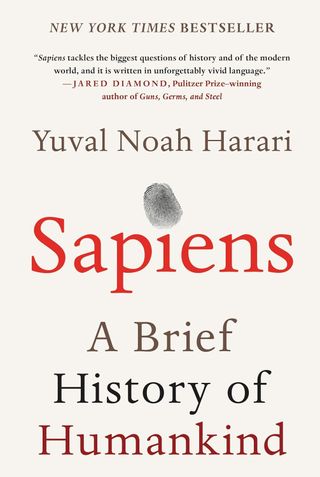
Cover of Sapiens: A Brief History of Humankind

Sapiens: A Brief History of Humankind

Yuval Noah Harari

Original language: English · Hardcover · ISBN 978-0062316097

Around 100,000 years ago, several distinct human species shared the planet. Homo sapiens was only one of them. Yuval Noah Harari, an Israeli historian, opens with this fact and traces how our species came to be the sole survivor. The book picks up roughly 70,000 years ago, at the point when modern cognitive abilities appear in the archaeological record, and follows the course of human development from there through the Agricultural Revolution, the spread of empires, and the rise of global networks of trade and belief.

Harari works across disciplinary lines, drawing on biology, anthropology, economics, and recorded history to examine how humans organized themselves into ever-larger groups. A central argument is that Homo sapiens succeeded in part because of a shared capacity for collective fiction: money, laws, religions, and nations are all, in his framing, stories that large numbers of people agree to treat as real. The book also addresses how humans have reshaped other species and entire ecosystems over millennia.

In its later sections, the book turns toward recent decades, noting that humans have begun to alter the biological rules that governed life for roughly four billion years. Harari raises questions about genetic engineering and other technologies without settling on a single prediction for what comes next.

Plot

One hundred thousand years ago, at least six different species of humans inhabited Earth. Yet today there is only one—homo sapiens. What happened to the others? And what may happen to us? Most books about the history of humanity pursue either a historical or a biological approach, but Dr. Yuval Noah Harari breaks the mold with this highly original book that begins about 70,000 years ago with the appearance of modern cognition. From examining the role evolving humans have played in the global ecosystem to charting the rise of empires, Sapiens integrates history and science to reconsider accepted narratives, connect past developments with contemporary concerns, and examine specific events within the context of larger ideas.

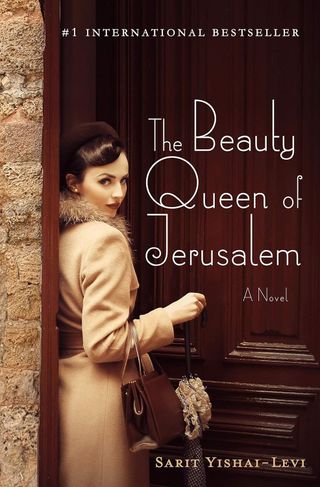
Cover of The Beauty Queen of Jerusalem

The Beauty Queen of Jerusalem

Sarit Yishai-Levi

Original language: Hebrew · Hardcover · ISBN 978-1250078162

Gabriela grows up in Jerusalem watching her mother Luna attract admiration from everyone around her, yet feeling shut out from that warmth herself. The distance between them is old and stubborn, and Gabriela has never fully understood its roots. When a family crisis forces her to look more closely, she begins tracing the lives of the women who came before her: her great-grandmother Mercada, known locally as a healer, and her grandmother Rosa, who worked cleaning houses for the British during the Mandate period.

As Gabriela reconstructs these stories, she encounters hidden romances, long-kept secrets, and patterns of emotional difficulty that repeat across four generations. The novel moves through several decades, touching on the era of World War II and reaching into the 1970s, with Jerusalem as its anchoring setting throughout. Sarit Yishai-Levi draws on the textures of Sephardi family life in the city, where household memory and spoken history carry weight alongside the larger political shifts happening outside.

The book was originally published in Hebrew and became a bestseller in Israel before being translated into English. Its structure follows each generation in turn, giving individual shape to the women whose choices and silences continue to affect those who come after them.

Plot

Gabriela's mother Luna is the most beautiful woman in all of Jerusalem, though her famed beauty and charm seem to be reserved for everyone but her daughter. Ever since Gabriela can remember, she and Luna have struggled to connect. But when tragedy strikes, Gabriela senses there's more to her mother than painted nails and lips.

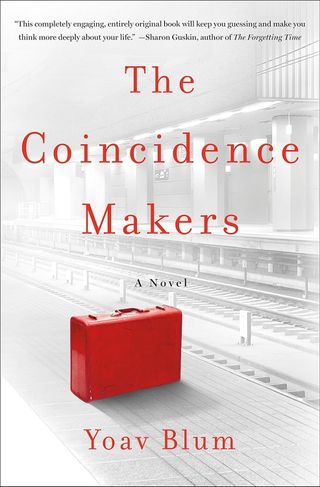
Cover of The Coincidence Makers

The Coincidence Makers

Yoav Blum

Original language: Hebrew · Hardcover · ISBN 978-1250146113

Guy, Emily, and Eric work for a secret organization whose purpose is to manufacture coincidences. A spilled drink, a missed train, a found lottery ticket: none of these are accidents. Each event is planned and carried out by trained agents who study techniques for staging situations that appear random but are designed to push ordinary people toward specific turning points. The three completed a specialized training course two years before the story begins, learning how to engineer encounters between future lovers, spark moments of creative inspiration, and set up the conditions for scientific breakthroughs.

When Guy receives a new and unusual assignment, his routine begins to unravel. A mysterious killer surfaces in town, and other hidden forces start to press against the edges of the organization's careful plans. The mission draws Guy, Emily, and Eric into questions they were not trained to answer, touching on fate, free will, and the nature of love.

Yoav Blum, an Israeli author, originally wrote the novel in Hebrew before it was translated into English. The story blends elements of speculative fiction with a premise that treats destiny as something constructed rather than discovered.

Plot

What if the drink you just spilled, the train you just missed, or the lottery ticket you just found was not just a random occurrence? What if it’s all part of a bigger plan? What if there’s no such thing as a chance encounter? What if there are people we don’t know determining our destiny? And what if they are even planning the fate of the world? Enter the Coincidence Makers―Guy, Emily, and Eric―three seemingly ordinary people who work for a secret organization devoted to creating and carrying out coincidences. What the rest of the world sees as random occurrences, are, in fact, carefully orchestrated events designed to spark significant changes in the lives of their targets―scientists on the brink of breakthroughs, struggling artists starved for inspiration, loves to be, or just plain people like you and me…

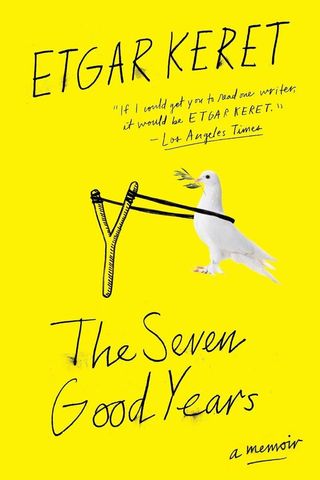
Cover of The Seven Good Years: A Memoir

The Seven Good Years: A Memoir

Etgar Keret

Original language: Hebrew · Paperback · ISBN 978-0399576003

Etgar Keret's first nonfiction book published in America covers seven years, framed by two events: the birth of his son Lev and the death of his father. Lev arrives at a hospital while victims of a suicide bombing are being brought in. Conversations among parents of toddlers turn to whether their children will serve in the army at eighteen. Private life and national life are difficult to separate.

Keret writes in short tragicomic pieces rather than one continuous narrative. Some follow his son, including Lev's insistence that he is a cat and therefore released from human rules and responsibilities. Others turn to the author's own family: a sister who became ultra-Orthodox and has eleven children, a brother who is a pacifist and supports legalizing marijuana, and parents who survived the Holocaust.

Further pieces move outward, from an old school friend whose main fear is that his matchstick model of the Eiffel Tower will be destroyed by a Scud missile, to the thinking behind the game Angry Birds. After his father's death, the siblings gather for the shivah, the Jewish mourning period, each arriving from a very different life. Worry, illness, and war run through the whole record.

Plot

The seven years between the birth of Etgar Keret’s son and the death of his father were good years, though still full of reasons to worry. Lev is born in the midst of a terrorist attack. Etgar’s father gets cancer. The threat of constant war looms over their home and permeates daily life. What emerges from this dark reality is a series of sublimely absurd ruminations on everything from Etgar’s three-year-old son’s impending military service to the terrorist mind-set behind Angry Birds. There’s Lev’s insistence that he is a cat, releasing him from any human responsibilities or rules. Etgar’s siblings, all very different people who have chosen radically divergent paths in life, come together after his father’s shivah to experience the grief and love that tie a family together forever.

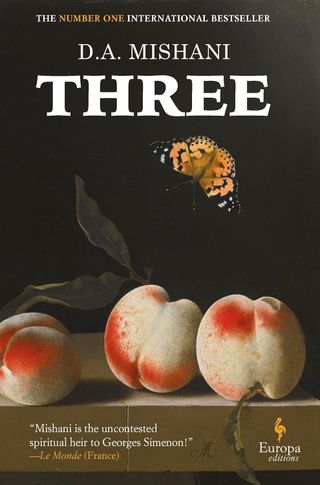
Cover of Three

Three

D.A. Mishani

Original language: Hebrew · Hardcover · ISBN 978-1609456092

Three by D.A. Mishani follows three women in the Holon area near Tel Aviv whose lives appear unconnected. Orna is recently divorced and looking for companionship through online dating. She begins seeing a man named Gil, but as their relationship develops, details about him start to seem inconsistent. Orna herself is not entirely honest, and the gap between what each person presents and what they conceal grows wider as the story unfolds.

The two other women at the center of the novel occupy very different positions. One is a devoutly religious immigrant working as a caretaker. The other is a researcher whose professional dissatisfaction is matched by a strained marriage. The three storylines run in parallel, and the structure of the book gradually reveals what binds them together. Mishani, known in Israel for his detective fiction, constructs the novel as a puzzle rather than a conventional thriller, letting tension build through accumulating small details and unanswered questions.

Holon is a city just south of Tel Aviv with its own distinct character, and Mishani uses its streets and apartments as grounded, specific settings rather than generic urban backdrop. The novel is translated from Hebrew.

Plot

An abandoned woman searching for love, a deeply religious immigrant caretaker, a disillusioned researcher trapped in her marriage. Three women whose lives seem as far apart as possible, united by a common secret. When Orna meets Gil on an online dating site, their lackluster affair seems like nothing more than a way to stave off the pain of her recent divorce. But soon it becomes clear that Gil may not be exactly who he claims to be. And Orna’s own lies may be weaving an unexpected trap for her.

More from Israel

See the country page for Israel for its map, facts and largest cities, or browse books from other countries.

Links go to Amazon; Hookito doesn’t sell books. Know a book that belongs here, or spotted a mistake? Write to submissions@hookito.com.

Where to next?

Back to the globe
Hookito landscape illustration