Hookito

Madagascar · Books

Books from Madagascar
8 books from and about Madagascar: what each is about, the plot, and a note from Professor Kogi.

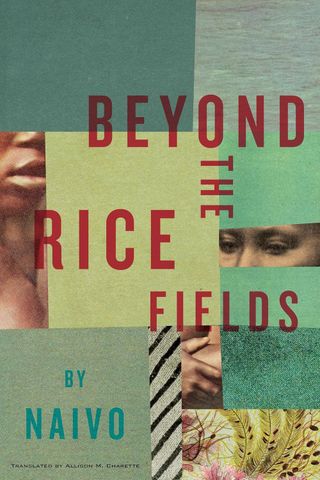
Cover of Beyond the Rice Fields

Beyond the Rice Fields

Naivo

Original language: French · Paperback · ISBN 978-1632061317

Beyond the Rice Fields, written by Naivo, follows two young people in nineteenth-century Madagascar. Fara is the daughter of a local family, and Tsito is a boy her father purchased as a slave after the destruction of his forest village. Growing up together in the settlement of Sahasoa, surrounded by cattle and rice cultivation, they form a close bond. Tsito looks ahead toward the possibility of freedom, while Fara is pulled back toward a family history she has long avoided.

As the story develops, outside forces press into the country. British Christian missionaries and French industrialists arrive with competing interests, and political violence spreads across the island. The relationship between Fara and Tsito fractures under these pressures, shaped by questions of status, belief, and belonging. The novel addresses the entanglement of personal lives with larger historical disruptions, including the slave trade, foreign intervention, and the internal power struggles of the Malagasy kingdom.

The book is noted as the first novel from Madagascar to be translated into English. It was translated from the original French and offers a rare fictional account of a period in Malagasy history that remains little known outside the island.

Plot

Fara and her father’s slave, Tsito, have been close since her father bought the boy after his forest village was destroyed. Now in Sahasoa, amongst the cattle and rice fields, everything is new for Tsito, and Fara at last has a companion. But as Tsito looks forward to the bright promise of freedom and Fara, backward to a dark, long-denied family history, a rift opens between them just as British Christian missionaries and French industrialists arrive and violence erupts across the country. Love and innocence fall away, and Tsito and Fara’s world becomes enveloped by tyranny, superstition, and fear.
Cover of Forget Colonialism?: Sacrifice and the Art of Memory in Madagascar

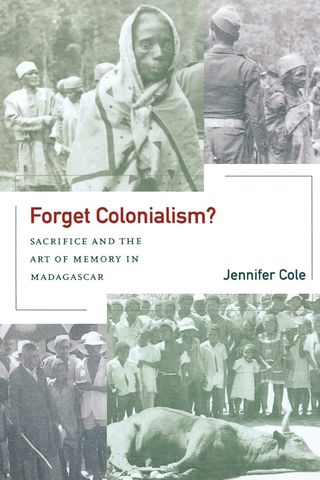
Forget Colonialism?: Sacrifice and the Art of Memory in Madagascar

Jennifer Cole

Original language: English · Paperback · ISBN 978-0520228467

Jennifer Cole's Forget Colonialism? examines how people in a village in eastern Madagascar remember and forget nearly a century of French colonial rule. Cole conducted fieldwork in a community that had experienced both intensive settler colonialism and a violent anticolonial rebellion, yet she found that residents appeared to set aside the colonial period in their everyday lives. The book's central puzzle is how that apparent forgetting worked in practice.

During democratic elections in 1992 and 1993, memories of colonial violence returned suddenly and forcefully across the community. Cole uses that shift to build a practice-based approach to social memory, grounded in close observation of how remembering and forgetting operate through daily routines, ritual, and sacrifice. Rather than treating memory as a fixed archive, she traces how a community shapes what is recalled and what recedes, often through ceremonial practices passed between generations.

The setting matters to the argument. East Madagascar saw heavy settlement by colonists under French rule, and the same region later carried the aftermath of armed revolt. Working outward from one place, Cole links personal recollection to wider questions about how formerly colonized populations account for the colonial past.

Plot

While doing fieldwork in a village in east Madagascar that had suffered both heavy settler colonialism and a bloody anticolonial rebellion, Jennifer Cole found herself confronted by a puzzle. People in the area had lived through almost a century of intrusive French colonial rule, but they appeared to have forgotten the colonial period in their daily lives. Then, during democratic elections in 1992–93, the terrifying memories came flooding back. Cole asks, How do once-colonized peoples remember the colonial period?

Cover of MALAGASY COOKBOOK

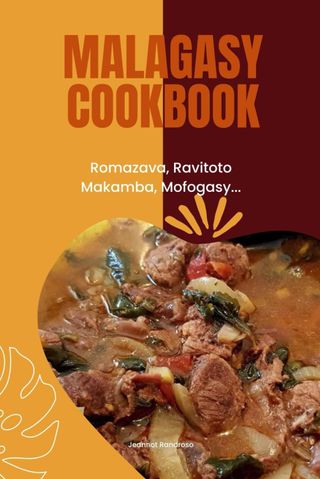
MALAGASY COOKBOOK

Jeannot Randroso

Original language: French · Paperback · ISBN 979-8875912979

This cookbook by Jeannot Randroso collects 40 recipes from Madagascar, the large island nation off the southeast coast of Africa. The dishes represent a cross-section of Malagasy home cooking, including romazava, a mixed-greens meat stew often described as the national dish, and ravitoto, a preparation of pounded cassava leaves typically served with pork. The book also covers mofogasy, a rice-flour pancake common as street food, along with coconut chicken, marinated meats, and fish seasoned with local spices.

Madagascar's cuisine reflects the island's position between Africa, Southeast Asia, and the Indian Ocean trade routes. Rice is central to nearly every meal, and many dishes combine it with slow-cooked proteins, leafy greens, or tropical ingredients such as coconut and vanilla. The 40 recipes gathered here range from everyday staples to preparations that highlight particular regional flavors.

The book is structured around traditional recipes rather than restaurant-style adaptations, giving each dish a place within the broader pattern of Malagasy cooking. Spice combinations native to Madagascar, where black pepper, cloves, and vanilla have been cultivated for generations, appear throughout the collection.

Plot

A beautiful, magnificent, and flavorful book on Malagasy cuisine. All the flavors of Malagasy cuisine. Romazava, ravitoto, mofogasy, coconut chicken, marinated meats, fish with Madagascar spices. Embark on a culinary journey and discover the richness of the large island through 40 traditional and original recipes.

Cover of Mankafy Sakafo

Mankafy Sakafo

Jill Donenfeld

Original language: English · Paperback · ISBN 978-0595425914

Mankafy Sakafo is a cookbook rooted in Jill Donenfeld's five-month stay in Madagascar, which began in 2005. During that time she lived with families across the island, moving between highlands and lowlands, mountains and coastal areas, and collecting recipes from each region. The book gathers these dishes into a single volume that covers street food, everyday home cooking, and the role of rice as a staple of Malagasy life.

Madagascar's cuisine draws on ingredients shaped by the island's geography and climate. Vanilla, coconut, and seafood appear frequently, reflecting both the tropical environment and the surrounding Indian Ocean. Donenfeld organizes recipes from the north and south of the island, giving a sense of how cooking traditions vary across a country that stretches roughly 1,600 kilometers from tip to tip. Alongside the recipes, she introduces the families and friends she encountered during her travels.

The book's title uses the Malagasy language, which belongs to the Austronesian language family and connects Madagascar linguistically to Southeast Asia rather than to mainland Africa. This detail mirrors the island's broader cultural history, in which food traditions carry influences from several continents and centuries of trade across the Indian Ocean.

Plot

Donenfeld traveled there in 2005 and stayed for five months. She stayed with various families and lived in many parts of the island. The book is a cohesive collection of recipes from all parts of the island-highlands and lowlands, mountains and beaches, north and south. She discusses the importance of rice, give recipes for street foods, and give recipes for everyday home cooking as well. Malagasy cuisine is quite rich, with an abundance of vanilla, coconut, and seafood.

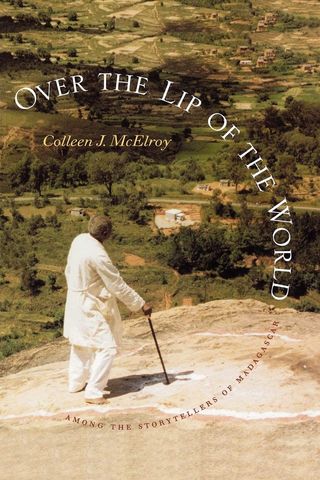
Cover of Over the Lip of the World: Among the Storytellers of Madagascar

Over the Lip of the World: Among the Storytellers of Madagascar

Colleen McElroy

Original language: English · Paperback · ISBN 978-0295981154

Colleen McElroy, an American poet and professor of English, traveled to Madagascar on a Fulbright research project to study the island's oral traditions and myths. Over the Lip of the World records both her fieldwork and her personal experiences moving through the country as she sought out storytellers and tried to document their craft. McElroy writes as an African American woman navigating a place whose cultures blend Southeast Asian, African, and Arab influences, and the book tracks the practical difficulties and unexpected encounters that shaped her research.

The narrative weaves in English translations of Malagasy stories covering subjects such as royalty and commoners, tricksters and shapechangers, love and revenge, and questions of morality and heroism. These traditional tales sit alongside McElroy's own account of daily life on the island, creating a structure that moves between the collected stories and the circumstances of collecting them. Madagascar, the world's fourth-largest island, sits in the Indian Ocean off the southeastern coast of Africa, and its relative isolation has produced distinctive ecosystems and cultural traditions that differ markedly from those of the African mainland.

Plot

Gifted travel writer, poet, professor of English, and insightful observer of human nature, Colleen McElroy journeyed to Madagascar to undertake a Fulbright research project exploring Malagasy oral traditions and myths. In Over the Lip of the World she depicts with equal verve the various storytelling traditions of the island and her own adventures in trying to find and record them.

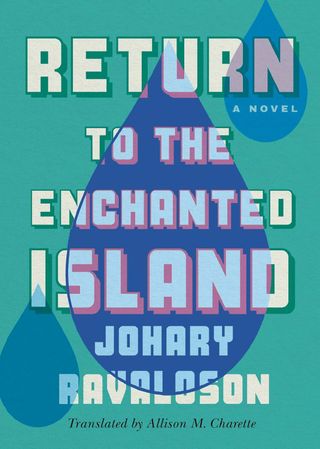
Cover of Return to the Enchanted Island

Return to the Enchanted Island

Johary Ravaloson

Original language: English · Paperback · ISBN 978-1542093514

Ietsy Razak carries the name of the first man in Malagasy mythology, a figure tied to the creation of the world. Raised with the expectation that he will live up to this origin, Ietsy instead drifts through adolescence marked by restlessness, insomnia, and a persistent sense of disconnection. When a sudden tragedy uproots him, he is sent to a boarding school in France, far from the island where his name carries weight.

In France, Ietsy does not find clarity. He loses himself in distractions, caught between the privileges of his background and the burden of a legacy he did not choose. The novel follows his eventual return to Madagascar, sometimes called the Enchanted Island, where he begins to negotiate a path between inherited myth and modern life. Johary Ravaloson sets the story against real tensions between tradition and the pull of a globalized present.

The book is one of only a small number of Malagasy novels published in English translation. It recasts a foundational origin narrative through a contemporary lens, grounding questions of identity and belonging in a specific place and culture rather than treating them as abstract concerns.

Plot

Named after the first man at the creation of the world in Malagasy mythology, Ietsy Razak was raised to perpetuate the glory of his namesake and expected to be as illuminated as his Great Ancestor. But in the chaos of modernity, his young life is marked only by restlessness, maddening insomnia, and an adolescent apathy. When an unexpected tragedy ships him off to a boarding school in France, his trip to the big city is no hero’s journey. Ietsy loses himself in the immediate pleasures of body and mind. Weighed down by his privilege and the legacy of his name, Ietsy struggles to find a foothold. Only a return to the “Enchanted Island,” as Madagascar is lovingly known, helps Ietsy stumble toward his destiny. This award-winning retelling of Madagascar’s origin story offers a distinctly twenty-first-century perspective on the country’s place in an ever-more-connected world.

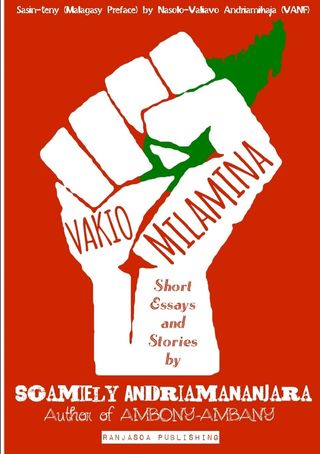
Cover of Vakio Milamina

Vakio Milamina

Soamiely Andriamananjara

Original language: English · Paperback · ISBN 978-1329622197

Vakio Milamina is a collection of short essays and stories by Soamiely Andriamananjara that explores Madagascar and Malagasy life from multiple angles. The title, in Malagasy, suggests a calm or unhurried reading pace, and the book is structured to be taken slowly rather than consumed in a single sitting. Each piece offers a different window into the culture, habits, and particularities of the island and its people.

The book does not attempt to explain Madagascar in a single sweep. Instead, it presents a series of small observations and narratives that accumulate into a fuller, more layered picture. Andriamananjara treats the country as something that resists easy summary, and the essays seem designed to leave readers with more questions than answers. The approach is closer to a guided walk than a lecture, with each piece adding texture without forcing a conclusion.

Madagascar sits in the Indian Ocean off the southeast coast of Africa, and its long geographic isolation has shaped distinct ecosystems and cultural traditions. Andriamananjara writes from within that distinctiveness, assembling details that highlight how the island continues to surprise even those who know it well. The collection is built for curiosity rather than completeness.

Plot

There is no need to rush to get to the final destination: take your time and enjoy discovering more puzzles along the way. You will probably find Madagascar and the Malagasy even more intriguing, more puzzling, and more enigmatic after you put the book down.

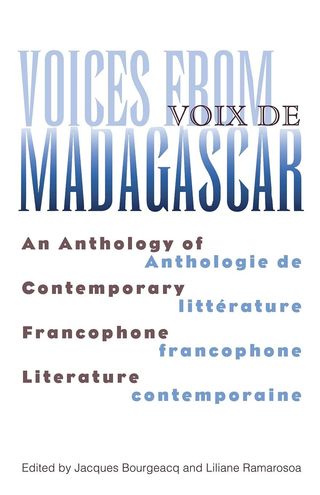
Cover of Voices from Madagascar

Voices from Madagascar

Jacques Bourgeacq, Liliane Ramarosoa

Original language: English · Paperback · ISBN 978-0896802186

Voices from Madagascar is an anthology compiled by Jacques Bourgeacq and Liliane Ramarosoa, presenting a selection of Malagasy literary works written in French. The collection includes short stories, poetry, novels, and plays, offered in both French and English translation. Much of this writing had circulated only locally, often in manuscript form, with little opportunity for publication or international distribution.

Madagascar's French-language literary tradition dates to the colonial period, when three poets stood out early: Jean-Joseph Rabearivelo, Jacques Rabemananjara, and Flavien Ranaivo. All three appeared in Léopold Senghor's 1948 Anthologie de la nouvelle poésie nègre et malgache. After Madagascar's political break with France in the 1970s and nearly two decades under a Marxist government, the country experienced significant cultural isolation. Writers on the island continued producing work in French alongside a separate body of literature in the Malagasy language, but reaching audiences beyond Madagascar remained difficult.

A few Malagasy authors living abroad found publishers in France, yet the larger body of literary work produced on the island stayed outside international view. This anthology gathers texts from that wider, less visible tradition and presents them to an English-speaking readership for the first time.

Plot

There is currently in Madagascar a rich literary production (short stories, poetry, novels, plays) that has not yet reached the United States for lack of diffusion outside the country. Until recently, Madagascar suffered from political isolation resulting from its breakup with France in the 1970s and the eighteen years of Marxism that followed. With little hope that their voices would be heard outside the island, writers nevertheless have continued to express themselves in French (alongside a literature written in the Malagasy language). Malagasy literature in French had begun in the colonial era with three poets: JeanJoseph Rabearivelo, Jacques Rabemananjara, and Flavien Ranaivo, all three presented in Léopold Senghors celebrated Anthologie de la nouvelle poésie nègre et malgache (1948). More recently, although a few Malagasy writers living outside the country have been published in France, the bulk of Malagasy literature today has remained largely unpublished, circulating locally mostly in manuscript form.

More from Madagascar

See the country page for Madagascar for its map, facts and largest cities, or browse books from other countries.

Links go to Amazon; Hookito doesn’t sell books. Know a book that belongs here, or spotted a mistake? Write to submissions@hookito.com.

Where to next?

Back to the globe
Hookito landscape illustration