Hookito

Palestine · Books

Books from Palestine
7 books from and about Palestine: what each is about, the plot, and a note from Professor Kogi.

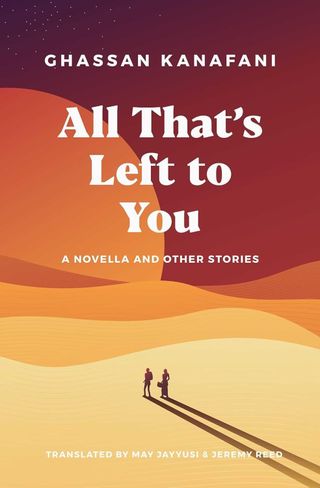
Cover of All that's Left to You

All that's Left to You

Ghassan Kanafani

Original language: Arabic · Paperback · ISBN 978-1566565486

All that's Left to You by Ghassan Kanafani follows a brother and sister in Gaza over the course of a single day and night. The two are cut off from the rest of their family, and the narrative moves between what is happening in the present and what each of them remembers. The brother carries a deep, unrelenting anger connected to his sister's sexual disgrace, a personal wound that also stands in for broader feelings of loss and displacement among Palestinians separated from their land and kin.

Kanafani's technique is unusual. The desert itself and the passage of time function almost as additional characters, each given a distinct voice alongside the brother and the sister. The story shifts between these perspectives to create a layered rhythm rather than a conventional linear plot. This structure ties the physical landscape of the region to the interior lives of the characters, making geography and memory inseparable.

First published in Arabic in 1966, this English translation introduced Kanafani's experimental prose to a wider readership. The collection that accompanies the title novella offers further examples of his compressed, structurally inventive fiction set against the realities of Palestinian life.

Plot

All That's Left to You presents the vivid story of twenty-four hours in the real and remembered lives of a brother and sister living in Gaza and separated from their family. The desert and time emerge as characters as Kanafani speaks through the desert, the brother, and the sister to build the powerful rhythm of the narrative. The Palestinian attachment to land and family, and the sorrow over their loss, are symbolized by the young man's unremitting anger and shame over his sister's sexual disgrace.

Cover of Minor Detail

Minor Detail

Adania Shibli

Original language: Arabic · Paperback · ISBN 978-0811229074

Minor Detail by Adania Shibli is a novel told in two parts of equal length. The first is set in the summer of 1949, in the Negev desert, one year after the conflict Palestinians call the Nakba, a word meaning catastrophe, which resulted in the displacement and exile of roughly 700,000 people. In this section, Israeli soldiers attack a Bedouin encampment and commit a brutal crime against a Palestinian teenage girl: assault, murder, and burial in the sand.

The second part takes place decades later in Ramallah, where a young woman becomes consumed by the effort to trace what happened in that specific incident. Her fixation deepens when she discovers that the crime took place exactly twenty-five years before her own date of birth. The coincidence pulls her further into an investigation shaped as much by gaps and silences as by the fragments she manages to recover.

Shibli constructs the novel so the two sections mirror each other in structure and length. The pairing places a documented act of violence alongside a later, quieter story of someone trying to reach it across time, restriction, and official record. The prose is spare and controlled throughout.

Plot

Minor Detail begins during the summer of 1949, one year after the war that the Palestinians mourn as the Nakba―the catastrophe that led to the displacement and exile of some 700,000 people―and the Israelis celebrate as the War of Independence. Israeli soldiers murder an encampment of Bedouin in the Negev desert, and among their victims they capture a Palestinian teenager and they rape her, kill her, and bury her in the sand. Many years later, in the near-present day, a young woman in Ramallah tries to uncover some of the details surrounding this particular rape and murder, and becomes fascinated to the point of obsession, not only because of the nature of the crime, but because it was committed exactly twenty-five years to the day before she was born.

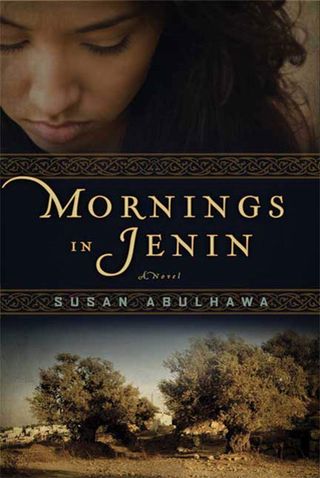
Cover of Mornings in Jenin

Mornings in Jenin

Susan Abulhawa

Original language: Arabic · Paperback · ISBN 978-1608190461

Mornings in Jenin follows four generations of the Abulheja family, beginning in 1948, when they are forced from the olive-farming village of Ein Hod and moved to the Jenin refugee camp. The patriarch, cut off from the groves he tended, declines there. His grandchildren grow up among canvas tents that are later replaced by cinderblock shelters, a sign that return may be distant.

The narrator is Amal, the patriarch's bright granddaughter, shaped by a father who read to her in the quiet before dawn. Her twin brothers take very different paths: one is taken as a small child and raised in an Israeli Jewish family, while the other gives himself to the Palestinian cause. Amal makes her way out of the camp and returns years later to marry and raise a daughter.

Susan Abulhawa threads the family's private life through five decades of Palestinian and Israeli history, including several major clashes. Friendship, first love, marriage, and parenthood unfold alongside displacement, loss, and waiting. The novel closes in on Amal's wish to pass her family's story to her daughter, so the family's account continues in another generation.

Plot

Mornings in Jenin is a multi-generational story about a Palestinian family. Forcibly removed from the olive-farming village of Ein Hod by the newly formed state of Israel in 1948, the Abulhejos are displaced to live in canvas tents in the Jenin refugee camp. We follow the Abulhejo family as they live through a half-century of violent history. Amidst the loss and fear, hatred, and pain, as their tents are replaced by more forebodingly permanent cinderblock huts, there is always the waiting, waiting to return to a lost home. The novel's voice is that of Amal, the granddaughter of the old village patriarch, a bright, sensitive girl who makes it out of the camps, only to return years later, to marry and bear a child. Through her eyes, with her evolving vision, we get the story of her brothers, one who is kidnapped to be raised Jewish, one who will end with bombs strapped to his middle. But of the many interwoven stories, stretching backward and forward in time, none is more important than Amal's own. Her story is one of love and loss, of childhood and marriage and parenthood, and finally the need to share her history with her daughter, to preserve the greatest love she has.

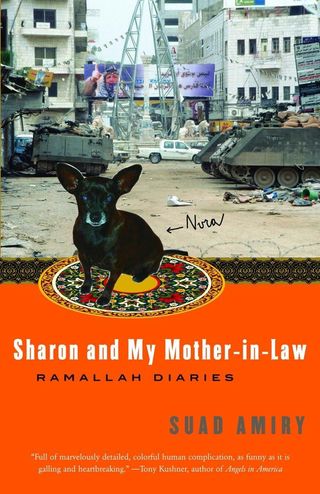
Cover of Sharon and My Mother-in-Law: Ramallah Diaries

Sharon and My Mother-in-Law: Ramallah Diaries

Suad Amiry

Original language: English · Paperback · ISBN 978-1400096497

Sharon and My Mother-in-Law draws on diaries and email correspondence that Suad Amiry kept between 1981 and 2004. The book records daily life in Ramallah, a city in the West Bank, during decades of military occupation. Amiry is an architect and writer, and her account focuses on the practical details of living under restriction: the difficulty of traveling between towns, the bureaucratic obstacles that shape ordinary tasks, and the long stretches of enforced confinement at home.

One recurring thread involves the absurdities of the permit and identity-card system. Amiry notes, for example, that her dog was issued a Jerusalem identity card at a time when thousands of Palestinian residents could not obtain one. Another section describes a forty-two-day curfew during which her ninety-two-year-old mother-in-law stayed in her house, compressing family tension and political pressure into a single domestic setting.

Throughout the book, Amiry's tone leans toward irony and dry humor rather than sentiment. She records dialogue and small incidents closely, building a picture of how occupation affects schedules, relationships, and moods in ways that are often mundane before they become unbearable. The title pairs the name of an Israeli prime minister with a family figure, linking the political and the personal from the first page.

Plot

Capturing the frustrations, cabin fever, and downright misery of her experiences, Amiry writes with elegance and humor about the enormous difficulty of moving from one place to another, the torture of falling in love with someone from another town, the absurdity of her dog receiving a Jerusalem identity card when thousands of Palestinians could not, and the trials of having her ninety-two-year-old mother-in-law living in her house during a forty-two-day curfew. With a wickedly sharp ear for dialogue and a keen eye for detail, Amiry gives us an original, ironic, and firsthand glimpse into the absurdity—and agony—of life in the Occupied Territories.

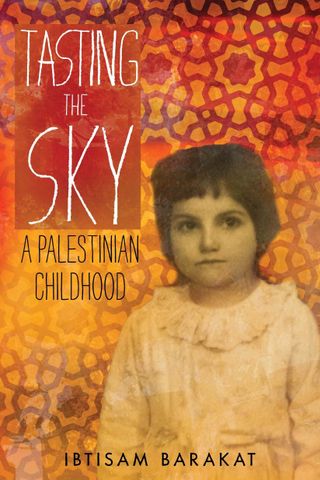
Cover of Tasting the Sky: A Palestinian Childhood

Tasting the Sky: A Palestinian Childhood

Ibtisam Barakat

Original language: English · Paperback · ISBN 978-1250097187

Tasting the Sky is a memoir by Ibtisam Barakat about her childhood in Ramallah and the years following the 1967 Six-Day War. The book opens with a scene set years later, then moves back to the war itself, when Barakat was a young girl. She recalls the confusion of bombs falling near her home, a frightening separation from her family, and the displacement that followed as her family became refugees. The memoir traces everyday life under occupation through the eyes of a child trying to make sense of events far larger than herself.

A central thread in the book is Barakat's encounter with the Arabic alphabet. She describes discovering Alef, the first letter, and the effect this has on her. Learning to read and write becomes a way for her to organize a world that has been broken apart. Language offers a kind of stability when almost everything else around her is uncertain. The memoir is built from fragments of memory rather than a single continuous narrative, and Barakat is direct about the limits of what a child can understand during wartime.

The book received the Arab American National Museum Book Award for Children's and Young Adult Literature. It is set primarily in and around Ramallah, in the Palestinian territories, during the late 1960s and early 1970s.

Plot

In this groundbreaking memoir set in Ramallah during the aftermath of the 1967 Six-Day War, Ibtisam Barakat captures what it is like to be a child whose world is shattered by war. With candor and courage, she stitches together memories of her childhood: fear and confusion as bombs explode near her home and she is separated from her family; the harshness of life in the Middle East as a Palestinian refugee; her unexpected joy when she discovers Alef, the first letter of the Arabic alphabet. This is the beginning of her passionate connection to words, and as language becomes her refuge, allowing her to piece together the fragments of her world, it becomes her true home.

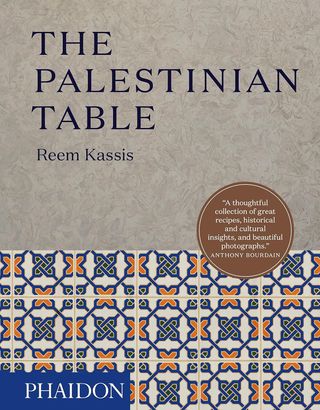
Cover of The Palestinian Table

The Palestinian Table

Reem Kassis

Original language: English · Hardcover · ISBN 978-0714874968

Reem Kassis's debut cookbook presents nearly 150 recipes drawn from three generations of her family's cooking. The dishes range from everyday breakfasts and salads to elaborate meals prepared for celebrations and gatherings. Each recipe is paired with commissioned photographs and framed by personal stories, local customs, and historical background that give shape to the food and its origins in Palestinian home kitchens.

Palestinian cuisine shares ingredients and techniques with neighboring traditions across the eastern Mediterranean, yet its particular combinations and preparations have received less focused attention in English-language cookbooks. Kassis addresses this gap by grounding her recipes in specific family and community practices rather than treating the food as a subset of a broader regional category. The book moves through courses and occasions, offering both quick preparations and slower, more involved ones.

Place runs through the book as a steady thread. Kassis connects individual dishes to the landscapes, seasons, and social rituals of Palestinian life, making geography and memory part of how each recipe is understood. The result is a cookbook that supplies practical kitchen instruction alongside a detailed picture of the food culture it documents.

Plot

The Palestinian Table is a visual feast of stunning, authentic dishes that demonstrate the true depth of this cuisine. But this is more than just a cookbook; author Reem Kassis truly creates a sense of 'place,' exploring the importance of heritage and community through her recipes and stories. In her debut cookbook, Reem Kassis weaves a tapestry of local customs,context, personal anecdotes and traditions of Palestinian life and cooking. Ranging from simple breakfasts to celebratory dishes fit for a feast, recipes are accompanied by specially commissioned photographs, bringing these vibrant dishes to life. This striking book takes readers on a gastronomic journey across Palestine, showcasing the rich culinary history of the area.

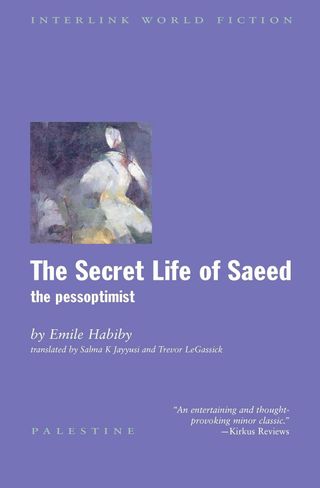
Cover of The Secret Life of Saeed: The Pessoptimist

The Secret Life of Saeed: The Pessoptimist

Emile Habiby

Original language: Arabic · Paperback · ISBN 978-1566564151

Saeed, a Palestinian who has become a citizen of Israel, works as an informer for the state. He is not especially brave, clever, or principled. His candor and gullibility lead him into one absurd situation after another, and his story moves between comedy and grief in quick succession. The novel follows his encounters with bureaucracy, suspicion, loyalty tests, and the everyday friction of living as an Arab inside Israel. Through a chain of tragicomic episodes, Saeed shifts slowly from a compliant collaborator into someone who begins, however clumsily, to assert a sense of identity and seek ordinary happiness.

Emile Habiby, who served as a member of the Israeli parliament, wrote from direct experience of the political contradictions he satirizes. The book mixes fact with fantasy and uses its foolish narrator to expose patterns of aggression, control, and resistance that straightforward realism might flatten. Habiby's tone is sharp but genuinely funny, grounding large political tensions in small personal disasters.

The novel was translated into Hebrew by Anton Shammas, and it received Israel's foremost prize for literature. A stage version drawn from the book was performed to wide acclaim across a decade, carrying Saeed's episodes from the page to a live audience over many seasons.

Plot

This contemporary classic, the story of a Palestinian who becomes a citizen of Israel, combines fact and fantasy, tragedy and comedy. Saeed is the comic hero, the luckless fool, whose tale tells of aggression and resistance, terror and heroism, reason and loyalty that typify the hardships and struggles of Arabs in Israel. An informer for the Zionist state, his stupidity, candor, and cowardice make him more of a victim than a villain; but in a series of tragicomic episodes, he is gradually transformed from a disaster-haunted, gullible collaborator into a Palestinian—no hero still, but a simple man intent on survival and, perhaps, happiness. The author’s own anger and sorrow at Palestine’s tragedy and his acquaintance with the absurdities of Israeli politics (he was once a member of Israel’s parliament himself) are here transmuted into satire both biting and funny.

More from Palestine

See the country page for Palestine for its map, facts and largest cities, or browse books from other countries.

Links go to Amazon; Hookito doesn’t sell books. Know a book that belongs here, or spotted a mistake? Write to submissions@hookito.com.

Where to next?

Back to the globe
Hookito landscape illustration