Hookito

Russia · Books

Books from Russia

21 books from and about Russia: what each is about, the plot, and a note from Professor Kogi.

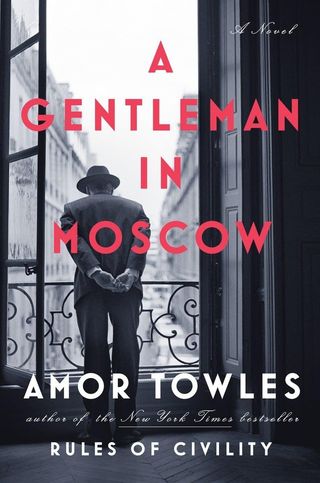
Cover of A Gentleman in Moscow

A Gentleman in Moscow

Amor Towles

Original language: English · Hardcover · ISBN 978-0670026197

In 1922, a Bolshevik tribunal declares Count Alexander Rostov an unrepentant aristocrat and sentences him to house arrest inside the Metropol, a large hotel situated across the street from the Kremlin in Moscow. Rostov, a well-read and witty man who has never held a job, is moved from his suite to a small attic room. Outside the hotel walls, decades of upheaval in Russian history proceed without him. His world shrinks to the hallways, restaurants, and rooms of a single building.

Within those confined quarters, Rostov builds an unexpected life. He forms relationships with hotel staff, guests, and others who pass through the Metropol over the years. The novel follows him from the early Soviet period onward, tracking how a man stripped of his former status finds new forms of connection and purpose. Amor Towles sets the entire story within the hotel, using it as a fixed point while the country outside transforms around it.

Towles previously wrote Rules of Civility, a novel set in late 1930s Manhattan. A Gentleman in Moscow was named a New York Times Readers' Choice pick among the best books of the 21st century and has reached more than two million readers.

Plot

In 1922, Count Alexander Rostov is deemed an unrepentant aristocrat by a Bolshevik tribunal, and is sentenced to house arrest in the Metropol, a grand hotel across the street from the Kremlin. Rostov, an indomitable man of erudition and wit, has never worked a day in his life, and must now live in an attic room while some of the most tumultuous decades in Russian history are unfolding outside the hotel’s doors. Unexpectedly, his reduced circumstances provide him entry into a much larger world of emotional discovery. Brimming with humor, a glittering cast of characters, and one beautifully rendered scene after another, this singular novel casts a spell as it relates the count’s endeavor to gain a deeper understanding of what it means to be a man of purpose.
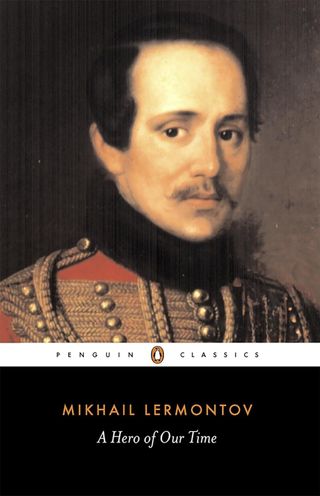
Cover of A Hero of Our Time

A Hero of Our Time

Mikhail Lermontov

Original language: Russian · Paperback · ISBN 978-0140447958

A Hero of Our Time, first published in 1840, is a novel by Mikhail Lermontov structured as a series of linked stories rather than a single continuous narrative. The central figure, Pechorin, is a young Russian officer stationed in the Caucasus whose intelligence and energy find no worthwhile outlet. He drifts through encounters with soldiers, smugglers, rival officers, and lovers, treating each situation as an experiment or distraction. The novel presents his actions through several different narrators and viewpoints, so the reader pieces together his character gradually rather than receiving a single authoritative portrait.

Pechorin belongs to a recognizable literary type sometimes called the Byronic hero: gifted, restless, self-aware, and destructive to those around him. Lermontov uses this figure to examine a specific social problem. In the Russia of the 1830s, educated young men with few channels for meaningful action could turn inward, becoming manipulative or indifferent. The title itself carries an ironic edge, since Pechorin is heroic only in the sense that he represents his generation.

The novel's structure, moving between travel journal, diary, and third-person account, was unusual for Russian fiction at the time. Lermontov completed it shortly before his death in a duel in 1841, at the age of twenty-six.

Plot

Its hero, Pechorin, is Byronic in his wasted gifts, his cynicism, and his desire for any kind of action-good or ill-that will stave off boredom. Outraging many critics when it was first published in 1840, A Hero of Our Time follows Pechorin as he embarks on an exciting adventure involving brigands, smugglers, soldiers, rivals, and lovers. This edition includes a new introduction, chronology, suggestions for further reading, maps, and full explanatory notes.

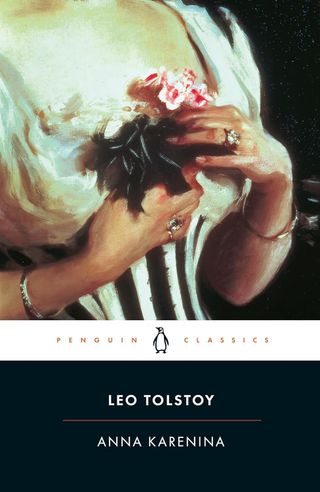
Cover of Anna Karenina

Anna Karenina

Leo Tolstoy

Original language: Russian · Paperback · ISBN 978-0140449174

Anna Karenina, first published in serial form between 1875 and 1877, is one of Leo Tolstoy's longest and most widely read novels. It follows Anna, a woman of status and comfort in imperial Russian society, who begins an affair with Count Vronsky, a young military officer. The relationship upends her standing in Moscow and St. Petersburg social circles and strains her connection to her husband and young son. Tolstoy traces the consequences of this affair with close attention to social pressure, emotional isolation, and the customs that governed aristocratic life in nineteenth-century Russia.

Running parallel to Anna's story is the arc of Konstantin Levin, a landowner who struggles with questions of purpose, faith, and belonging on his rural estate. Levin's sections draw on Tolstoy's own experiences managing agricultural land and grappling with philosophical doubt. The two storylines rarely intersect directly, but they mirror each other in their attention to what holds a life together and what pulls it apart.

This Penguin Classics edition uses a translation that has been recognized for its closeness to Tolstoy's Russian prose style. The novel moves between city ballrooms and country fields, between public reputation and private feeling, across a wide cast of characters.

Plot

The heroine of Tolstoy's epic of love and self-destruction, Anna Karenina has beauty, wealth, popularity and an adored son, but feels that her life is empty until she encounters the impetuous officer Count Vronsky. Their subsequent affair scandalizes society and family alike, and brings jealousy and bitterness in its wake. Contrasting with this is the vividly observed story of Levin, a man striving to find contentment and a meaning to his life - and also a self-portrait of Tolstoy himself.

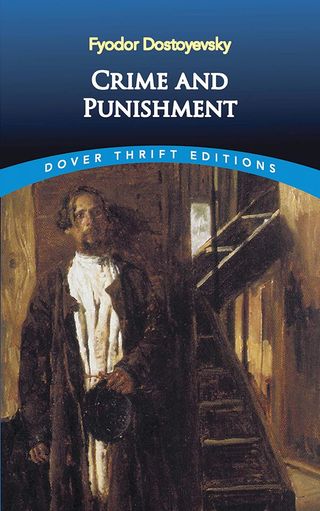
Cover of Crime and Punishment

Crime and Punishment

Fyodor Dostoyevsky

Original language: Russian · Paperback · ISBN 978-0486415871

Crime and Punishment was first published in twelve monthly installments in the Russian literary journal The Russian Messenger during 1866. It was the second full-length novel Fyodor Dostoyevsky completed after returning from ten years of exile in Siberia, and it is widely regarded as the first major work of his later period.

The story is set in St. Petersburg and follows Rodion Raskolnikov, a former student living in poverty. He develops a theory that certain extraordinary people stand above ordinary moral law, and to test it, partly hoping to fund future good works, he plans and carries out the murder of a pawnbroker. He compares himself to Napoleon Bonaparte, arguing that great historical figures always acted beyond conventional rules.

Much of the book unfolds as a psychological struggle. Raskolnikov moves between defiance and mounting dread, shadowed by the investigating magistrate Porfiry Petrovich and drawn toward Sonya Marmeladova, a young woman whose own difficult circumstances shape their exchanges. Dostoyevsky builds the narrative around conscience, suffering, and the question of whether a theory can hold once its consequences become real.

Plot

Raskolnikov, an impoverished student tormented by his own nihilism, and the struggle between good and evil, believes he is above the law. Convinced that humanitarian ends justify vile means, he brutally murders an old woman—a pawnbroker whom he regards as "stupid, ailing, greedy…good for nothing." Overwhelmed afterward by feelings of guilt and terror, Raskolnikov confesses to the crime and goes to prison. There he realizes that happiness and redemption can only be achieved through suffering.

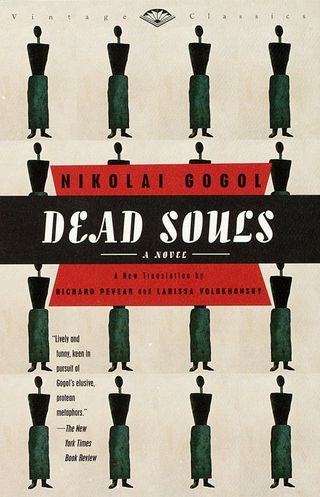
Cover of Dead Souls

Dead Souls

Nikolai Gogol

Original language: Russian · Paperback · ISBN 978-0679776444

Dead Souls follows Pavel Chichikov, a smooth-talking schemer who travels through the Russian provinces with an unusual business plan. He calls on local landowners to buy dead souls, meaning serfs who have died since the last census but still appear on official registers as living property. Because owners pay tax on every registered name, Chichikov offers to take those names off their hands.

Nikolai Gogol published the first part of the novel in 1842. Through Chichikov's visits to one estate after another, the book introduces a cast of provincial figures: sentimental dreamers, stubborn widows, reckless gamblers, misers living in squalor, and layers of local officials. Few can resist the odd logic of his offer, and each meeting shows another texture of rural self-interest in nineteenth-century Russia.

Much of the action unfolds on country roads and in the guest rooms of small towns, where reputation travels faster than fact. This edition uses a translation by Richard Pevear and Larissa Volokhonsky. Gogol planned the book as the first part of a larger work, but the continuation was never finished in a form he accepted before his death in 1852.

Plot

As Gogol's wily antihero, Chichikov, combs the back country wheeling and dealing for "dead souls"--deceased serfs who still represent money to anyone sharp enough to trade in them--we are introduced to a Dickensian cast of peasants, landowners, and conniving petty officials, few of whom can resist the seductive illogic of Chichikov's proposition. This lively, idiomatic English version by the award-winning translators Richard Pevear and Larissa Volokhonsky makes accessible the full extent of the novel's lyricism, sulphurous humor, and delight in human oddity and error.

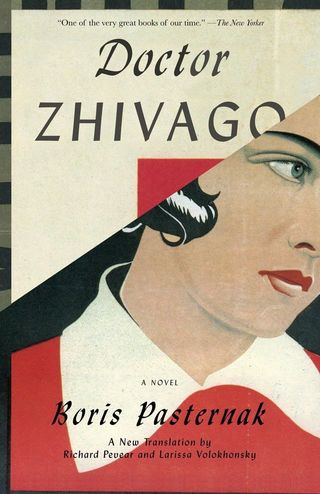
Cover of Doctor Zhivago

Doctor Zhivago

Boris Pasternak

Original language: Russian · Paperback · ISBN 978-0307390950

Boris Pasternak's only novel follows Yury Zhivago, a physician and poet whose life runs between the early 1900s and the Second World War, through the Russian Revolution and its aftermath. He moves his family from Moscow toward the Ural Mountains hoping for shelter, but finds himself caught between the White and Red forces. His artistic nature leaves him exposed to the new political order, and he loves Lara, the wife of a revolutionary.

The novel was submitted to the Soviet journal Novyi Mir in 1956 and initially accepted, but authorities blocked publication. A typescript reached the Italian publisher Giangiacomo Feltrinelli, who issued an Italian edition in 1957. Inside the Soviet Union the book appeared only in 1987. After its Western release Pasternak was rejected by Soviet authorities, and he was compelled to decline the 1958 Nobel Prize for Literature.

In 1958 the CIA obtained a Russian-language typescript and arranged a covert print run through Mouton Publishers in the Hague, with Dutch intelligence help and under Feltrinelli's imprint without a signed contract. Copies were handed out at the Brussels World's Fair through the Vatican pavilion. A second funded run of seven thousand copies carried the name of a nonexistent French publisher. The agency's role was confirmed only in April 2014.

Plot

Taking his family from Moscow to what he hopes will be shelter in the Ural Mountains, Zhivago finds himself instead embroiled in the battle between the Whites and the Reds. Set against this backdrop of cruelty and strife is Zhivago's love for the tender and beautiful Lara, the very embodiment of the pain and chaos of those cataclysmic times. Pevear and Volokhonsky masterfully restore the spirit of Pasternak's original—his style, rhythms, voicings, and tone—in this beautiful translation of a classic of world literature.

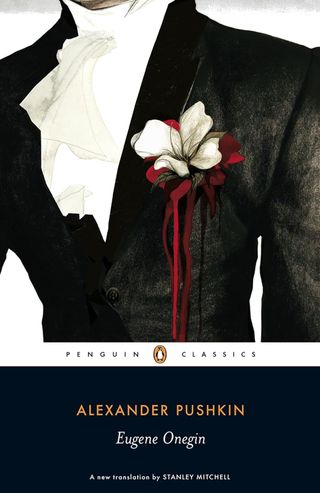
Cover of Eugene Onegin

Eugene Onegin

Alexander Pushkin

Original language: Russian · Paperback · ISBN 978-0140448108

Eugene Onegin is a novel written entirely in verse by Alexander Pushkin, composed over several years in the 1820s and early 1830s. The story follows its title character, a young aristocrat in St. Petersburg who has grown restless with the social routines of the city. After inheriting a country estate, Onegin leaves for rural life, where he meets Tatyana, a sincere and emotionally open young woman. She confesses her feelings to him in a letter, but Onegin turns her away, claiming he is unsuited to love or marriage.

The poem also traces Onegin's friendship with Lensky, a young poet, which ends in a duel brought about by carelessness and social pressure. Pushkin wrote the work in a distinctive fourteen-line stanza form, sometimes called the Onegin stanza, with a fixed rhyme scheme that gives the narrative both structure and flexibility. The narrator frequently interrupts the story with personal asides, reflections on Russian society, and observations about writing itself.

The setting moves between St. Petersburg, the Russian countryside, and Moscow, grounding the characters in specific social worlds of early nineteenth-century Russia. Pushkin uses this geography to contrast urban sophistication with provincial simplicity, and the distance between them shapes much of the story's tension.

Plot

Pushkin's incomparable poem has at its center a young Russian dandy much like Pushkin in his attitudes and habits. Eugene Onegin, bored with the triviality of everyday life, takes a trip to the countryside, where he encounters the young and passionate Tatyana. She falls in love with him but is cruelly rejected. Years later, Eugene Onegin sees the error of his ways, but fate is not on his side. A tragic story about love, innocence, and friendship, this beautifully written tale is a treasure for any fan of Russian literature.

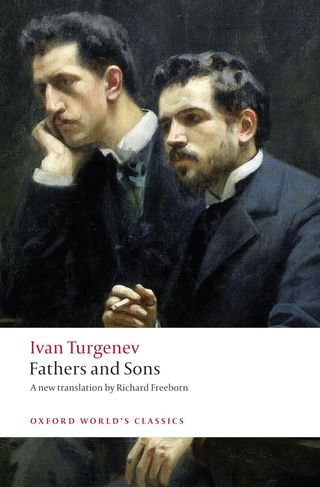
Cover of Fathers and Sons

Fathers and Sons

Ivan Turgenev

Original language: Russian · Paperback · ISBN 978-0199536047

Ivan Turgenev published Fathers and Sons in 1862, setting most of the action on a Russian country estate where two generations measure each other and find little agreement. Arkady Kirsanov, a young graduate, brings his friend Yevgeny Bazarov home. Bazarov calls himself a nihilist, meaning he rejects inherited truths in art, religion, and politics and trusts only what scientific experiment can confirm. Arkady's father and uncle belong to an older, more genteel liberal tradition, and the friction moves from polite unease toward open argument.

The novel appeared at a tense moment in Russian intellectual life, and the response was immediate. Readers on the political right accused Turgenev of glorifying nihilism, while critics on the left read Bazarov as a hostile caricature of progressive youth. The disagreement over how the character should be understood, whether admired, pitied, or simply observed, has continued since.

This Oxford World's Classics edition presents a translation commissioned specially for the series, the first to work from Turgenev's own working manuscript, which came to light only in 1988. Earlier translators had no access to those draft pages, so small choices of wording and emphasis differ here.

Plot

When a young graduate returns home he is accompanied, much to his father and uncle's discomfort, by a strange friend "who doesn't acknowledge any authorities, who doesn't accept a single principle on faith." Turgenev's masterpiece of generational conflict shocked Russian society when it was published in 1862 and continues today to seem as fresh and outspoken as it did to those who first encountered its nihilistic hero.

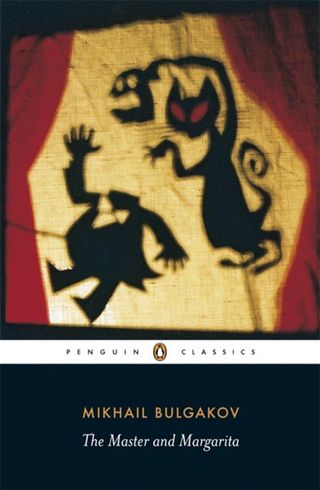
Cover of Master and Margarita

Master and Margarita

Mikhail Bulgakov

Original language: Russian · Paperback · ISBN 978-0140455465

Mikhail Bulgakov wrote The Master and Margarita in secret during the Stalin era, and the novel went unpublished in Russia for more than thirty years after his death. It circulated in samizdat, the practice of copying and passing along forbidden texts by hand, before finally reaching print. When it did appear, the book quickly became one of the most widely read works of twentieth-century Russian literature.

The story opens in Soviet Moscow, where the Devil arrives with a strange entourage that includes a enormous, gun-carrying cat and a fanged figure named Koroviev. Their presence sets off a wave of havoc among the city's cultural establishment, sending officials and writers into panic, prison, or worse. Running through this chaos are two quieter figures: the Master, a writer confined to a psychiatric hospital, and Margarita, his devoted companion, who is determined to find him.

Bulgakov layered the novel with multiple storylines, including scenes set in ancient Jerusalem, and drew on folk carnival traditions to build a sharp satire of Soviet bureaucracy and propaganda. This Penguin edition uses a complete and unabridged Russian text, with an introduction by Richard Pevear on the unusual history of the book's composition and eventual publication.

Plot

In Soviet Moscow, God is dead, but the devil - to say nothing of his retinue of demons, from a loudmouthed, gun-toting tomcat, to the fanged fallen angel Koroviev - is very much alive. As death and destruction spread through the city like wildfire, condemning Moscow's cultural elite to prison cells and body bags, only a madman, the Master, and Margarita, his beautiful, courageous lover, can hope to end the chaos. Written in secret during the darkest days of Stalin's reign and circulated in samizdat form for decades, when The Master and the Margarita was finally published it became an overnight literary phenomenon, signalling artistic freedom for Russians everywhere. This luminous translation from the complete and unabridged Russian text is accompanied by an introduction by Richard Pevear exploring the extraordinary circumstances of the novel's composition and publication, and how Bulgakov drew on carnivalesque folk traditions to create his ironic subversion of Soviet propaganda.

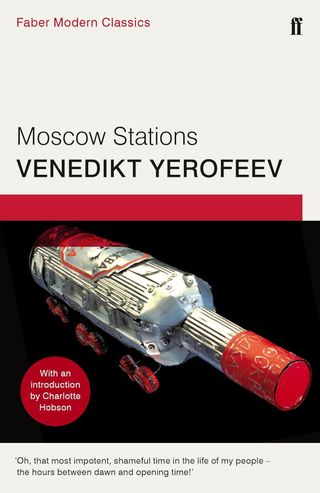
Cover of Moscow Stations

Moscow Stations

V. Yerofeev

Original language: Russian · Paperback · ISBN 978-0571322787

Moscow Stations is the only novel by Russian writer Venedikt Yerofeev, written in 1969. It could not be officially published in the Soviet Union and instead circulated as samizdat, a term for unofficial manuscripts typed and passed from hand to hand among trusted readers. The book eventually reached a wider audience and has been translated into many languages.

The story follows Venya, a man far more devoted to drinking with his colleagues than to holding down a job. After losing his position, he spends his remaining money on alcohol and boards a train bound for Petushki, a small town where his beloved and child are waiting. Petushki represents everything bright and orderly in his imagination. But as the journey continues, Venya drinks more and more, and the destination starts to feel unreachable. The line between what is real and what is imagined grows uncertain.

The train route from Moscow to Petushki runs roughly 125 kilometers east through the Vladimir region. Yerofeev uses the journey as a frame for monologues, encounters with other passengers, and commentary on life under Soviet conditions. The tone shifts between dark comedy and genuine sadness, with alcohol acting as both fuel and obstacle throughout.

Plot

Venya is more interested in how much he and his colleagues can drink during the working day than in his job. Once he is fired, he spends the last of his money on booze and sets off on a train journey to visit beautiful, picturesque, utopian Petushki, where his beloved and child are waiting for him. But Venya's drinking gets out of control on the train, and Petushki seems to lie increasingly beyond his grasp. Funny and sad, Yerofeev's alcohol-soaked story of a man on a train perfectly captures Soviet society on the brink of doom: exhausted, corrupt and heading into the night in sodden dignity.

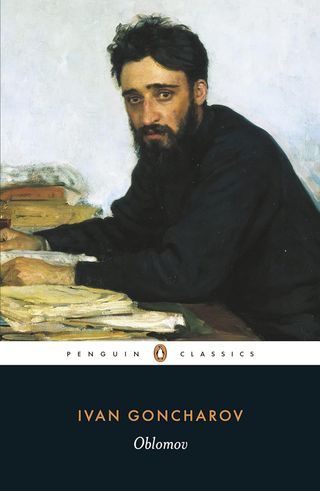
Cover of Oblomov

Oblomov

Ivan Goncharov

Original language: Russian · Paperback · ISBN 978-0140449877

Oblomov, published in 1859, is Ivan Goncharov's novel about a Russian landowner who has largely stopped participating in life. Ilya Ilyich Oblomov has left the Civil Service, let his finances slide, and fallen into debt. He passes his days in a neglected apartment, attended by Zakhar, a servant as idle as his master. The opening chapters follow his effort to leave his bed.

The story turns on Oblomov's friendship with Stolz, an energetic man of German and Russian parentage whose steady activity marks him out from his friend. Through Stolz, Oblomov meets Olga Ilyinskaya, and their growing attachment tests whether affection can move a man who postpones everything. Goncharov treats his central figure with humour and sympathy, tracing the inertia back to upbringing, class, and a landowning world in decline.

The novel made Goncharov widely known in Russia, and the term Oblomovism entered Russian discussion soon after, describing a wider pattern of aristocratic stagnation. The critic Nikolai Dobrolyubov gave the idea currency in an essay published in 1859. This edition uses David Magarshack's English translation, which carries the mixture of comedy and near-tragedy in Goncharov's original.

Plot

Ilya Ilyich Oblomov is a member of Russia’s dying aristocracy—a man so lazy that he has given up his job in the Civil Service, neglected his books, insulted his friends, and found himself in debt. Too apathetic to do anything about his problems, he lives in a grubby, crumbling apartment, waited on by Zakhar, his equally idle servant. Terrified by the activity necessary to participate in the real world, Oblomov manages to avoid work, postpones change, and—finally—risks losing the love of his life. This superb translation by David Magarshack captures all the subtle comedy and near-tragedy of the original.

Cover of Russian Cuisine: Traditional and Contemporary Home Cooking

Russian Cuisine: Traditional and Contemporary Home Cooking

Maria Depenweiller

Original language: English · Paperback · ISBN 978-1770502338

Russian Cuisine: Traditional and Contemporary Home Cooking is a cookbook and cultural guide written by Maria Depenweiller, a native Muscovite who grew up in Moscow before moving to Canada. The book traces how Russian cooking developed over centuries, explaining how dishes now considered classics came to be part of the national table. It covers practical topics such as traditional cooking methods, including the Russian oven and the samovar, a metal container used to heat water for tea.

Beyond recipes, the book places Russian food in its political and social context. It describes how the Soviet Revolution changed everyday eating habits and how tea drinking became a widespread tradition across the country. Readers will find dishes from different eras, including schi, a cabbage soup with roots in peasant kitchens, and rasstegai, an open-topped pastry filled with fish or meat. Soviet-era favorites such as ant hill torte also appear alongside zakuski, the assortment of small dishes served before a main meal.

The book includes guidance on table settings, backyard gardening, and pantry staples. It also pairs chapters with suggestions for Russian literature and music, connecting the food to broader cultural life across a country that stretches through eleven time zones and encompasses over 180 ethnic groups.

Plot

Detailing the evolution and development of traditional Russian cooking, this book gives a better understanding of the foods that are now known as classical Russian dishes. Through the words of native Muscovite, Maria Depenweiller, who was born and raised in Moscow before immigrating to Canada, Russian Cuisine: Traditional and Contemporary Home Cooking covers not only Russian cooking methods such as the Russian oven samovar, but also the impact of Russian politics on its food. Discover how: The Soviet Revolution impacted Russian eating habits. Or how the Russian tea drinking tradition got started. Learn about the home cooking of the Russian Empire and try schi and rasstegai. Delight your guests with marvelous assortment of zakuski or ant hill torte from the classical Soviet cuisine. Complete the experience with suggested reading from the literature Russian classics and music accompaniment to match the mood. From table settings, to backyard gardens and pantry items, this book teaches you everything you need to know about Russian food.

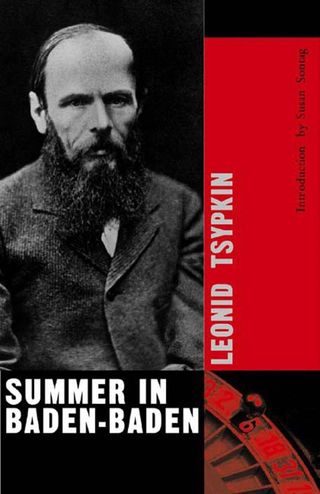
Cover of Summer in Baden-Baden

Summer in Baden-Baden

Leonid Tsypkin

Original language: Russian · Paperback · ISBN 978-0811215480

Summer in Baden-Baden operates on two timelines at once. In one, a narrator identified with the author, Leonid Tsypkin, rides a train toward Leningrad in late December. In the other, it is April 1867, and Fyodor Dostoyevsky and his young wife Anna Grigor'yevna are leaving Russia for Germany, beginning what would become a four-year stay abroad. The two strands run in parallel, braided together through Tsypkin's absorption in the Dostoyevskys' lives.

The 1867 thread follows the couple through the early period of their marriage. Dostoyevsky's compulsive gambling, his fierce dedication to writing, and the strains these place on his relationship with Anna form the core of the narrative. Anna's steadiness and capacity for forgiveness become a counterweight to his turbulence. Tsypkin drew closely on historical sources, particularly Anna Dostoyevsky's own diary and memoirs, aiming for factual accuracy while reshaping the material into something personal and literary.

The book occupies an unusual space between fiction and biographical reconstruction. Tsypkin, a physician and largely unpublished writer during his lifetime, completed it in the early 1980s. The novel's long, flowing sentences carry both timelines forward in a single current, linking the narrator's present-day devotion to Dostoyevsky with the historical scenes he reconstructs.

Plot

A complex, highly original novel, Summer in Baden-Baden has a double narrative. It is wintertime, late December: a species of "now." A narrator―Tsypkinis on a train going to Leningrad. And it is also mid-April 1867. The newly married Dostoyevskys, Fyodor, and his wife, Anna Grigor'yevna, are on their way to Germany, for a four-year trip. This is not, like J. M. Coetzee's The Master of St. Petersburg, a Dostoyevsky fantasy. Neither is it a docu-novel, although its author was obsessed with getting everything "right." Nothing is invented, everything is invented. Dostoyevsky's reckless passions for gambling, for his literary vocation, for his wife, are matched by her all-forgiving love, which in turn resonates with the love of literature's disciple, Leonid Tsypkin, for Dostoyevsky.

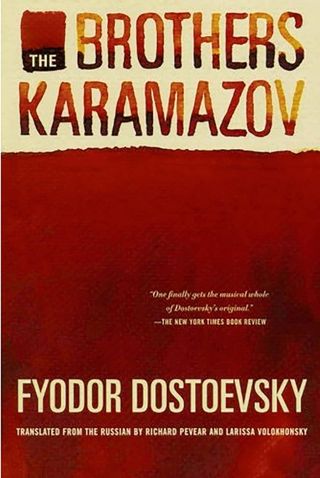
Cover of The Brothers Karamazov

The Brothers Karamazov

Fyodor Dostoevsky

Original language: Russian · Paperback · ISBN 978-0374528379

Fyodor Dostoevsky's final novel, published in 1880, follows the Karamazov family in a Russian provincial town during the 1870s. At its center is the father, Fyodor Pavlovich, a coarse and sentimental landowner whose relationships with his three adult sons are tangled by money, jealousy, and competing claims to love. Dmitri, the eldest, is impulsive and driven by passion. Ivan, the middle son, is intellectual and skeptical. Alyosha, the youngest, is a novice at a local monastery, drawn toward faith and quiet attention to others.

The plot builds around a murder and the courtroom trial that follows, but these events serve a larger purpose. Dostoevsky uses the family's conflicts to examine questions about God, free will, suffering, and moral responsibility. One extended chapter, in which Ivan presents a philosophical argument to Alyosha, remains among the most discussed passages in Russian literature. The novel also portrays a wide cast of townspeople, monks, women caught between the brothers, and children whose fates echo the central tensions.

Dostoevsky completed the book shortly before his death in 1881. It is set against a period he saw as both a high point and a crisis in Russian society, when older religious traditions and newer secular ideas pressed against each other with increasing force.

Plot

The Brothers Karamasov is a murder mystery, a courtroom drama, and an exploration of erotic rivalry in a series of triangular love affairs involving the “wicked and sentimental” Fyodor Pavlovich Karamazov and his three sons―the impulsive and sensual Dmitri; the coldly rational Ivan; and the healthy, red-cheeked young novice Alyosha. Through the gripping events of their story, Dostoevsky portrays the whole of Russian life, is social and spiritual striving, in what was both the golden age and a tragic turning point in Russian culture.

Cover of The Complete Poems of Anna Akhmatova

The Complete Poems of Anna Akhmatova

Anna Akhmatova

Original language: Russian · Paperback · ISBN 978-0862417161

Anna Akhmatova was born in 1889 near Odessa and grew up to become one of the most significant Russian poets of the twentieth century. She lived through revolution, two world wars, and decades of Soviet repression. Authorities censored her writing and publicly attacked her reputation, yet she refused to leave Russia or stop composing poetry. During the most dangerous periods, when putting verses on paper could lead to arrest, a small circle of trusted friends committed her poems to memory, preserving lines that might otherwise have been lost.

This collected edition brings together around 800 of Akhmatova's poems in English translation. It also includes a photo-essay documenting her life, a preface by the translator, and an introduction by Anatoly Naiman, who served as her literary secretary during the 1960s. A reprinted memoir by the philosopher Isaiah Berlin, drawn from his book Personal Impressions, rounds out the volume. Berlin visited Akhmatova in Leningrad in 1945, and his account of that meeting became one of the most discussed literary encounters of the century.

Akhmatova's subjects range from early love lyrics written in the St Petersburg artistic circles before the revolution to later works shaped by grief, political terror, and endurance under state pressure. She died in 1966, by then widely regarded as a major figure in world poetry.

Plot

Born in 1889, Anna survived upheavals, refusing to abandon either Russia or her craft despite vicious attacks on her name and censorship of her work. When committing poems to paper threatened to cause her arrest, a few close friends faithfully memorized her lines. By the time she died in 1966, Anna was recognized as one of the world's great poets. This book contains 800 of her poems, an extensive photo-essay, a preface by the translator, an introduction Anatoly Naiman (Akhmatova's literary agent during the 1960s), and a reprint of Isaiah Berlin's memoir of Anna from his book "Personal Impressions".

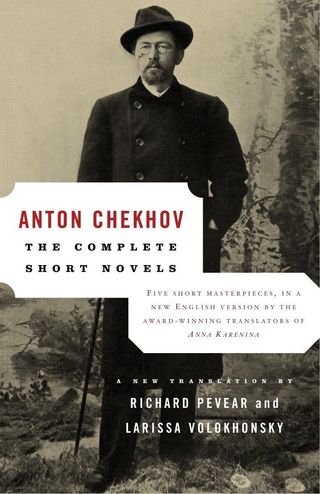
Cover of The Complete Short Novels

The Complete Short Novels

Anton Chekhov

Original language: Russian · Paperback · ISBN 978-1400032921

Anton Chekhov is widely recognized for his short stories, but he also wrote five works substantial enough to be considered short novels. This volume collects all five in one place. The Steppe follows a nine-year-old boy traveling by wagon train across the open grasslands of southern Russia, capturing fear and wonder through his young perspective. The Duel places a rigid rationalist and a man of literary temperament on a collision course, with the conflict producing unexpected turns. The Story of an Unknown Man centers on a political radical who has taken a position as valet to a high official's son in order to spy, only to find that a terminal illness reshapes everything he once believed in.

Three Years traces the life of a wealthy but passive Moscow merchant caught in a series of personal ironies, where money and social standing fail to simplify human relationships. My Life follows a man who abandons privilege and status to take up manual labor, a choice that sets his moral convictions against the complicated realities of the people around him. Across the five works, Chekhov returns to tensions between idealism and compromise, illness and purpose, social rank and personal freedom, all set within the landscapes and social structures of late nineteenth-century Russia.

Plot

The Steppe—the most lyrical of the five—is an account of a nine-year-old boy’s frightening journey by wagon train across the steppe of southern Russia. The Duel sets two decadent figures—a fanatical rationalist and a man of literary sensibility—on a collision course that ends in a series of surprising reversals. In The Story of an Unknown Man, a political radical spying on an important official by serving as valet to his son gradually discovers that his own terminal illness has changed his long-held priorities in startling ways. Three Years recounts a complex series of ironies in the personal life of a rich but passive Moscow merchant. In My Life, a man renounces wealth and social position for a life of manual labor. The resulting conflict between the moral simplicity of his ideals and the complex realities of human nature culminates in a brief apocalyptic vision that is unique in Chekhov’s work.

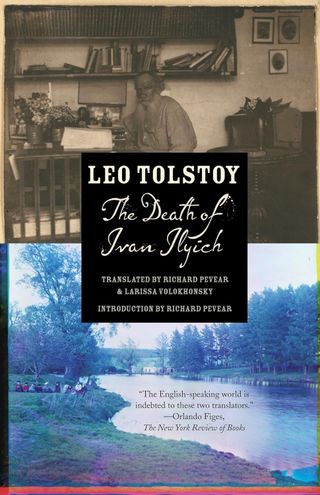
Cover of The Death of Ivan Ilyich

The Death of Ivan Ilyich

Leo Tolstoy

Original language: Russian · Paperback · ISBN 978-0307951335

Ivan Ilyich is a high court judge in nineteenth-century Russia who has built a life around professional advancement and social standing. His marriage is cold, his home life hollow, but he regards these as ordinary compromises. The novella opens after his death, with colleagues reacting to the news largely in terms of what it means for their own careers and promotions. Tolstoy then steps back to trace Ivan's life from its unremarkable beginnings.

A fall during a routine household task leaves Ivan with a worsening internal injury. As his condition deteriorates, the distance between his public composure and his private terror grows sharper. Doctors offer contradictory opinions. His wife and daughter treat his illness as an inconvenience. The only person who provides genuine comfort is Gerasim, a young peasant servant who tends to him without pretense or discomfort around dying.

Tolstoy wrote this novella in the mid-1880s, during a period when his interests had shifted strongly toward moral and spiritual questions. The story examines how a person might confront mortality after decades spent avoiding any serious reflection on how life has been lived. It is one of his most frequently read shorter works.

Plot

Ivan Ilyich is a middle-aged man who has spent his life focused on his career as a bureaucrat and emotionally detached from his wife and children. After an accident he finds himself on the brink of an untimely death, which he sees as a terrible injustice. Face to face with his mortality, Ivan begins to question everything he has believed about the meaning of life. The Death of Ivan Ilyich is a masterpiece of psychological realism and philosophical profundity that has inspired generations of readers.

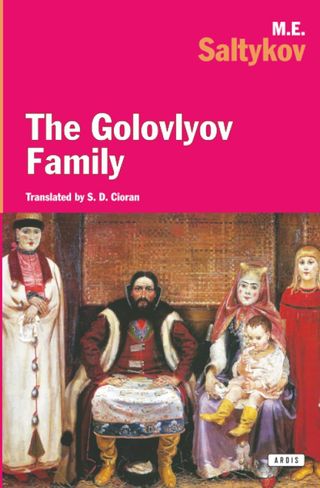
Cover of The Golovlyov Family

The Golovlyov Family

M. E Saltykov

Original language: Russian · Paperback · ISBN 978-1468301564

The Golovlyov Family follows the decline of a landowning Russian household across several generations. At the head of the family stands Arina Petrovna, a controlling matriarch who manages the estate with rigid authority and little warmth. Her children, raised in an atmosphere of emotional coldness, lack the capacity to sustain themselves or each other. One by one, they fall into dependence, drink, or despair. The novel tracks this disintegration with a steady, forensic attention to how each family member contributes to the collective collapse.

The most prominent figure among the children is Porfiry Vladimirovich, nicknamed Little Judas by those around him. Porfiry speaks constantly in the language of piety and family feeling, but his words serve only to manipulate and control. His religious talk functions as a tool of domination rather than genuine belief. Saltykov-Shchedrin, writing in the 1870s and 1880s, was known as one of the sharpest satirists of Russian public life, and this novel concentrates that satirical eye on the private sphere of the household.

The estate itself plays a central role, becoming less a home and more a place where inhabitants are trapped by inheritance, obligation, and habit. The story examines what happens when a family loses any real connection between its members while preserving all the outward forms of closeness.

Plot

In this scathing portrait of 19th-century Russian aristocracy, Mikhail Saltykov-Shchedrin chronicles the slow, suffocating collapse of the Golovlyov family. At the center is Arina Petrovna, a domineering matriarch who rules her estate with iron will and emotional austerity. Her children—weak, vain, and spiritually hollow—drift into ruin, none more hauntingly than Porfiry Vladimirovich, known as “Little Judas,” whose pious hypocrisy masks a soul steeped in cruelty and self-delusion. Written with biting satire and psychological depth, The Golovlyov Family is widely regarded as Saltykov-Shchedrin’s magnum opus and one of the darkest works in Russian literature. It is a novel of generational rot, where love is absent, faith is performative, and the family estate becomes a mausoleum of the living dead.

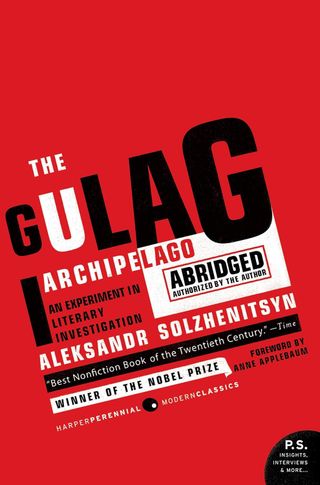
Cover of The Gulag Archipelago

The Gulag Archipelago

Aleksandr Solzhenitsyn

Original language: Russian · Paperback · ISBN 978-0061253805

The Gulag Archipelago is Aleksandr Solzhenitsyn's account of the Soviet forced-labor camp system, assembled from his own eleven years of imprisonment and exile and from the testimonies of over two hundred other survivors. The book traces the origins of Soviet state repression from 1918 onward, documenting secret police operations, interrogation methods, transit networks, prison camps, and the forced displacement or destruction of entire populations. Solzhenitsyn also records the fates of returning Soviet soldiers who had been held as prisoners of war by Germany, only to face suspicion and punishment at home.

This edition condenses the original work into a single abridged volume, prepared with the author's direct involvement. Solzhenitsyn organized the material around specific people and situations rather than presenting a purely statistical survey. Individual portraits of men, women, and children appear throughout, grounding the broader institutional record in particular lives. Alongside accounts of systematic cruelty, the book describes instances of resistance and moral endurance among people who had no institutional protection.

Solzhenitsyn was awarded the Nobel Prize in Literature. The Gulag Archipelago draws on both personal memory and Soviet archival sources, combining documented evidence with sustained narrative across a wide span of decades, from the early years of Soviet rule through the period that followed the Second World War.

Plot

Drawing on his own experiences before, during and after his eleven years of incarceration and exile, on evidence provided by more than 200 fellow prisoners, and on Soviet archives, Solzhenitsyn reveals with torrential narrative and dramatic power the entire apparatus of Soviet repression, the state within the state that once ruled all-powerfully with its creation by Lenin in 1918. Through truly Shakespearean portraits of its victims-this man, that woman, that child-we encounter the secret police operations, the labor camps and prisons, the uprooting or extermination of whole populations, the “welcome” that awaited Russian soldiers who had been German prisoners of war. Yet we also witness astounding moral courage, the incorruptibility with which the occasional individual or a few scattered groups, all defenseless, endured brutality and degradation. And Solzhenitsyn’s genius has transmuted this grisly indictment into a literary miracle.

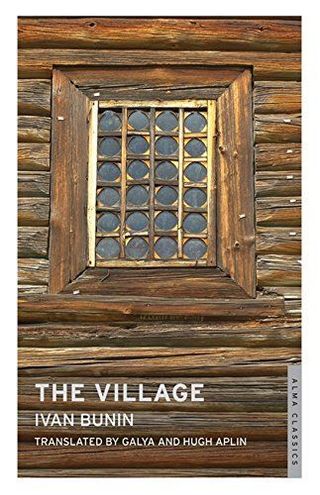
Cover of The Village

The Village

Ivan Bunin

Original language: Russian · Paperback · ISBN 978-1847492838

The Village is Ivan Bunin's first full-length novel, set in the rural southwest of Russia during the period surrounding the 1905 Revolution. The story follows two brothers whose lives have taken different paths: one has become a landowner, the other a self-educated peasant. Through their experiences and the people around them, the novel presents a stark picture of provincial existence marked by poverty, ignorance, and recurring violence.

Bunin's prose is detailed and often harsh, offering little comfort or sentimentality about life on the land. The characters occupy a world of limited horizons, where small cruelties and frustrations accumulate without resolution. The 1905 Revolution, which shook cities across the Russian Empire, registers here mainly as a distant tremor felt through local disorder and confusion. Bunin does not romanticize the peasantry or the countryside; instead, he records their conditions with a cold, observational clarity.

Published in 1910, the novel arrived several years before the larger upheavals that would reshape Russia. Bunin, who later became the first Russian writer to receive the Nobel Prize in Literature in 1933, wrote The Village at a time when debates about rural reform and the condition of the peasantry were intensely political subjects across the empire.

Plot

The Village, Ivan Bunin’s first full-length novel, is a bleak and uncompromising portrayal of rural life in southwest Russia. Set at the time of the 1905 Revolution and centering on episodes in the lives of a landowner and his self-educated peasant brother, the book follows characters sunk so far below the average intelligence as to be scarcely human.

Cover of War and Peace

War and Peace

Leo Tolstoy

Original language: Russian · Paperback · ISBN 978-1400079988

Leo Tolstoy's War and Peace follows five aristocratic Russian families between 1805 and 1813, a period shaped by Napoleon's advance into Russia. The novel opens during the reign of Tsar Alexander I, at a time when the Russian nobility still spoke French as a social requirement, a tradition dating back to Catherine the Great's efforts to align Russia with Western European culture. This linguistic detail runs through the book's drawing rooms and dinner tables, where characters shift between languages depending on audience and occasion.

Three figures anchor the story. Pierre Bezukhov, one of dozens of illegitimate sons of old Count Bezukhov, struggles to claim his inheritance while searching for some larger purpose in life. Prince Andrei Bolkonsky leaves his family at the Bolkonsky estate of Bald Hills to serve in the war. Natasha Rostov, daughter of a warm but financially careless noble household, draws the attention of both men at different points in the narrative.

Around these central lives, Tolstoy places peasants, soldiers, generals, and socialites, tracking how Napoleon's 1812 invasion disrupts every layer of Russian society. The Kuragin family introduces figures of dubious character, while the Drubetskoys represent impoverished nobility trying to regain standing. Tolstoy moves steadily between battlefield and household, treating both with close, specific attention.

Plot

War and Peace centers broadly on Napoleon’s invasion of Russia in 1812 and follows three of the best-known characters in literature: Pierre Bezukhov, the illegitimate son of a count who is fighting for his inheritance and yearning for spiritual fulfillment; Prince Andrei Bolkonsky, who leaves behind his family to fight in the war against Napoleon; and Natasha Rostov, the beautiful young daughter of a nobleman, who intrigues both men. As Napoleon’s army invades, Tolstoy vividly follows characters from diverse backgrounds—peasants and nobility, civilians and soldiers—as they struggle with the problems unique to their era, their history, and their culture. And as the novel progresses, these characters transcend their specificity, becoming some of the most moving—and human—figures in world literature.

More from Russia

See the country page for Russia for its map, facts and largest cities, or browse books from other countries.

Free editions are on Project Gutenberg, matched by title and author. Links go to Amazon; Hookito doesn’t sell books. Know a book that belongs here, or spotted a mistake? Write to submissions@hookito.com.

Where to next?

Back to the globe
Hookito landscape illustration